History
The line began life not as a passenger railway but as a freight project. It was conceived as part of the planned "Tokyo Outer Loop Line" (Tōkyō-gaikanjōsen), a scheme to link the five radial trunk lines reaching Tokyo — the Tōkaidō, Chūō, Tōhoku, Jōban and Sōbu lines — in a wider loop, with a freight railway running from the Shiohama marshalling yard in Kawasaki along the bay to Kisarazu in Chiba. The line was built by the Japan Railway Construction Public Corporation as a metropolitan transit ("D-line") project. Because most of the route was laid out for freight, much of it was built on elevated structure, and the delta junction of branch and main tracks near Nishi-Funabashi survives as a remnant of that freight-oriented design. The plan was later changed from a freight line to a passenger line.
Construction opened in stages. The first section opened on 10 May 1975 as a 6.5 km freight link between the Chiba Freight Terminal and the freight yard beside Soga Station, initially using a Kawasaki Steel private line to reach Soga. Passenger service began on 3 March 1986 between Nishi-Funabashi and Chiba-kō (now Chibaminato). On 1 December 1988 the line was extended west to Shin-Kiba and the Ichikawashiohama–Nishi-Funabashi link opened, marking the first full operational use of ATS-P on the JR network; through service from the Musashino Line also began that day. The final section, between Tokyo and Shin-Kiba, opened on 10 March 1990, completing the line; rapid and commuter-rapid services and the 205 series began at the same time. The platforms at Tokyo Station, set underground roughly halfway towards Yūrakuchō Station, were originally built to accommodate the Narita Shinkansen, a high-speed line to Narita Airport that was planned but never built; their distance from the main concourse means that transferring to other lines at Tokyo can take 15 to 20 minutes.
The Keiyō Line and the Rinkai Line share a common origin in the Outer Loop plan: west of Shin-Kiba the route was intended to continue to the Tokyo Freight Terminal, and the nearly complete tunnel on that alignment was reused by the Tōkyō Waterfront Area Rapid Transit Rinkai Line when central Tokyo's artificial island of Odaiba developed as a commercial and tourist area in the 1990s. A physical connection between the two lines remains but is used only by charter passenger trains, typically carrying groups to Tokyo Disney Resort.
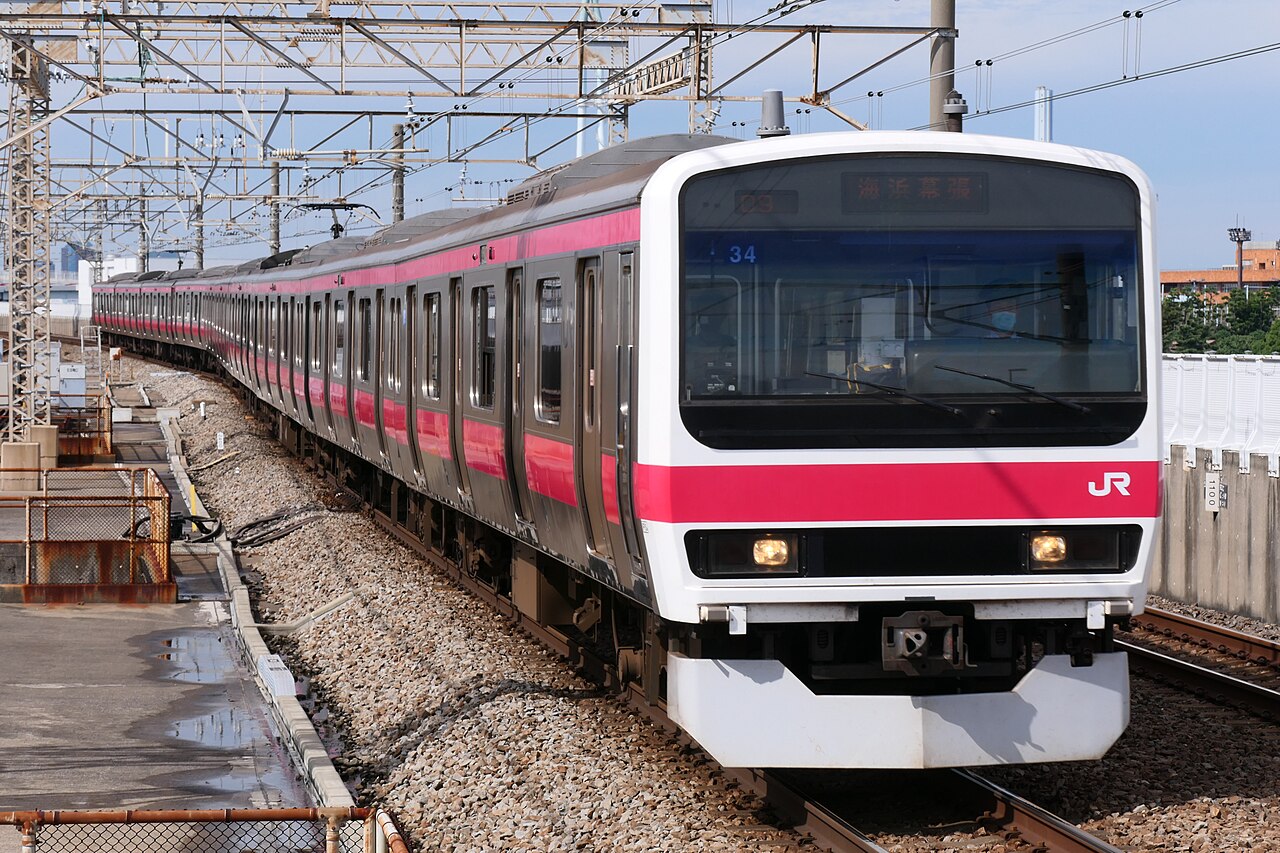
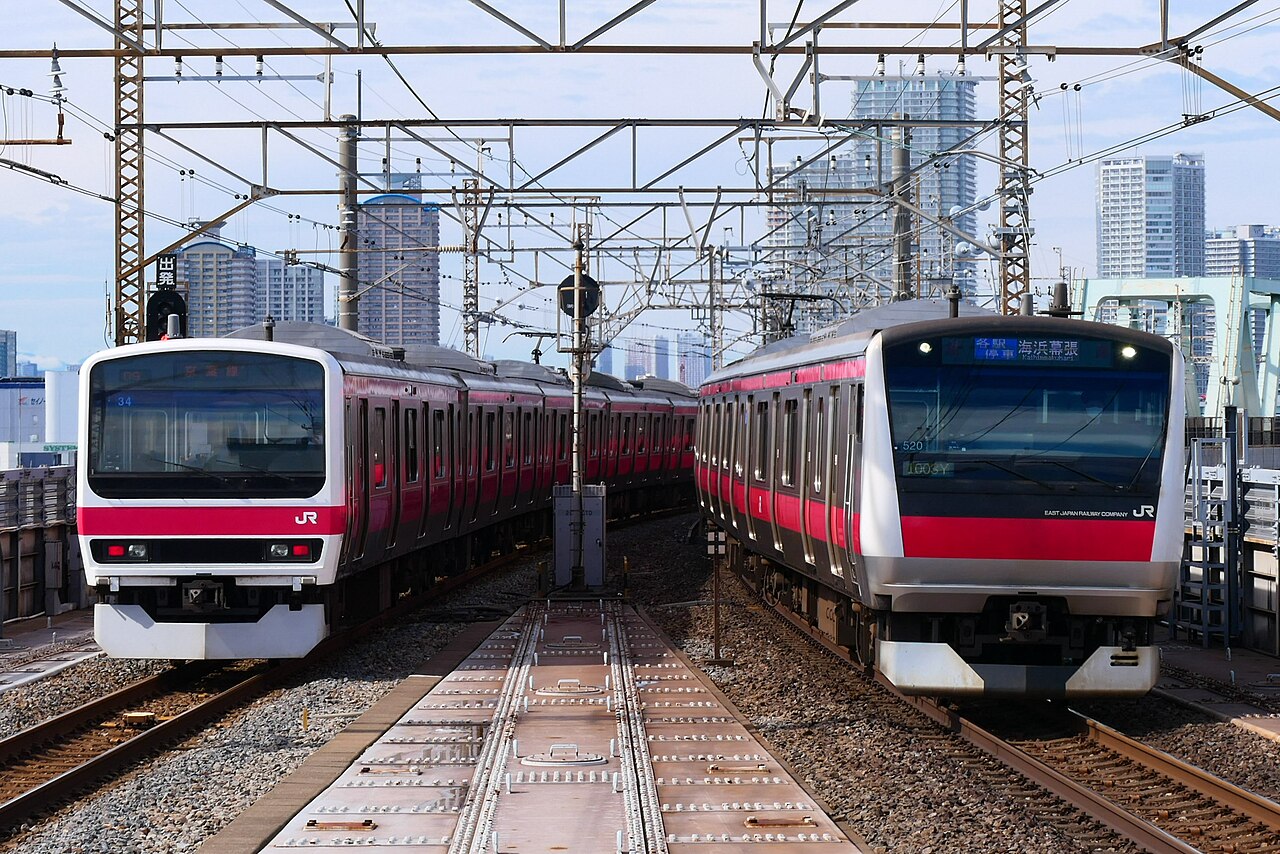
Today JR East operates the whole line as a Class-1 railway, while Japan Freight Railway (JR Freight) holds Class-2 freight rights on the Nishi-Funabashi–Soga section; the railway infrastructure is owned by the Japan Railway Construction, Transport and Technology Agency, the successor to the public corporation that built it. The line acts as a bypass of the Sōbu Main Line between Tokyo and the Chiba area and, at Soga, connects with the Uchibō and Sotobō lines, over which limited express services (the Wakashio and Sazanami) reach the Bōsō Peninsula; local and rapid trains also run through to the Uchibō, Sotobō and Tōgane lines. Station numbering using the prefix JE was introduced on 20 August 2016, and the line's newest station, Makuhari-Toyosuna, opened on 18 March 2023. Passenger trains are formed of E233-5000 series (in service from 1 July 2010) and 209-500 series sets, based at the Keiyō Rolling Stock Center near Shin-Narashino. On the busiest section, Kasai-Rinkai Park to Shin-Kiba, the peak congestion ratio was 119% in fiscal 2024, down from around 190% in the late 1990s when it trailed only the parallel Tokyo Metro Tōzai Line; the line's average transport density was about 158,945 passengers per day in fiscal 2023. A March 2024 timetable revision drew criticism from the Chiba prefectural government for sharply reducing rapid services and abolishing the commuter-rapid service in the rush hours, leaving only two early-morning westbound rapid trips at the request of local and prefectural authorities.
Timeline
- 197510 May: the first section opens as a freight line, a 6.5 km link between the Chiba Freight Terminal and the freight yard beside Soga Station (using a Kawasaki Steel private line to reach Soga).
- 19863 March: passenger service begins between Nishi-Funabashi and Chiba-kō (now Chibaminato).
- 19871 April: JNR is privatised; JR East takes over the line and JR Freight becomes the Class-2 operator on the Chiba Freight Terminal–Soga section.
- 19881 December: extended west to Shin-Kiba and the Ichikawashiohama–Nishi-Funabashi link opens; first full operational use of ATS-P on the JR network; through service from the Musashino Line begins.
- 199010 March: the final section between Tokyo and Shin-Kiba opens, completing the line; rapid and commuter-rapid services and the 205 series are introduced. Tokyo Station platforms reuse the alignment planned for the never-built Narita Shinkansen.
- 199116 March: the Wakashio and Sazanami limited express services are rerouted via the Keiyō Line.
- 199214 March: Chiba-kō Station is renamed Chibaminato to avoid confusion with Chiba Port.
- 20002 December: JR Freight becomes the Class-2 operator on the Nishi-Funabashi–Soga section and freight trains begin running over it.
- 20101 July: the E233-5000 series enters revenue service.
- 201620 August: station numbering is introduced, with the prefix JE assigned from Tokyo to Chibaminato. ATOS train management was introduced on 25 September 2016.
- 202318 March: Makuhari-Toyosuna Station opens between Kaihin-Makuhari and Shin-Narashino, the line's newest station.
- 2024March: a timetable revision sharply reduces rapid services and abolishes the commuter-rapid service in the rush hours, leaving only two early-morning westbound rapid trips. (EN gives 16 March; the JA chronology gives 14 March.)
Sources
Facts last verified 3 June 2026.
Gallery 3 photos
Every photo for this page — tap any image to view it full-size. All from Wikimedia Commons (credit under each).