History
Most of the route was built by the Kōbu Railway in the Meiji era. The first section, Tachikawa–Shinjuku, opened on 11 April 1889, and the Tachikawa–Hachioji section followed on 11 August 1889. Rising ridership brought electrification of the Nakano–Iidamachi section in August 1904, the first rapid electric railway in Tokyo, and service reached Ochanomizu on 31 December 1904. The Kōbu Railway was nationalised under the Japanese Government Railways on 1 October 1906, when the line took its present name, the Chūō Line; it then pushed east into central Tokyo, reaching the current Tōkyō terminus in March 1919.
The line took its modern shape between the wars: by 1930 it was electrified from Tōkyō to Asakawa (now Takao), and the Ochanomizu–Nakano corridor was quadruple-tracked in the early 1930s. On 15 September 1933 limited-stop ‘express trains’ (kyūkō densha) began on the new pair of tracks — the direct precursor of today’s rapid service. After the Second World War the Japanese Government Railways became Japanese National Railways (JNR) and the western suburbs grew explosively; trains were lengthened to ten cars by 1956 and crowding grew so severe that the line earned the grim nickname of the ‘Murder Line’. The JNR 101 series, from 1957, brought the orange-vermillion livery (JNR Vermillion No. 1) that became the line’s signature colour, and on 17 March 1961 the express trains were renamed ‘Rapid’ (kaisoku) to avoid confusion with the higher-fare Azusa limited express.
From the 1960s JNR fought the overcrowding through its ‘Commuting Five Directions Operation’ plan. The line was quadruple-tracked between Nakano and Ogikubo in April 1966 and on to Mitaka in April 1969; the Tozai subway reached Nakano in 1966, and the resulting through-running onto the Chūō–Sōbu Line was the first through service JNR ever ran. A faster Special Rapid (later the Chūō Special Rapid) was introduced on 3 July 1967 — the same day rapid operation reached west from Nakano to Takao — partly to compete with the no-surcharge express of the rival Keio Line. The 201 series replaced the 101 series from 1981, and when JNR was privatised on 1 April 1987 the line passed to the East Japan Railway Company (JR East); further variants followed, including the Commuter Special Rapid in April 1993.
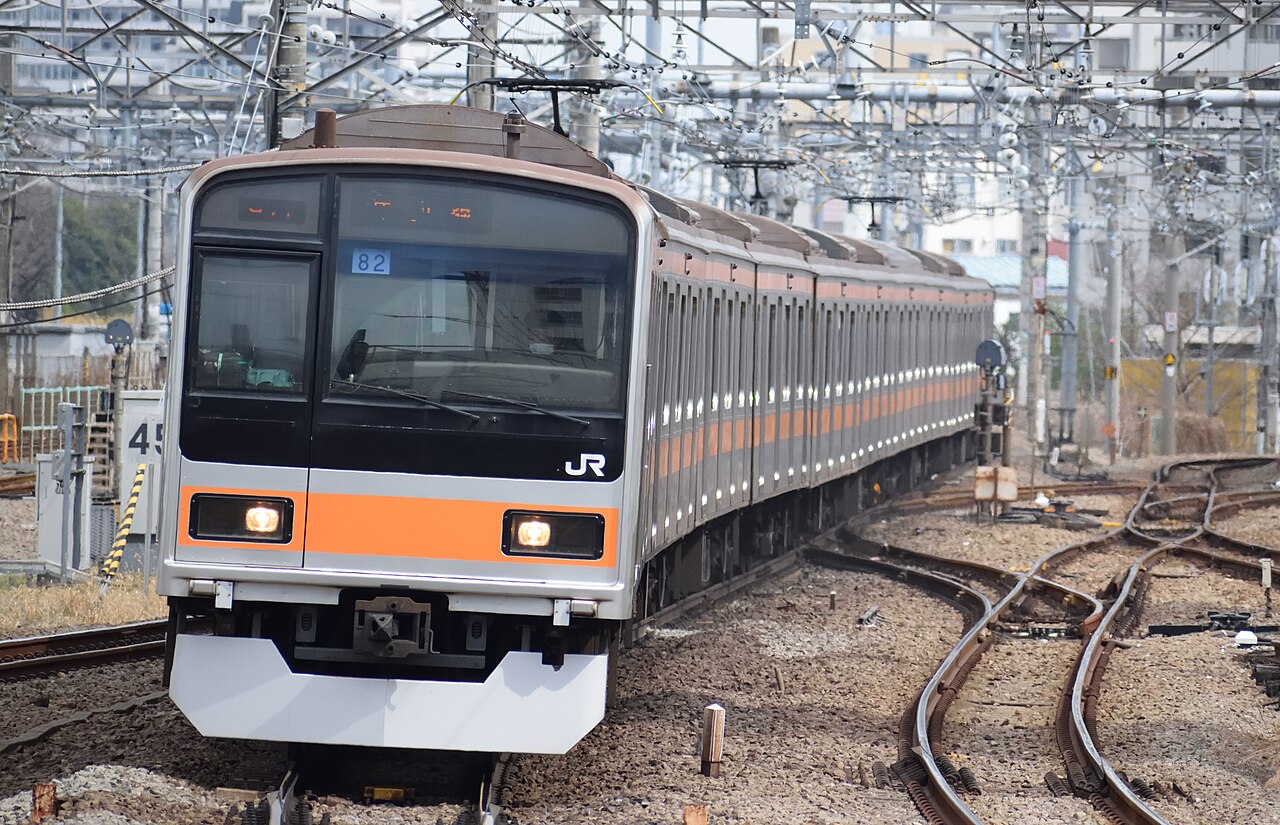
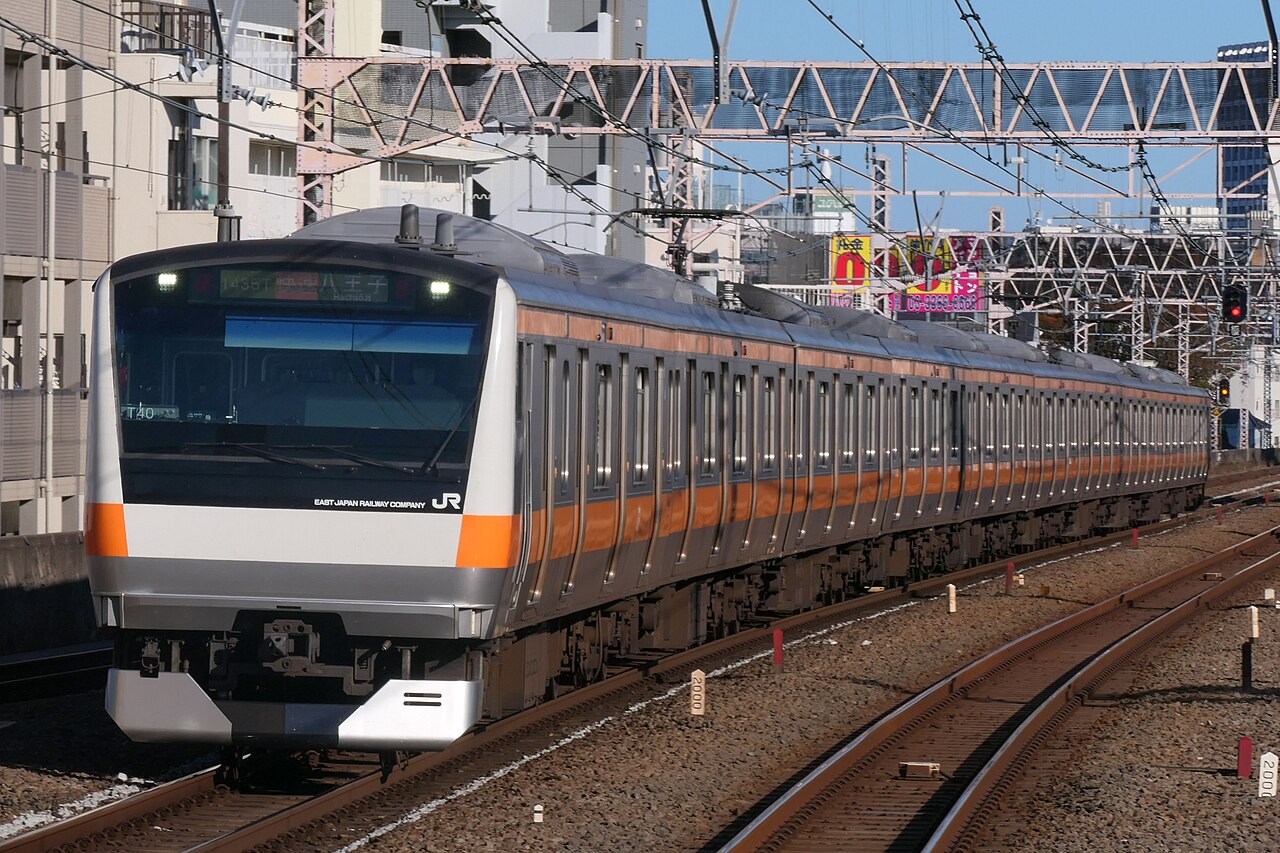
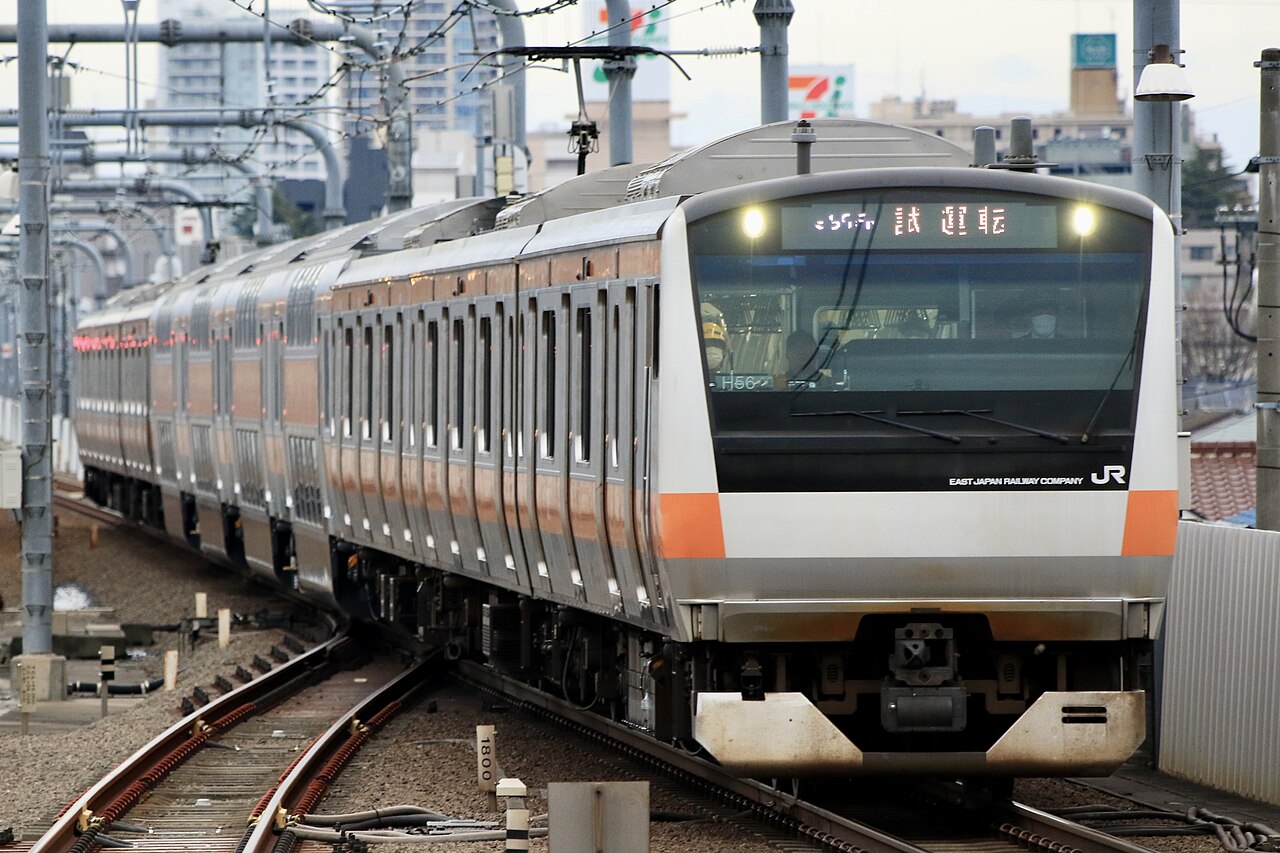
In the 2000s a major continuous grade-separation project elevated the line through the western suburbs to remove the level crossings that the dense service kept shut. The English-language source puts the Mitaka–Tachikawa works at ¥180 billion; built in phases from 1999, the elevation was substantially completed in November 2010 and the wider project finished in 2014, removing eighteen level crossings. E233 series trains — still the line’s stock — entered service on 26 December 2006, 688 cars being ordered to replace the 201 series, whose last regular run was on 14 October 2010. Station numbering (JC01–JC24) followed in 2016, and on 14 March 2020 the last early-morning and late-night local trains were converted to rapid service, fully separating the line from the Chūō–Sōbu locals. Most recently, bilevel Green (first-class) cars were added to form twelve-car sets, beginning a fare-free trial on 13 October 2024 ahead of the paid Green Car service in 2025.
Crowding and throughput define the line. JR East has run up to 30 trains an hour on the corridor since the 1960s; on the morning-peak Nakano-to-Shinjuku section, congestion stayed above 180 percent until fiscal 2019, fell to about 116 percent during the COVID-19 pandemic in fiscal 2020, and recovered to 158 percent by fiscal 2023 (Japan’s Ministry of Land, Infrastructure, Transport and Tourism). The Japanese source states that in recent statistics the line has the highest transport capacity and passenger volume of any operating system among Greater Tokyo’s railways. The English source, citing a New York Times report, notes that by 2000 the Chūō Line had the highest reported number of personal-injury accidents, including suicides, in the JR East network; JR East has added platform fencing, mirrors and blue lighting and plans platform screen doors along the line by fiscal 2032. For Yamanashi Prefecture, finally, the line is in the prefecture’s own words the only trunk railway linking it with the metropolitan area.
Timeline
- 188911 April: the Kōbu Railway opens the Shinjuku–Tachikawa section, the origin of the line; the Tachikawa–Hachioji section follows on 11 August.
- 1904August: the Nakano–Iidamachi section is electrified (the first rapid electric railway in Tokyo); service reaches Ochanomizu on 31 December.
- 19061 October: the Kōbu Railway is nationalised; the line takes its present name, the Chūō Line.
- 1919March: the line is extended to its current Tōkyō Station terminus (1 March).
- 193315 September: limited-stop 'express trains' (kyūkō densha) begin between Ochanomizu and Nakano, the direct precursor of today's rapid service.
- 1957JNR 101 series trains are introduced on the express service, bringing the orange-vermillion (JNR Vermillion No. 1) livery that becomes the line's colour.
- 196117 March: the express trains are rebranded 'Rapid' (kaisoku) to avoid confusion with the higher-fare Azusa/Alps limited express extended to Shinjuku.
- 1966April: Nakano–Ogikubo is quadruple-tracked; the Tozai subway reaches Nakano and through-running onto the Chūō–Sōbu Line begins — JNR's first through service.
- 19673 July: rapid operation is extended west from Nakano to Takao and the Special Rapid (later Chūō Special Rapid) is introduced, partly to compete with the no-surcharge Keio Line express.
- 1969April: Ogikubo–Mitaka is quadruple-tracked.
- 1981201 series production trains enter service (after 1979 prototypes), replacing the 101 series.
- 19871 April: JNR is privatised; the Chūō Line (Rapid) passes to the East Japan Railway Company (JR East).
- 1993April: the Commuter Special Rapid begins operation (towards Tōkyō in the morning peak).
- 20055 September: women-only cars are (re)introduced on the line.
- 200626 December: E233 series trains enter service; 688 cars are ordered to replace the 201 series.
- 201014 October: the 201 series makes its last regular run. November: the Mitaka–Tachikawa grade-separation works are substantially completed (project finished 2014; 18 level crossings removed).
- 2016Station numbering is introduced, from JC01 (Tōkyō) to JC24 (Takao).
- 202014 March: the last early-morning and late-night local trains are converted to rapid service, fully separating the line from the Chūō–Sōbu locals.
- 202413 October: twelve-car sets with two bilevel Green (first-class) cars begin running on a fare-free trial basis.
- 202515 March: the paid Green Car service begins (the Japanese source dates it 15 March 2025; the English source says early 2025).
Sources
Facts last verified 3 June 2026.
Gallery 4 photos
Every photo for this page — tap any image to view it full-size. All from Wikimedia Commons (credit under each).