History
The line is one of the oldest in the Kansai region. The Katamachi-to-Shijonawate section was opened on 22 August 1895 by the Naniwa Railway, built as a pilgrimage route to Shijonawate Shrine and Nozaki Kannon at the western foot of Mount Iimori and as a replacement for boat transport on the Neyagawa river; the original section ran about 12.98 km of single track. On 9 February 1897 the line was transferred to the Kansai Railway, which wanted its own trunk line to Osaka from Nagoya, and the Shijonawate-to-Kizu section was opened in 1898. According to the English Wikipedia account, because the original Katamachi terminus could not be expanded an Amijima terminus was constructed; after the Kansai Railway shifted its main line onto the former Osaka Railway route via Oji to Minatomachi (present-day JR Namba), the Katamachi route was reduced to a local branch. The railway was nationalised in 1907; under the national-railway line-naming system of 12 October 1909 the Kizu-Sakuranomiya section was named the Sakuranomiya Line and the Hanaten-Katamachi section the Katamachi Line, and after the Hanaten-Sakuranomiya section was abolished on 15 November 1913 the whole Kizu-Katamachi route became the Katamachi Line.
Electrification and double-tracking came piecemeal over many decades. The Shijonawate-to-Katamachi section was electrified on 1 December 1932 - the first electrified section among the national-railway (then Japan Governmental Railways) lines in the Kansai/Keihanshin region, with steam haulage retained on the Kizu-Shijonawate stretch. Electrification was extended from Shijonawate to Nagao on 25 December 1950, and the remaining Kizu-Nagao section was finally electrified on 11 March 1989, after the privatisation of Japanese National Railways (JNR), allowing electric trains to run over the entire line. Double-tracking advanced in parallel: the Hanaten-Shigino section was duplicated in 1927, the Katamachi-Shigino section in 1955, the Shijonawate-Hanaten sections in 1969, Nagao-Shijonawate on 1 October 1979, and Matsuiyamate-Nagao in 1989, by which point the whole passenger main line from Matsuiyamate to the Kyobashi (former Katamachi) end was double track; the Kizu-Matsuiyamate section remains single track. The 1 October 1979 double-tracking to Nagao also brought the first automatic ticket gates installed on a Kansai national-railway line.
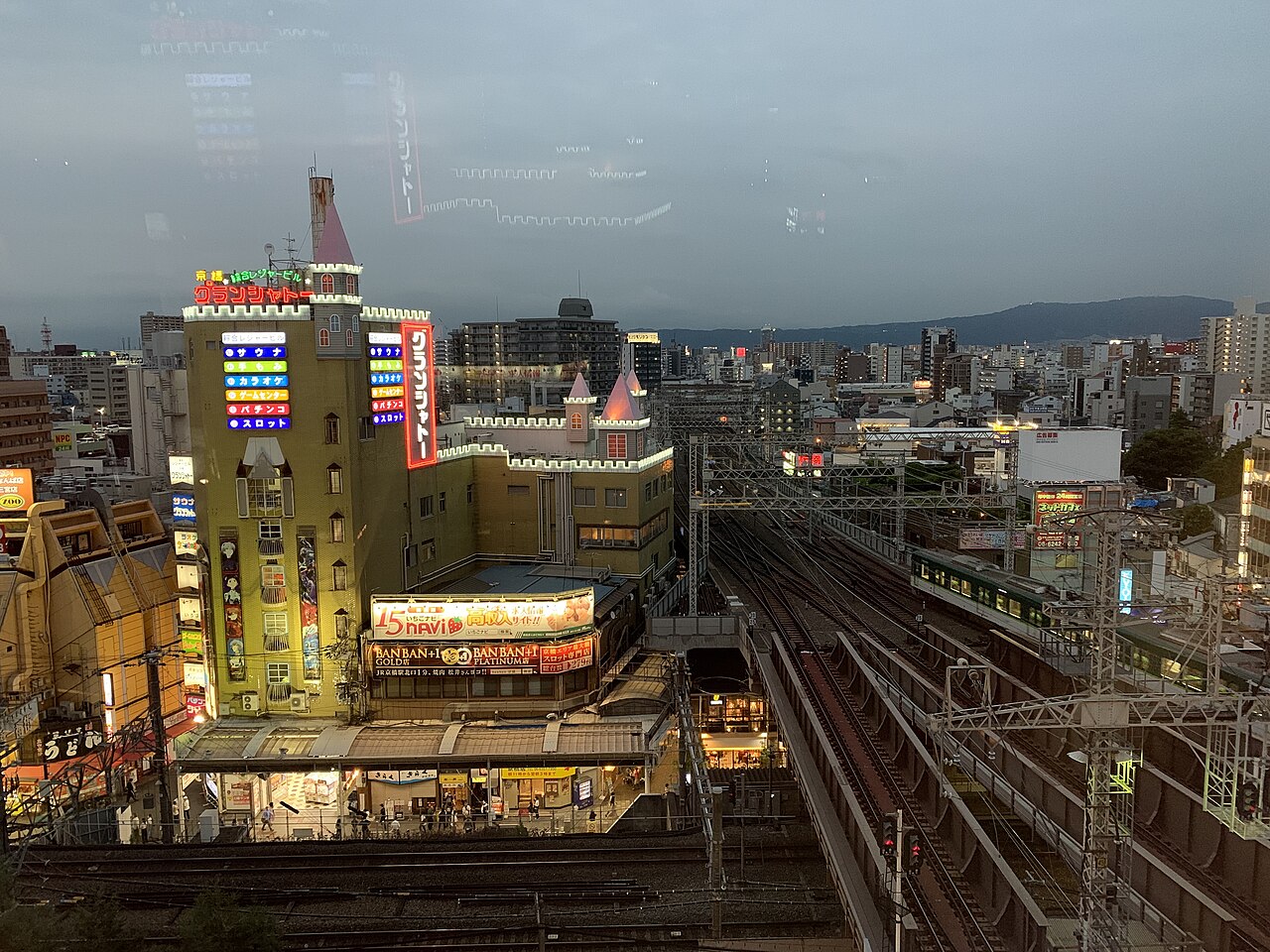
On 1 April 1987 JNR was privatised and the Katamachi Line passed to JR West, with Japan Freight Railway (JR Freight) operating as a Category-2 operator over part of the line. The common nickname "Gakkentoshi Line" was adopted on 13 March 1988, the same day a Rapid service began running. The line's defining modern change came on 8 March 1997, when the new JR Tozai Line opened and connected to the Katamachi Line at Kyobashi: the short Kyobashi-Katamachi section (0.5 km) was abolished and the original Katamachi Station - which gave the line its formal name - was closed, replaced by Osakajo-kitazume Station on the new line. From then most trains have run through to the Fukuchiyama Line (JR Takarazuka Line), and via the JR Tozai Line and Amagasaki on to the Tokaido and Sanyo main lines (JR Kobe Line) toward Kobe, Himeji and Sanda. With the 1997 opening, Tanabe Station was renamed Kyotanabe and Kamitanabe Station was renamed JR Miyamaki.
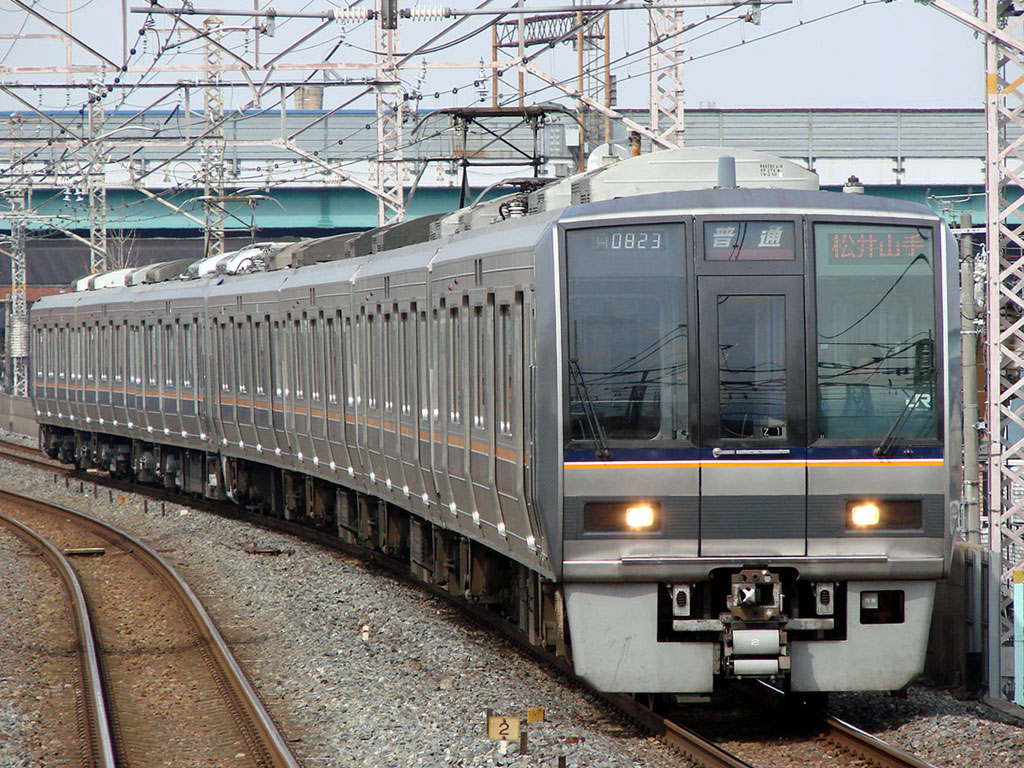
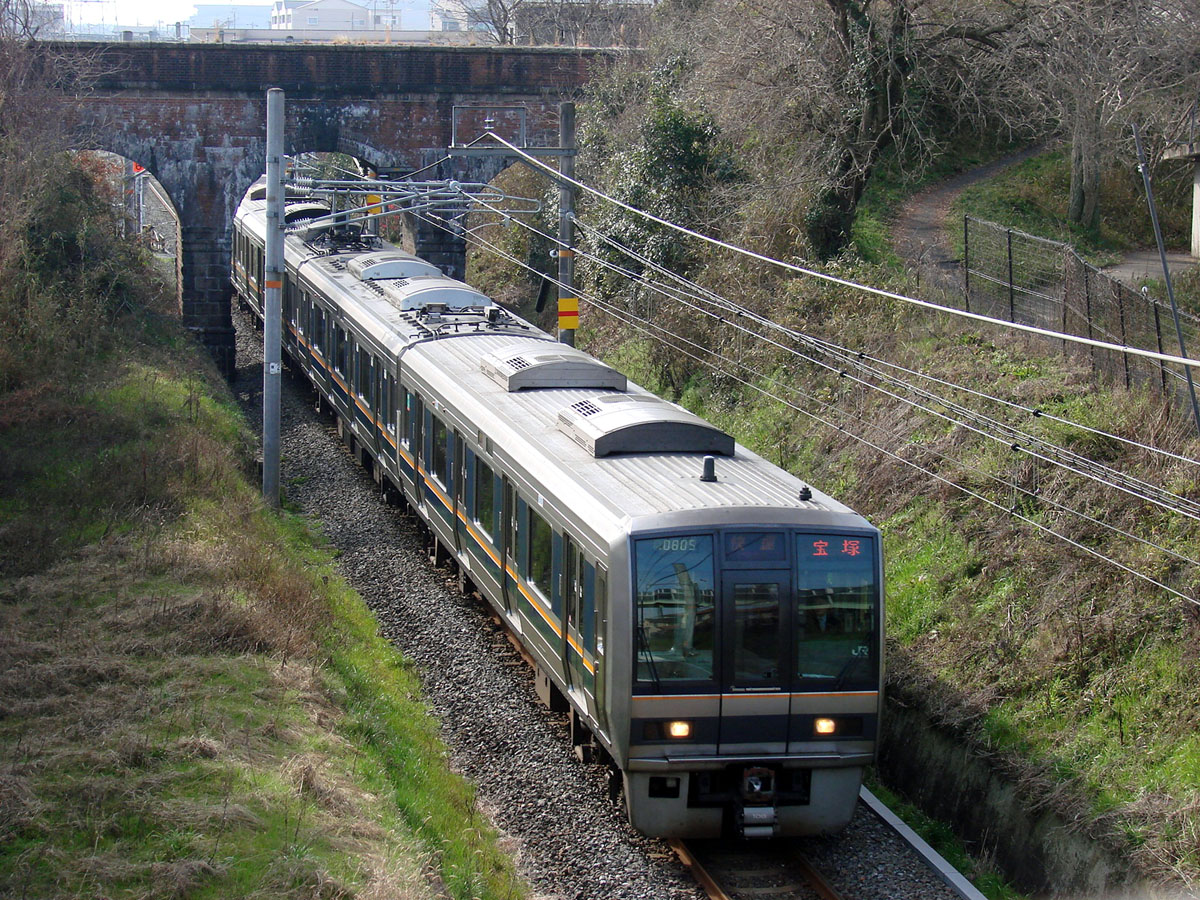
In the 21st century the line was further modernised. The 207 series, introduced on 30 April 1991, and the 321 series, introduced on 14 March 2008, are the current rolling stock, all based at the Aboshi depot complex. A Regional Rapid service began on 10 May 1999. The Osaka Higashi Line, converted from the line's former Joto freight branch, opened its Hanaten-Kyuhoji section on 15 March 2008 and was extended to Shin-Osaka on 16 March 2019, on which date the Direct Rapid through-services to Amagasaki ceased and Higashi-Neyagawa Station was renamed Neyagawa-Koen. Station numbering (JR-H18 at Kizu through JR-H41 at Kyobashi) was introduced on 17 March 2018, and at the FY2014 introduction of the route symbol "H" the line colour was changed from the yellow-green adopted in 1990 to the cherry (deep-pink) colour shared with the connecting JR Tozai Line. As of fiscal year 2020 the line's most congested segment, Shigino to Kyobashi in the morning peak, ran at a congestion rate of 120 percent. Today the entire line is managed by JR West's Kinki Region Headquarters.
Timeline
- 189522 August: the Naniwa Railway opens the Katamachi-Shijonawate section (about 12.98 km), all single track.
- 18979 February: the line is transferred to the Kansai Railway, which seeks its own Nagoya-Osaka trunk line.
- 1898The Shijonawate-Kizu section opens; the line's starting point is moved from Katamachi to Kizu (16 September).
- 1907The Kansai Railway is nationalised.
- 190912 October: under the national-railway line-naming system, Hanaten-Katamachi is named the Katamachi Line (Kizu-Sakuranomiya becomes the Sakuranomiya Line).
- 191315 November: the Hanaten-Sakuranomiya section is abolished; the Kizu-Katamachi route becomes the Katamachi Line.
- 192710 December: the Hanaten-Shigino section is double-tracked.
- 19321 December: the Shijonawate-Katamachi section is electrified - the first electrified section among the national-railway lines in the Kansai/Keihanshin region.
- 195025 December: electrification is extended from Shijonawate to Nagao.
- 195525 January: the Katamachi-Shigino section is double-tracked.
- 1969The Shijonawate-Hanaten sections are double-tracked.
- 19791 October: the Nagao-Shijonawate section is double-tracked; Fujisaka and Higashi-Neyagawa stations open; the first automatic ticket gates on a Kansai national-railway line are installed.
- 19871 April: JNR is privatised; the line passes to JR West, with JR Freight as a Category-2 operator on part of the line.
- 198813 March: the nickname "Gakkentoshi Line" is adopted and Rapid service begins.
- 198911 March: the Kizu-Nagao section is electrified; Matsuiyamate Station opens; Matsuiyamate-Nagao is double-tracked.
- 199130 April: the 207 series enters service.
- 19978 March: the JR Tozai Line opens and connects at Kyobashi; Kyobashi-Katamachi (0.5 km) is abolished and Katamachi Station closes; through service to the JR Takarazuka/JR Kobe lines begins; Tanabe renamed Kyotanabe and Kamitanabe renamed JR Miyamaki.
- 199910 May: Regional Rapid service begins.
- 200814 March: the 321 series enters service. 15 March: the Osaka Higashi Line (Hanaten-Kyuhoji), converted from the line's former Joto freight branch, opens.
- 201817 March: station numbering is introduced (JR-H18 at Kizu to JR-H41 at Kyobashi).
- 201916 March: the Osaka Higashi Line is extended to Shin-Osaka; the Direct Rapid through-services to Amagasaki end; Higashi-Neyagawa Station is renamed Neyagawa-Koen.
Sources
Facts last verified 3 June 2026.
Gallery 5 photos
Every photo for this page — tap any image to view it full-size. All from Wikimedia Commons (credit under each).