History
The Takarazuka Line is unusual among major Japanese trunk lines in that it was conceived less as an intercity link than as an instrument of suburban development. Takarazuka was not a large city, and a line running through farmland between Umeda and the hills was not an obvious commercial prospect. Its early success owed much to the aggressive strategy of the company, which deliberately developed housing along the route for the growing white-collar population who would commute into central Osaka by train. To generate ridership it opened a zoo at Minoo (on the branch Minoo Line) in November 1910, a hot spring at Takarazuka in May 1911, and a ballpark at Toyonaka in 1913. This integrated model — a railway company creating its own demand through housing, leisure and retail — became enormously influential in Japanese private-railway management. Takarazuka itself became home to the Takarazuka Revue (宝塚歌劇団), and the line remains the access route to the Takarazuka Grand Theatre.
The line's tramway origins left a lasting physical mark: because the route was laid out to follow land acquired for housing development, it has numerous sharp curves that have long hindered high-speed operation, in marked contrast to Hankyū's other two trunk lines to Kobe and Kyoto. In 1918 the company changed its name from the Minoo Arima Electric Tramway to Hanshin Kyūkō Dentetsu. After the Kobe Main Line opened on 16 July 1920, branching off at Jūsō, the track between Umeda and Jūsō was shared between the two lines; this arrangement lasted until 1926, when the original double track was elevated and replaced by a separate four-track alignment. Express (急行) services began on 1 October 1932, initially taking 35 minutes between Umeda and Takarazuka.
For decades the Takarazuka Line was something of a poor relation to the Kobe Line, running smaller and older cars. Larger cars of the Kobe Line standard could not operate on the line until 1952 because of its restricted structure gauge, and the small cars were not finally eliminated until December 1963. The Umeda–Jūsō section was quadruple-tracked on 18 February 1959, using the former site of the Kitano Line, with the two new eastern tracks taken over by Kyoto Line trains. The line's overhead voltage was raised from 600 V to 1,500 V DC on 24 August 1969. On 10 March 1978 the entire line was reclassified from a tramway under the Tramways Act to a railway under the Local Railway Act.
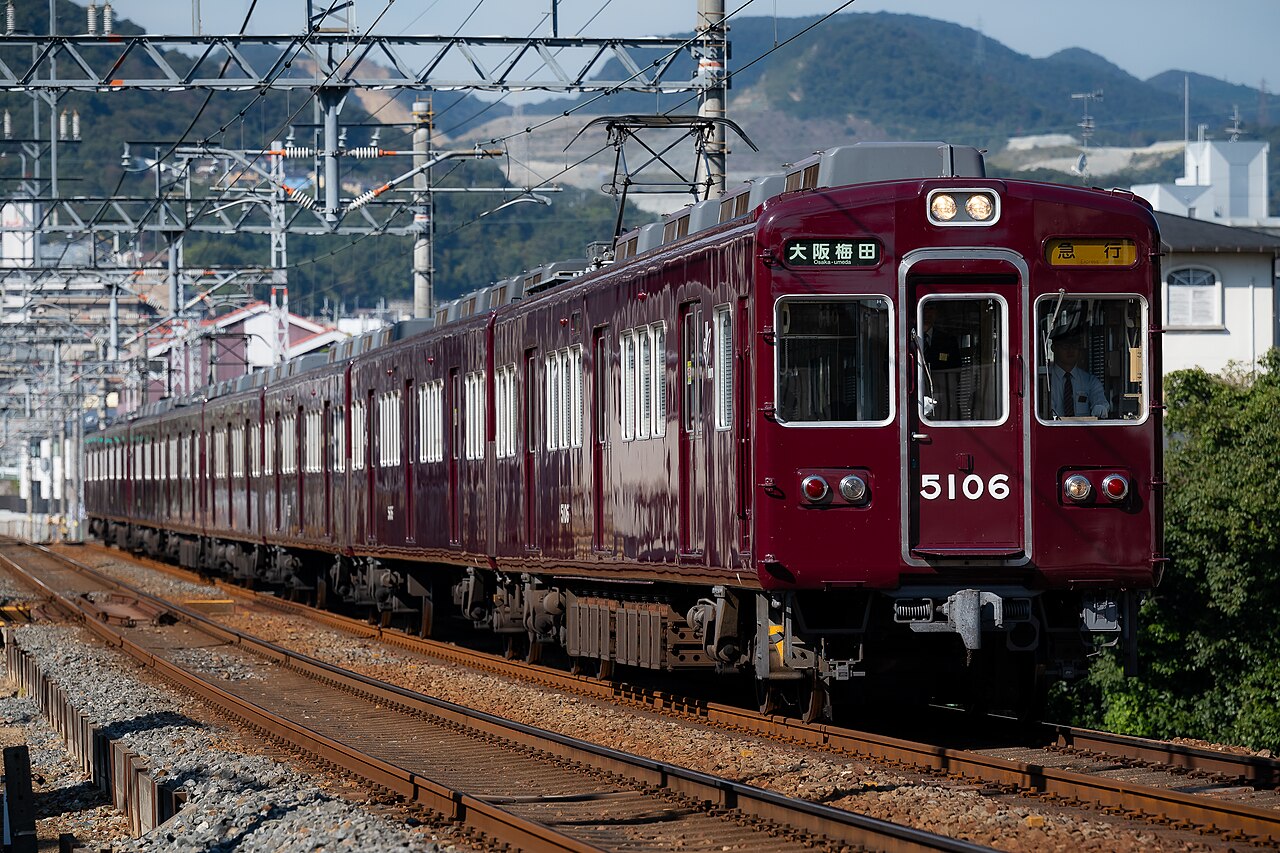
As commuter traffic grew, the Takarazuka Line became the setting for Hankyū's first ten-car operation, which began in March 1982; ten-car trains were later discontinued in December 2022. A wholesale timetable revision in December 1986 shifted the daytime pattern from 15-minute to 10-minute intervals and added an express stop at Toyonaka. Through services onto the connecting Nose Electric Railway began on 17 November 1997 with the introduction of the "Nissei Express" limited express, following elevation work at Kawanishi-Noseguchi Station. After the Mikuni grade-separation was completed in 2000 and the station relocated, the line's maximum speed was raised from 90 km/h to 100 km/h — still its present ceiling — and a 30 km/h curve restriction near the old Mikuni Station was removed; the relocation also shortened the line by 0.1 km.
Several stations were renamed over the line's history. On 21 December 2013 Hattori became Hattori-tenjin and Nakayama became Nakayama-kannon, and station numbering was introduced across the whole line; on 1 October 2019 the Osaka terminus Umeda was renamed Osaka-Umeda, and Ishibashi became Ishibashi-handai-mae. Today the line is operated by Hankyū Railway, with services including Local, Semi-Express, Express, Commuter Express, Commuter Limited Express and the through-running "Nissei Express" limited express to Nissei-Chūō on the Nose Electric Railway. It remains a busy commuter artery: in fiscal year 2024 its most congested section in the morning peak was Mikuni to Jūsō, with a peak congestion rate of 126 percent.
Timeline
- 191010 March: the Minoo Arima Electric Tramway opens the entire Umeda (now Osaka-Umeda)–Takarazuka line, built to 1,435 mm standard gauge as a double-tracked, electrified railway at 600 V DC. A zoo opens at Minoo in November.
- 1911May: a hot spring opens at Takarazuka, one of the company's measures to build ridership along the new line.
- 1913A ballpark opens at Toyonaka along the line.
- 1918The company is renamed from the Minoo Arima Electric Tramway to Hanshin Kyūkō Dentetsu.
- 192016 July: the Kobe Main Line opens, branching at Jūsō; the Umeda–Jūsō track is shared between the two lines.
- 1926The shared Umeda–Jūsō double track is elevated and replaced by a separate four-track alignment, separating the Takarazuka and Kobe lines.
- 19321 October: Express (急行) services begin, initially taking 35 minutes between Umeda and Takarazuka.
- 1952Larger Kobe Line standard cars can operate on the line for the first time; until now the line's small structure gauge had prevented it.
- 195918 February: the Umeda–Jūsō section is quadruple-tracked using the former Kitano Line site; the two new eastern tracks are used by Kyoto Line trains.
- 1963December: the line's small cars are finally eliminated.
- 196924 August: the overhead voltage is raised from 600 V to 1,500 V DC.
- 197810 March: the entire line is reclassified from a tramway (Tramways Act) to a railway (Local Railway Act).
- 1982March: Hankyū's first ten-car operation begins on the Takarazuka Line.
- 1986December: a wholesale timetable revision shifts the daytime pattern from 15-minute to 10-minute intervals and adds an express stop at Toyonaka.
- 199717 November: through services to the Nose Electric Railway begin with the introduction of the "Nissei Express" limited express, after elevation work at Kawanishi-Noseguchi Station.
- 2000After the Mikuni grade-separation is completed and the station relocated, the maximum speed is raised from 90 km/h to 100 km/h and a 30 km/h curve restriction near the old Mikuni Station is removed; the relocation shortens the line by 0.1 km.
- 201321 December: Hattori is renamed Hattori-tenjin and Nakayama is renamed Nakayama-kannon; station numbering is introduced across the whole line.
- 20191 October: the Osaka terminus Umeda is renamed Osaka-Umeda, and Ishibashi is renamed Ishibashi-handai-mae.
- 202217 December: a Hankyū-wide timetable revision abolishes through services to the Minoo Line and ends ten-car operation; the Commuter Limited Express becomes eight cars and is increased.
- 2024FY2024: the morning-peak most-congested section is Mikuni → Jūsō, with a peak congestion rate of 126%.
Sources
Facts last verified 3 June 2026.
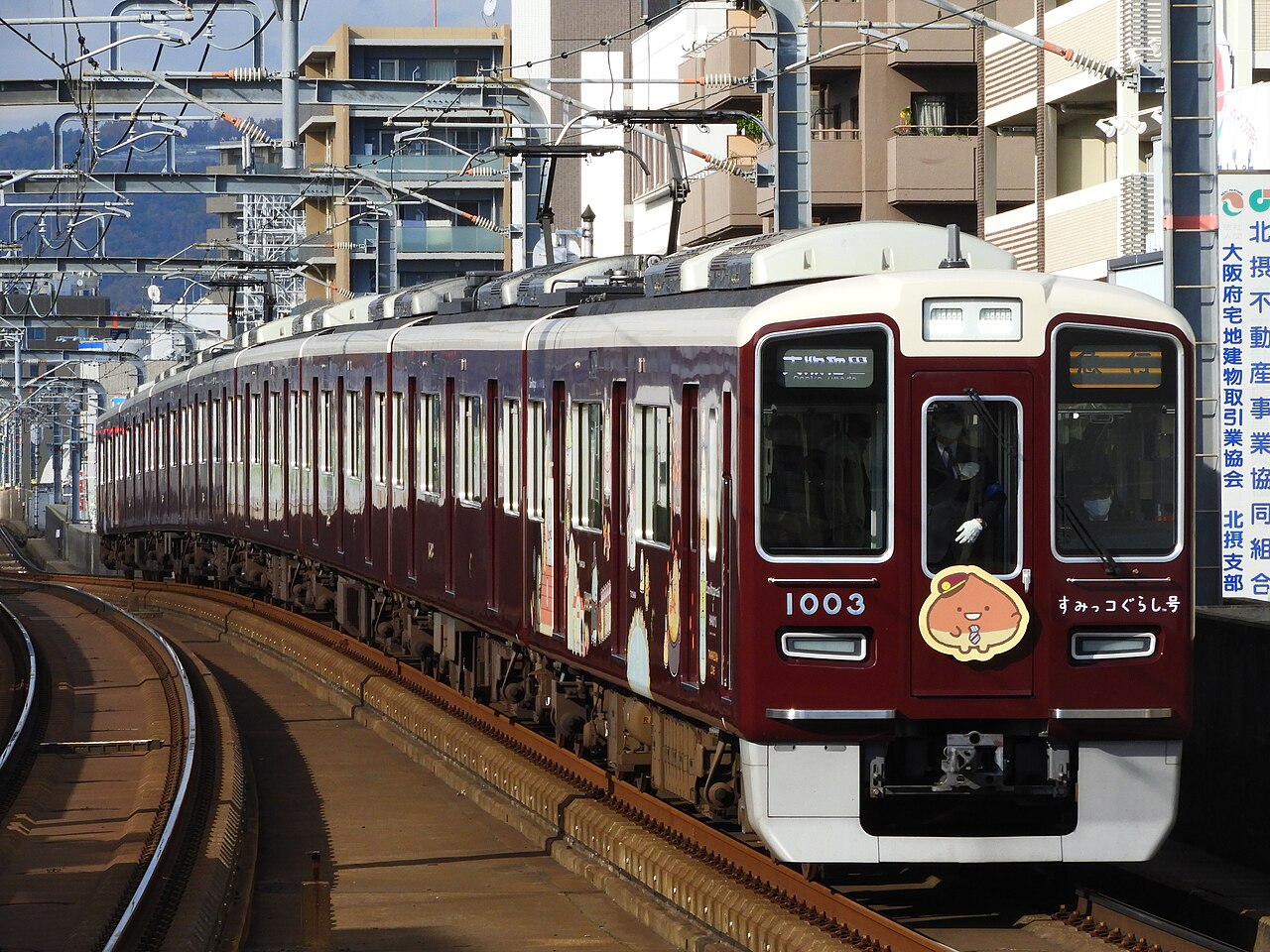
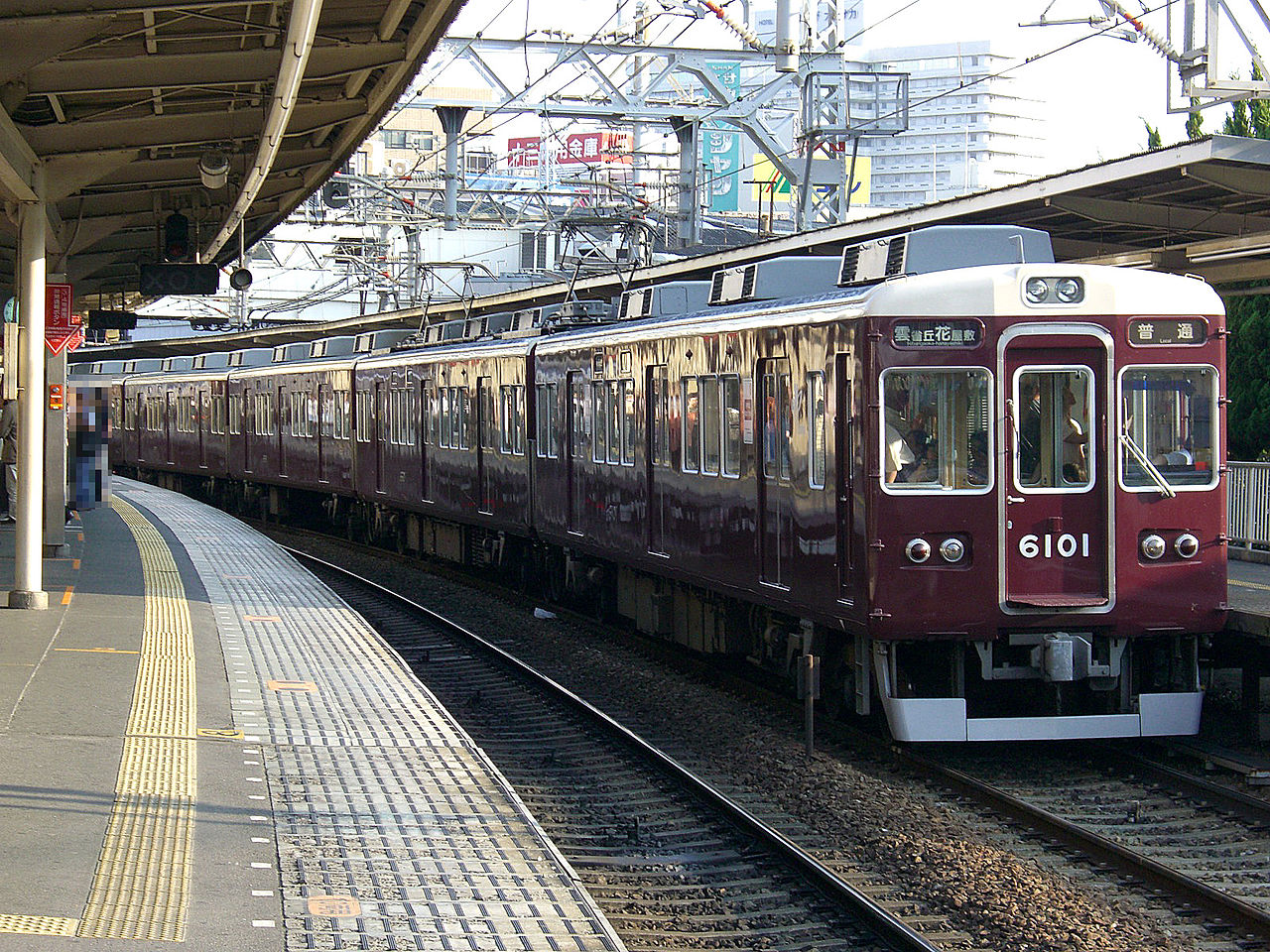
Gallery 2 photos
Every photo for this page — tap any image to view it full-size. All from Wikimedia Commons (credit under each).