History
According to the English-language source, the Keikyu Main Line began as a short 2 km line in 1895, and by 1905 it had been extended from Shinagawa Station in Tokyo to central Yokohama, becoming a major interurban line between the two cities. The Japanese-language source frames the origin through the company that built it: the line traces back to the Daishi Electric Railway, which operated a pilgrimage railway to Kawasaki Daishi (Heikenji temple) and which, with the aim of building a Tokyo–Yokohama (Keihin) connecting railway, renamed itself the Keihin Electric Railway and opened a tramway from southern Tokyo toward the Kawasaki area; the same source states that the Daishi Electric Railway, the predecessor of Keikyu, was founded in 1898.
The early build was incremental. The Japanese chronology records that on 1 February 1901 the Keihin Electric Railway opened the section between Ōmori-teishajōmae (later Ōmori) and Kawasaki (later Rokugōbashi), laid to 1,435 mm gauge and operated at 600 V DC — a date and figures the English source corroborates when it says the Keihin Railway opened the Kawasaki-to-Ōmori section in 1901 as a 1,435 mm line electrified at 600 V DC. In 1904 the line was regauged to the narrower 1,372 mm and extended to Shinagawa, and on 24 December 1905 it was extended from Kawasaki toward the Kanagawa (Yokohama) area.
A second company supplied the southern half. The Keihin Electric Railway took a capital stake in the Shōnan Electric Railway, which had been planning a suburban line between Yokohama and Yokosuka and had been hit by the effects of the Great Kantō Earthquake; with Keihin's investment the Shōnan Electric Railway opened, in the Shōwa era, sections corresponding to parts of today's Keikyū Main Line and Keikyū Zushi Line. The English source dates the Shōnan Electric Railway's opening of the Uraga-to-Koganechō section to 1930 as a standard-gauge line electrified at 1,500 V DC, with the line from Yokohama extended to connect at Koganechō in 1931. Because Keihin's line used the 1,372 mm gauge while Shōnan's had been licensed and opened at standard gauge, through-running required regauging one of them; the two companies were joined at Hinodechō in December 1931, after which Keihin's line was converted to standard gauge. The English source records that freight services ceased in 1932 and the line was regauged to standard gauge the following year. The Japanese chronology gives the decisive step on 1 April 1933: through-running into the national railway's Shinagawa Station began, Takanawa Station was abolished, Shinagawa Station opened, the section north of Yokohama was regauged from 1,372 mm back to 1,435 mm, and through operation between Shinagawa and Uraga began.
War-era consolidation reshaped the operator. The Shōnan Electric Railway merged with the Keihin Electric Railway in 1941, and the following year that company merged into Tokyu (the wartime "Greater Tokyu"). The English source states the voltage on the entire line was raised to 1,500 V DC in 1945, and that in 1948 the Keihin Electric Railway was created to operate the railway; the Japanese record dates the separation of Keikyu (Keihin Kyūkō Dentetsu) from Tokyu to 1 June 1948, after which the line was renamed the Main Line (Honsen).
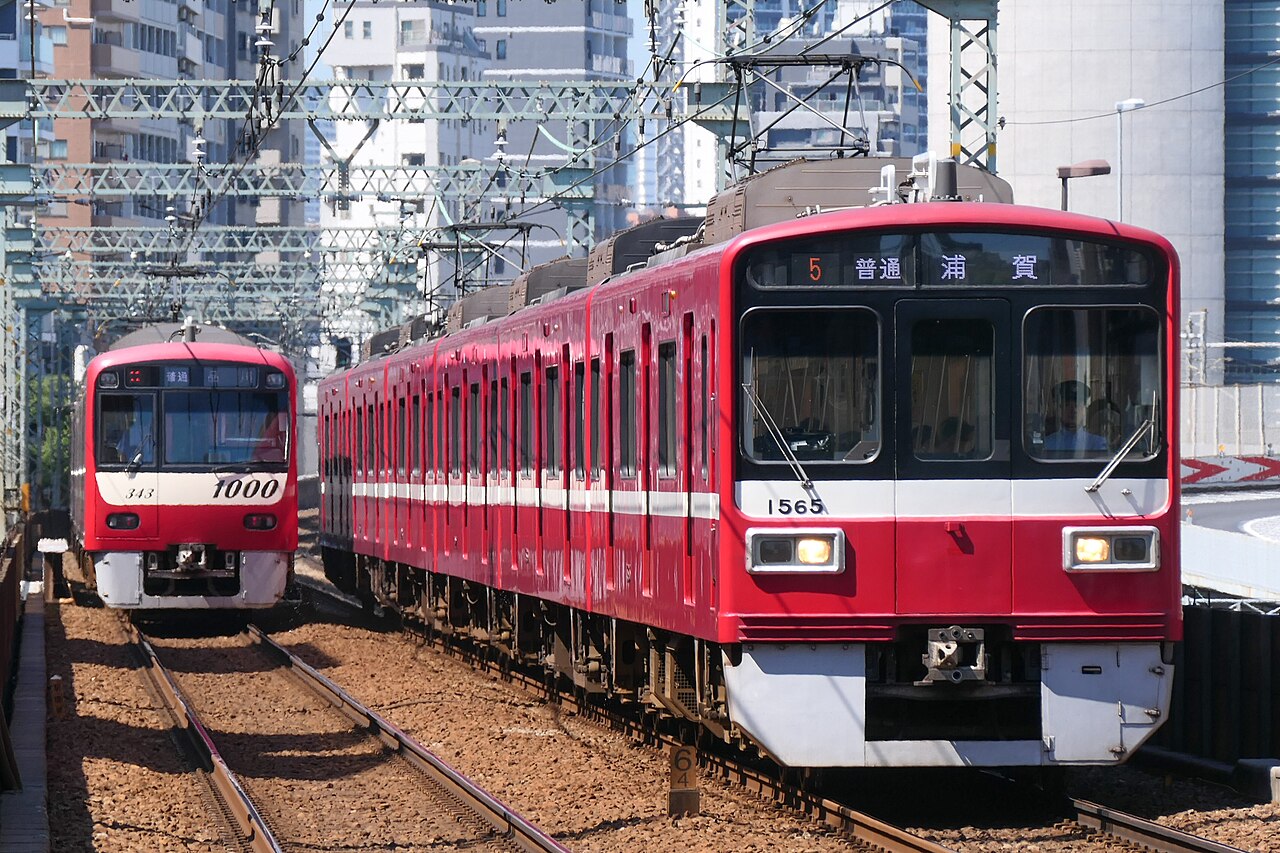
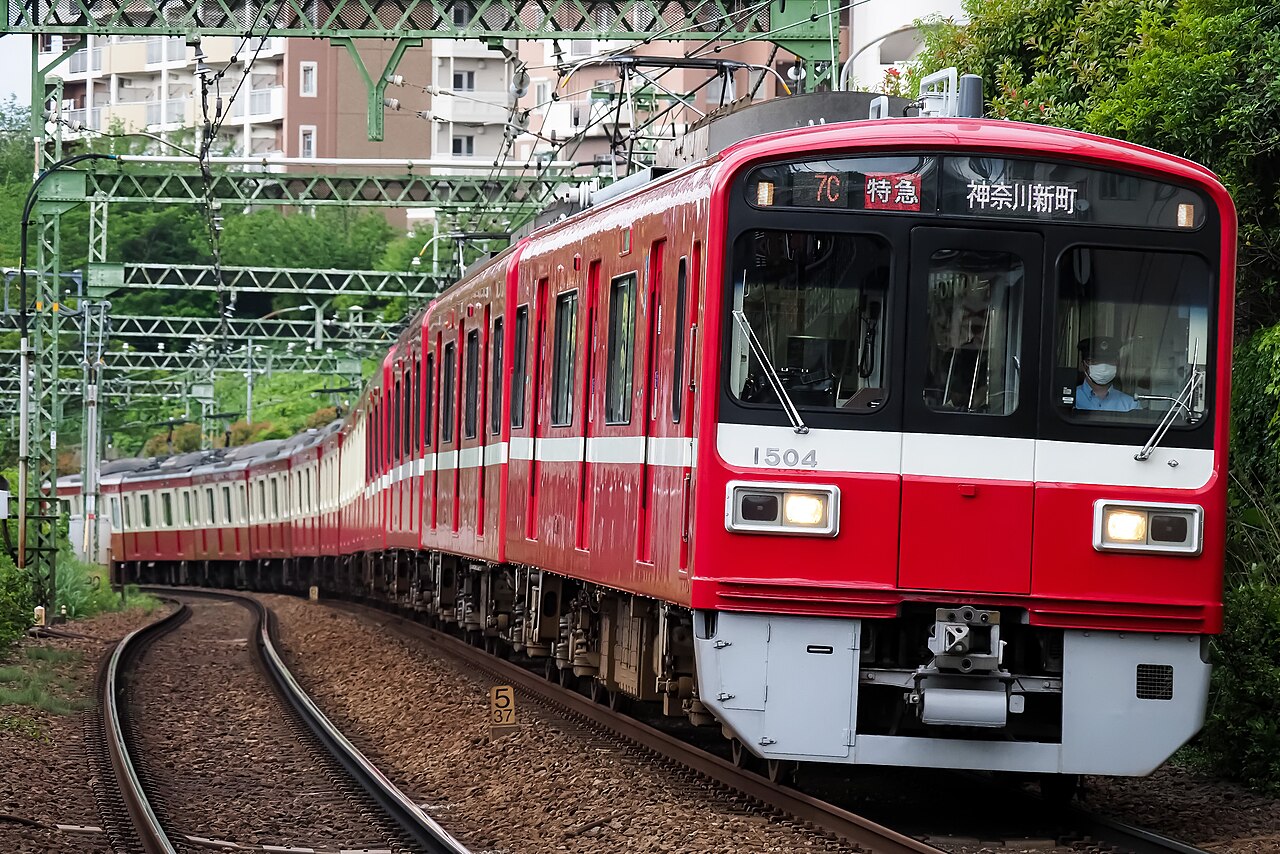
In the postwar decades the line was upgraded for higher capacity and speed in a corridor where it competes directly with the parallel JR East Tōkaidō and Keihin-Tōhoku lines; the Japanese source notes the line uses 120 km/h running to compete with JR on the favourably aligned Shinagawa–Yokohama stretch. Today the line is double-tracked except for a three-track section between Koyasu and Kanagawa-shimmachi and a quadruple-tracked section between Kanazawa-bunko and Kanazawa-hakkei. From Sengakuji it through-runs onto the Toei Asakusa Line and, via that line, onto the Keisei and Hokusō networks, so that together with the Keikyū Airport Line it functions as an airport-access railway: it connects to Haneda Airport, while its through-service partner Keisei reaches Narita Airport, linking the two airports. Operational changes in the 2010s and 2020s continued: in October 2012 the section between Heiwajima and Rokugōdote was elevated to remove level crossings and Keikyū Kamata Station was rebuilt as a dual-level junction connecting the Main Line with the Airport Line; from 25 November 2023 all "Airport Express" services were renamed "Express"; and elevation of the Shinagawa-to-Shimbamba section, including a rebuilt Kitashinagawa Station, was reported underway as of 2023, due for completion in 2029.
Reported figures differ slightly between the two sources and are given here with their scope. The English-language infobox gives the line length as 55.5 km with 50 stations, a maximum speed of 120 km/h, and a daily ridership of 1,129,320 (FY2010); the Japanese-language infobox gives the line length as 56.7 km, likewise 50 stations, 1,435 mm gauge, 1,500 V DC overhead electrification, and a 120 km/h maximum speed.
The line has seen several mudslide- and level-crossing-related accidents. On 7 April 1997 the first three cars of a four-car train derailed after colliding with a mudslide between Keikyū Taura and Anjinzuka, injuring 22. On 24 September 2012 the first three cars of an eight-car train derailed after striking a mudslide between Oppama and Keikyū Taura, injuring 28 including the driver, with about 700 passengers aboard; the source reports the train was travelling at 75 km/h before braking and was scrapped afterward. On 5 September 2019 a rapid limited express collided with a truck and derailed at a level crossing between Kanagawa-shimmachi and the station then called Nakakido in Yokohama's Kanagawa Ward; the truck driver was killed and 35 others were injured, and that train too was scrapped.
Timeline
- 1895Per the EN article, the Keikyu Main Line began as a short 2 km line.
- 1898The Daishi Electric Railway, the predecessor of Keikyu, was founded (JA article).
- 19011 February: the Keihin Electric Railway opens the Ōmori–Kawasaki (later Rokugōbashi) section at 1,435 mm gauge, 600 V DC. (EN: Kawasaki–Ōmori section opened in 1901 as 1,435 mm, 600 V DC.)
- 1904The line is regauged to 1,372 mm and extended to Shinagawa.
- 1905By 1905 the line is extended from Shinagawa toward central Yokohama (24 December: Kawasaki–Kanagawa section opens).
- 1930The Shōnan Electric Railway opens the Uraga–Koganechō section as a standard-gauge line electrified at 1,500 V DC.
- 1931December: the Keihin and Shōnan lines are joined at Hinodechō; the line from Yokohama is extended to connect at Koganechō.
- 19331 April: through-running into JNR Shinagawa Station begins; Takanawa Station closes; the section north of Yokohama is regauged from 1,372 mm back to 1,435 mm; Shinagawa–Uraga through operation begins. (EN: regauged to standard gauge the year after freight ceased in 1932.)
- 1941The Shōnan Electric Railway merges with the Keihin Electric Railway.
- 1942The Keihin Electric Railway merges into Tokyu (the wartime 'Greater Tokyu').
- 1945The voltage on the entire line is raised to 1,500 V DC (EN article).
- 19481 June: Keikyu (Keihin Kyūkō Dentetsu) separates from Tokyu to operate the railway; the line is later renamed the Main Line (Honsen).
- 19977 April: the first three cars of a four-car train derail after hitting a mudslide between Keikyū Taura and Anjinzuka; 22 injured.
- 201224 September: an eight-car train's first three cars derail after striking a mudslide between Oppama and Keikyū Taura; 28 injured, train scrapped. October: Heiwajima–Rokugōdote elevated and Keikyū Kamata rebuilt as a dual-level junction.
- 20195 September: a rapid limited express collides with a truck and derails at a level crossing between Kanagawa-shimmachi and Nakakido (now Keikyū Higashi-Kanagawa) in Yokohama; the truck driver is killed and 35 others injured; the train is scrapped.
- 202325 November: all 'Airport Express' services are renamed 'Express'. Elevation of the Shinagawa–Shimbamba section (incl. a rebuilt Kitashinagawa Station) is reported underway, due for completion in 2029.
Sources
Facts last verified 3 June 2026.
Gallery 5 photos
Every photo for this page — tap any image to view it full-size. All from Wikimedia Commons (credit under each).