History
The line's origins lie with the Kure Naval District (Kure Chinjufu), established in 1890; poor overland access prompted a local railway-promotion movement, and in January 1900 a bill to build a Kure–Kaitaichi railway was passed. Construction began in May 1901, and on 27 December 1903 the Kaitaichi–Kure section (about 19.96 km) opened, with intermediate stations at Yano, Saka, Tenno and Yoshiura and the terminus at Kure. The English and Japanese Wikipedia accounts differ on the opener's status: the English article calls it a privately built line, while the Japanese article describes it as a government-built line (kansetsu-sen). Both agree that the section was leased to the Sanyo Railway from 1 December 1904 and then nationalised on 1 December 1906. On 12 October 1909, under the national railway line-naming scheme, the Kaitaichi–Kure section was formally named the "Kure Line."
The line to the east, between Kure and Mihara, came later as the separate Sango Line (Sango-sen). Building it forward from Mihara, the Mihara–Sunami section opened on 19 March 1930, reaching Aki-Saizaki in 1931, Takehara in 1932, and Mitsuuchinoumi (later Yasuura) in February 1935. From the Kure side, the Kure–Hiro extension (6.8 km) opened on 24 March 1935, adding Akiaga and Hiro stations. On 24 November 1935 the final Mitsuuchinoumi–Hiro section (16.0 km) opened and completed the through line; the Sango Line was absorbed into the Kure Line and the whole route took the Kure Line name. With the line complete, Kure's importance as a naval port brought through express trains running to Tokyo; historically the route also served as a bypass of the Sanyo Main Line, whose parallel inland alignment includes the "Seno-hachi," the steepest sustained gradient on that line.
A pre-war plan to double-track the Kaitaichi–Kure section was drawn up in 1939 and construction began in March 1941, but wartime material shortages stalled the work and the double-tracking plan was frozen in 1945. The partly completed tunnels and roadbed were left in place and later reused: when the entire line was electrified, the Kure–Kaitaichi section adopted new tunnels bored during the war in place of the older low-standard alignment. Electrification work began on 25 April 1968, and the whole line was electrified at 1,500 V DC on 15 September 1970; centralised traffic control (CTC) entered use across the line on 28 September 1970 — the first CTC installation in the Hiroshima Railway Administration district per the Japanese article — and electric-train operation began with the 1 October 1970 timetable revision. The opening of the Sanyo Shinkansen (fully opened 10 March 1975) led to the withdrawal of the line's express services, all of which were gone except the "Aki" sleeper limited express; the "Aki" itself was discontinued on 2 October 1978, ending limited-/express-class trains on the line. All freight operations on the line ended on 1 November 1986.
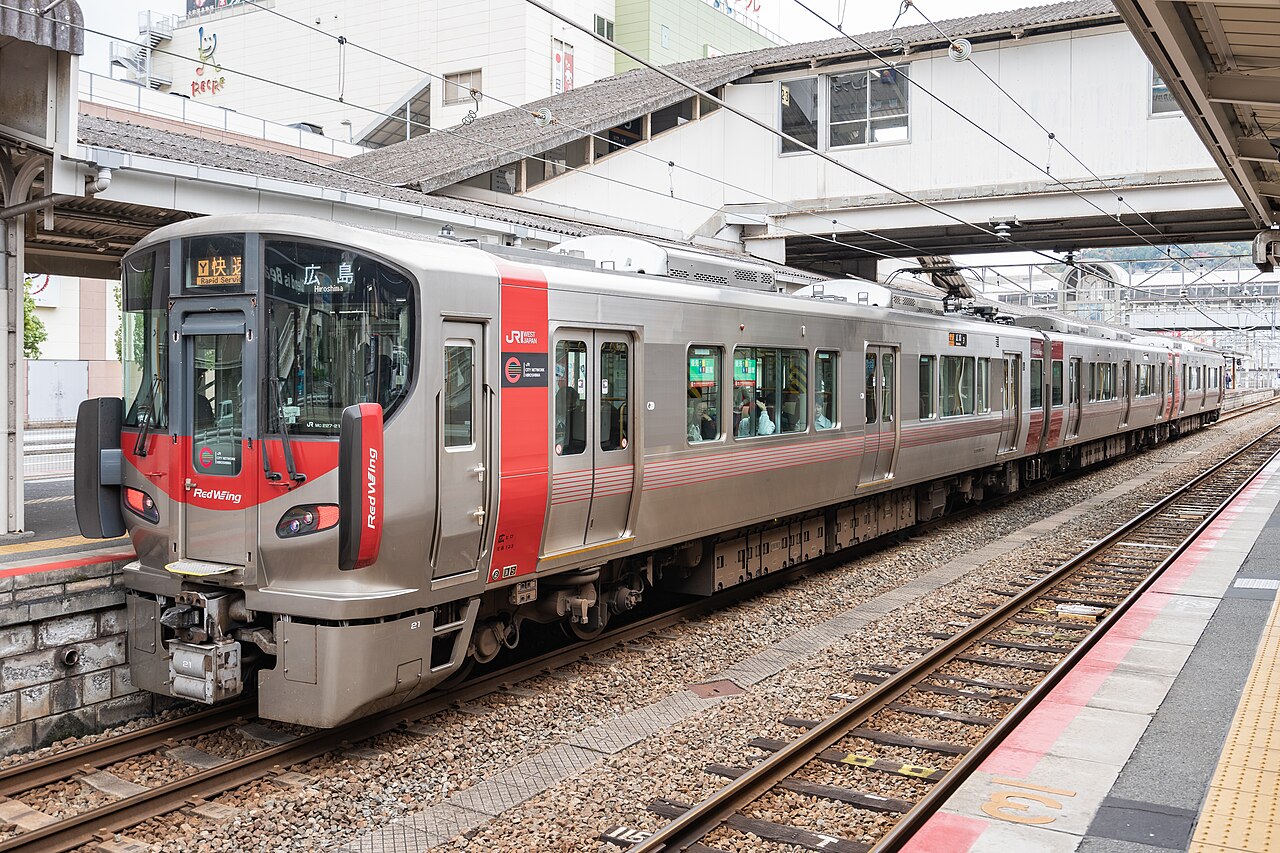
On 1 April 1987, with the privatisation of Japanese National Railways, the Kure Line passed to JR West. Local improvement campaigns continued: a JR Kure Line double-tracking promotion association was formed in 1988, and in 1994 the total cost of double-tracking the Kure–Hiro section was estimated at 23.5 billion yen; JR West countered that adding passing facilities could deliver comparable capacity for about a tenth of the cost, and three new crossing facilities were provided (with the new Mizushiri and Karugahama stations and a relocated Kawaraishi Station), enabling rapid running even in the rush hour. The "Aki-ji Liner" rapid-service name has been used since 7 February 1999. A yellow line colour and the route symbol "Y" were adopted with the 14 March 2015 timetable revision, on which date the 227 series electric trains entered service. Today the line carries only rapid ("Aki-ji Liner," "Commuter Liner" and, from 14 March 2026, "City Liner") and local services, operated with 227 series trains; trains from the Hiro–Kaitaichi side all run through to Hiroshima Station. The whole line is within JR West's Hiroshima Branch and the ICOCA IC-card area, and the Japanese article describes Kure Station as having the highest boarding figures of any single-track section on JR West. The line has suffered repeated weather closures on its coastal, mountainous alignment: the July 2018 West Japan heavy rain suspended the Mihara–Hiro section from 5 July and eventually the whole line, with full service restored on 15 December 2018, about five months later.
Timeline
- 190327 December: the Kaitaichi–Kure section (about 19.96 km) opens, with intermediate stations at Yano, Saka, Tenno and Yoshiura and the terminus at Kure.
- 19041 December: the Kaitaichi–Kure section is leased to the Sanyo Railway.
- 19061 December: the line is nationalised.
- 190912 October: under the national railway line-naming scheme, the Kaitaichi–Kure section is named the "Kure Line."
- 193019 March: the separate Sango Line opens its first section, Mihara–Sunami (about 5.15 km).
- 193524 March: the Kure–Hiro extension (6.8 km) opens, adding Akiaga and Hiro. 24 November: the Mitsuuchinoumi–Hiro section (16.0 km) opens, completing the through line; the Sango Line is absorbed into the Kure Line.
- 1941March: construction begins on double-tracking the Kaitaichi–Kure section (planned 1939); it is later stalled by wartime material shortages.
- 1945The double-tracking plan is frozen due to wartime material shortages.
- 196825 April: electrification work begins.
- 197015 September: the entire line is electrified at 1,500 V DC. 28 September: CTC begins across the line. 1 October: electric-train operation begins with a timetable revision.
- 197510 March: with the full opening of the Sanyo Shinkansen, the line's express services are withdrawn except the "Aki" sleeper limited express.
- 19782 October: the "Aki" sleeper limited express is discontinued, ending limited-/express-class trains on the line.
- 19861 November: all freight operations on the line end.
- 19871 April: on the privatisation of JNR, the Kure Line passes to JR West.
- 1994The total cost of double-tracking the Kure–Hiro section is estimated at 23.5 billion yen; JR West instead provides passing facilities at about a tenth of the cost.
- 19997 February: the "Aki-ji Liner" rapid-service name comes into use; new Mizushiri and Karugahama stations open and Kawaraishi Station is relocated.
- 201514 March: the yellow line colour and route symbol "Y" are fully introduced; 227 series electric trains enter service.
- 20185 July onward: the July 2018 West Japan heavy rain suspends the line; full service is restored on 15 December, about five months later.
Sources
Facts last verified 3 June 2026.
Gallery 5 photos
Every photo for this page — tap any image to view it full-size. All from Wikimedia Commons (credit under each).