History
The line's origins lie with the private Kyushu Railway Company, which opened the Tosu–Saga section in 1891 and extended the railway to Nagasaki via Haiki in 1898. The Japanese source describes the same early network in finer detail: the company first built what are today the Sasebo Line and Ōmura Line routes, opening the Tosu–Haiki and Nagayo–Nagasaki sections in 1897 and, for roughly a year until the route was through-connected, bridging the gap with a ferry across Ōmura Bay; through service over the whole Tosu–Haiki–Nagasaki route was established in 1898. In 1907 the Railway Nationalization Act nationalised all of Japan's major railways, and the Kyushu Railway passed into state hands.
The line took its present alignment in 1934. Because the original route via Sasebo and Ōmura was circuitous, a shorter cut-off line — the "Ariake Line" — was built between Hizen-Yamaguchi (today Kōhoku), Hizen-Kashima and Isahaya and incorporated into the Nagasaki Main Line; the older route was split off as the Sasebo Line (Hizen-Yamaguchi–Haiki) and the Ōmura Line (Haiki–Isahaya). A further short-cut followed in 1972, when the 6,173-metre Shin-Nagasaki Tunnel and the associated Kikitsu–Urakami deviation (the "new line," via Ichinuno) opened; the Japanese source notes this new line is about 6.7 km shorter than the original "old line" via Nagayo and greatly cut the Isahaya–Nagasaki journey time. Both the old and new lines remain part of the Nagasaki Main Line, and the old route via Nagayo is the only section never to have been electrified.
Double-tracking and electrification came in stages. The Saga–Nabeshima section was the first to be doubled, in 1966; by 1969 the Tosu–Hizen-Yamaguchi and Isahaya–Kikitsu sections had been doubled, and the Urakami–Nagasaki section was doubled in 1990. Electrification was pursued, together with the parallel Sasebo Line, to build up a high-speed limited-express network in the wake of the San'yō Shinkansen's extension; the Japanese source records a total project cost of ¥12.5 billion, of which ¥8.9 billion in utility bonds was underwritten by Nagasaki and Saga prefectures. Construction began in October 1973, and although completion had been aimed for 1975, the whole Tosu–Nagasaki line was electrified in 1976 at 20 kV AC, 60 Hz. The coastal terrain around the Ariake Sea between Kōhoku and Isahaya made double-tracking prohibitively expensive, so that section remains single-track and curving — to raise express speeds there, JR Kyushu deployed tilting 885 series trains. Freight services beyond Nabeshima ceased in 1999.
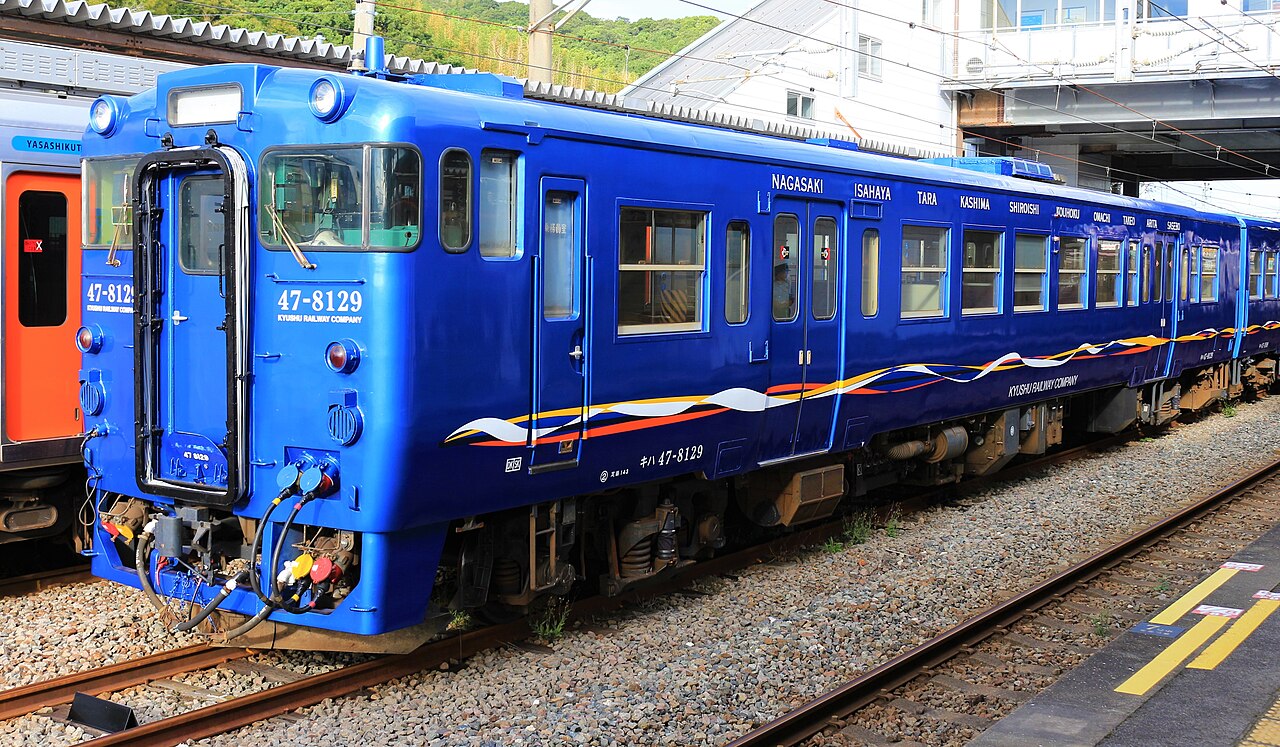
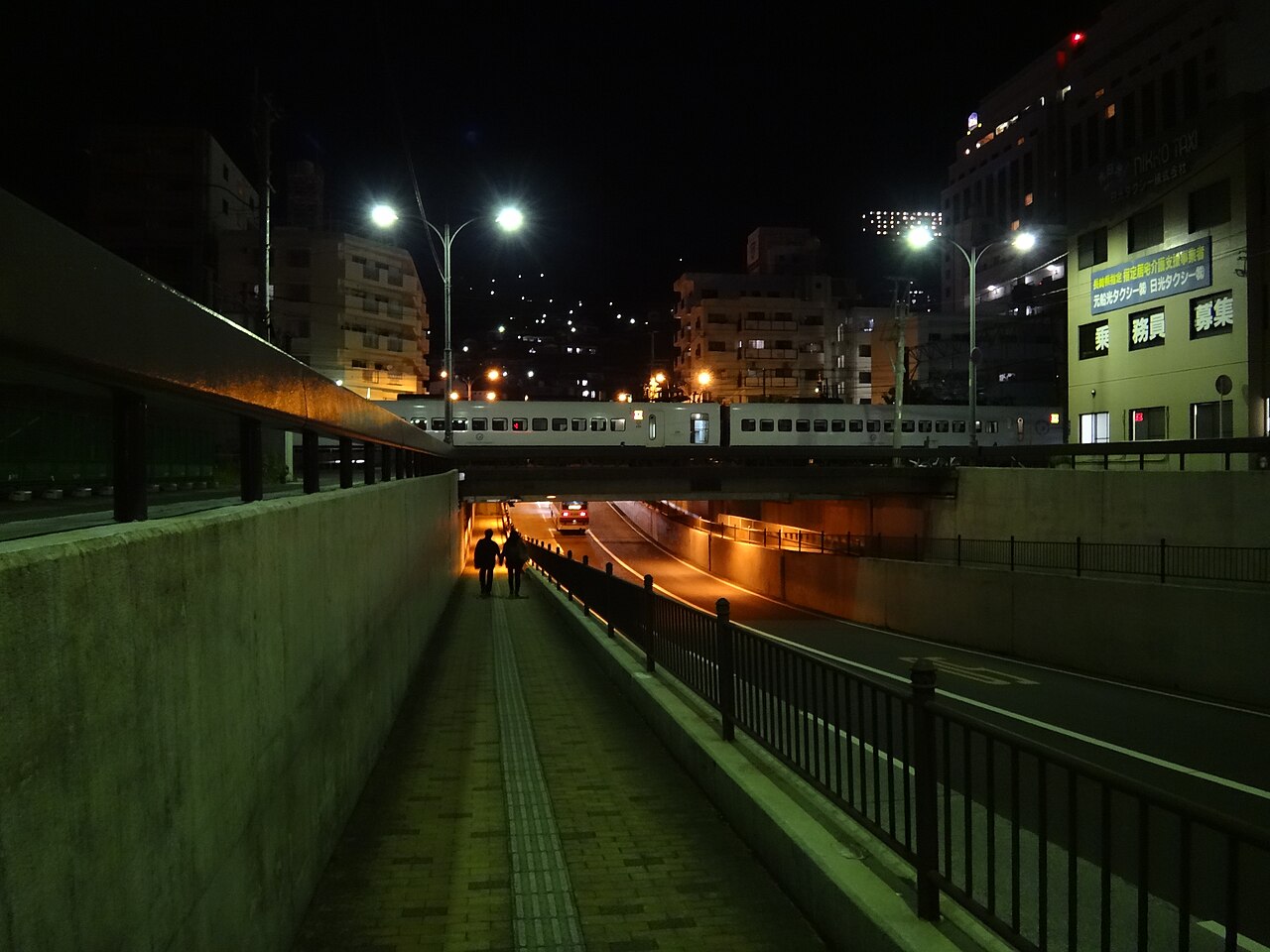
On 1 April 1987 the line passed, on the privatisation of Japanese National Railways, to JR Kyushu (as the Type-1 railway operator) and to JR Freight (as a Type-2 operator running freight). The Urakami–Nagasaki section was elevated, with the work completed on 28 March 2020 according to the Japanese source. The largest recent change accompanied the opening of the Nishi Kyushu Shinkansen (Takeo-Onsen–Nagasaki) on 23 September 2022. From that date the Kōhoku–Isahaya section moved to vertical separation: JR Kyushu continues to run trains there as a Type-2 operator while the infrastructure of the 60.8 km section is maintained by the Saga-Nagasaki Railway Management Centre as a Type-3 operator; JR Freight's operation was withdrawn; Hizen-Yamaguchi Station was renamed Kōhoku; and the Hizen-Hama–Nagasaki section was de-electrified, with diesel trains replacing the electric services there.
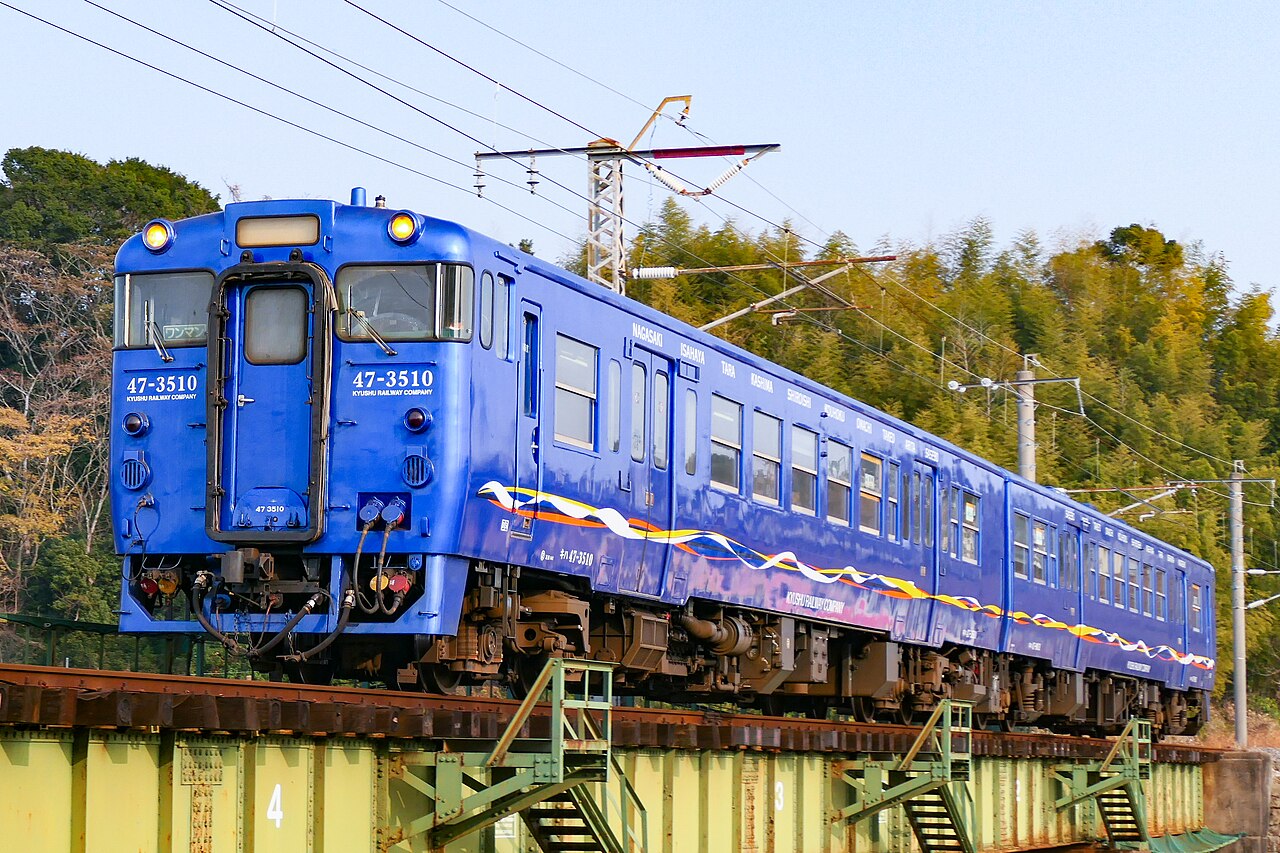
Today JR Kyushu runs a mix of limited-express, rapid and local services. Since the Shinkansen opening, the Relay Kamome limited express runs on the Nagasaki Main Line as far as Kōhoku before diverting to Takeo-Onsen for the connection to the Nishi Kyushu Shinkansen; the Midori and Huis Ten Bosch limited expresses run east of Kōhoku; and a new Kasasagi limited express was introduced to replace lost express services. The Seaside Liner rapid service and Wanman driver-only local trains also operate on the line. Overnight sleeper trains were withdrawn in stages: the Sakura (Tokyo–Nagasaki) was discontinued in the 1 March 2005 timetable revision and the Akatsuki (Kyoto–Nagasaki) in the 15 March 2008 revision (the English source dates both to 2008; the Japanese source gives the more precise 2005/2008 split). The Japanese source characterises the line as a "limited-express highway": before the 2022 Shinkansen opening, it ranked among the top four nationally in ridership of JR conventional-line limited expresses, and reports a whole-line average of 14,861 passengers per day with passenger revenue of ¥12,330 million in fiscal year 2016.
Timeline
- 1891The Kyushu Railway Co. opens the Tosu–Saga section (the line's first segment).
- 1897The Tosu–Haiki and Nagayo–Nagasaki (present-day Urakami) sections open; an Ōmura Bay ferry temporarily bridges the gap.
- 1898Through service is established over the Tosu–Haiki–Nagasaki route (EN: extension to Nagasaki via Haiki).
- 1907The Railway Nationalization Act nationalises Japan's major railways; the Kyushu Railway is taken over by the state.
- 1930The 1.1 km Nagasaki–Nagasaki-kō extension opens (later a freight line; formally closed 14 November 1982).
- 1934The Hizen-Yamaguchi–Isahaya cut-off (Ariake Line) opens and is incorporated; the old route is split into the Sasebo Line (Hizen-Yamaguchi–Haiki) and the Ōmura Line (Haiki–Isahaya).
- 1966The Saga–Nabeshima section is the first to be double-tracked.
- 1969By this year the Tosu–Hizen-Yamaguchi and Isahaya–Kikitsu sections have been double-tracked.
- 1972The 6,173 m Shin-Nagasaki Tunnel and the Kikitsu–Urakami deviation (the 'new line' via Ichinuno) open; express services move to the new line.
- 1973October: electrification construction begins (aimed at 1975 completion).
- 1976The entire Tosu–Nagasaki line is electrified at 20 kV AC 60 Hz (one year later than planned).
- 19871 April: on JNR privatisation, the line transfers to JR Kyushu (Type-1) and JR Freight (Type-2).
- 199010 March: the Urakami–Nagasaki section is double-tracked.
- 19991 July: freight services beyond Nabeshima (Nabeshima–Nagasaki) cease.
- 20051 March: the overnight sleeper train Sakura (Tokyo–Nagasaki) is discontinued in the timetable revision.
- 200815 March: the overnight sleeper train Akatsuki (Kyoto–Nagasaki) is discontinued, ending through limited-express service to Honshu.
- 202028 March: the Urakami–Nagasaki section is elevated (grade separation completed).
- 20211 April: the Saga-Nagasaki Railway Management Centre is established to manage the Hizen-Yamaguchi (Kōhoku)–Isahaya infrastructure.
- 202223 September: with the Nishi Kyushu Shinkansen opening, the Kōhoku–Isahaya (60.8 km) section moves to vertical separation (JR Kyushu Type-2; Centre Type-3); JR Freight withdraws; Hizen-Yamaguchi is renamed Kōhoku; Hizen-Hama–Nagasaki is de-electrified.
Sources
Facts last verified 3 June 2026.
Gallery 4 photos
Every photo for this page — tap any image to view it full-size. All from Wikimedia Commons (credit under each).