History
The line was assembled over half a century from several independently built predecessors. The earliest component was the Miyazaki Prefectural Railway's Obi Line, opened on 18 August 1913 between Obi and Aburatsu as a 762 mm-gauge light railway; in the same year the Miyazaki Light Railway opened from Akae (today's Minami-Miyazaki) to Uchiumi on the coast. The Obi Line was nationalised on 1 July 1935 as the Aburatsu Line, after which the corridor was rebuilt to the national 1,067 mm gauge and absorbed into the new Shibushi Line, a process that in part amounted to a regauging of the original narrow-gauge alignment. The Shibushi Line itself was extended in stages from 1935 onward — Shibushi to Yowara (1935), on to Odotsu (1936), to Aburatsu (1937), and finally to Kitago in 1941.
The Nichinan Line proper was created on 8 May 1963, when a new passenger-only section opened from Minami-Miyazaki to Kitago, reusing the trackbed of the Miyazaki Kotsu railway between Minami-Miyazaki and Uchiumi that had been abolished in 1962. With this link the former Shibushi Line section from Shibushi to Kitago was incorporated, so that the whole Minami-Miyazaki–Shibushi route became the Nichinan Line while the remnant Shibushi Line was reduced to the Nishi-Miyakonojo–Shibushi segment. Freight working on the new Minami-Miyazaki–Kitago section began on 30 March 1964. Shibushi, the line's southern terminus, was once a junction where the Shibushi Line and the Osumi Line also met and where an engine depot stood; both of those connecting lines were abolished in 1987 as designated deficit-conversion lines, and in February 1990 Shibushi Station was relocated eastward and cut back to a single track, shortening the line by 0.1 km.
Steam traction ended on 20 January 1975 under the national dieselisation programme, and freight service over the whole line was discontinued on 15 November 1982. On 1 April 1987, with the break-up and privatisation of Japanese National Railways, the line passed to JR Kyushu as a Class 1 railway operator. One-man operation began on 1 March 1994. The line's only electrified section was energised on 18 July 1996, when the Miyazaki Airport Line opened and the Minami-Miyazaki–Tayoshi stretch was wired for through airport services.
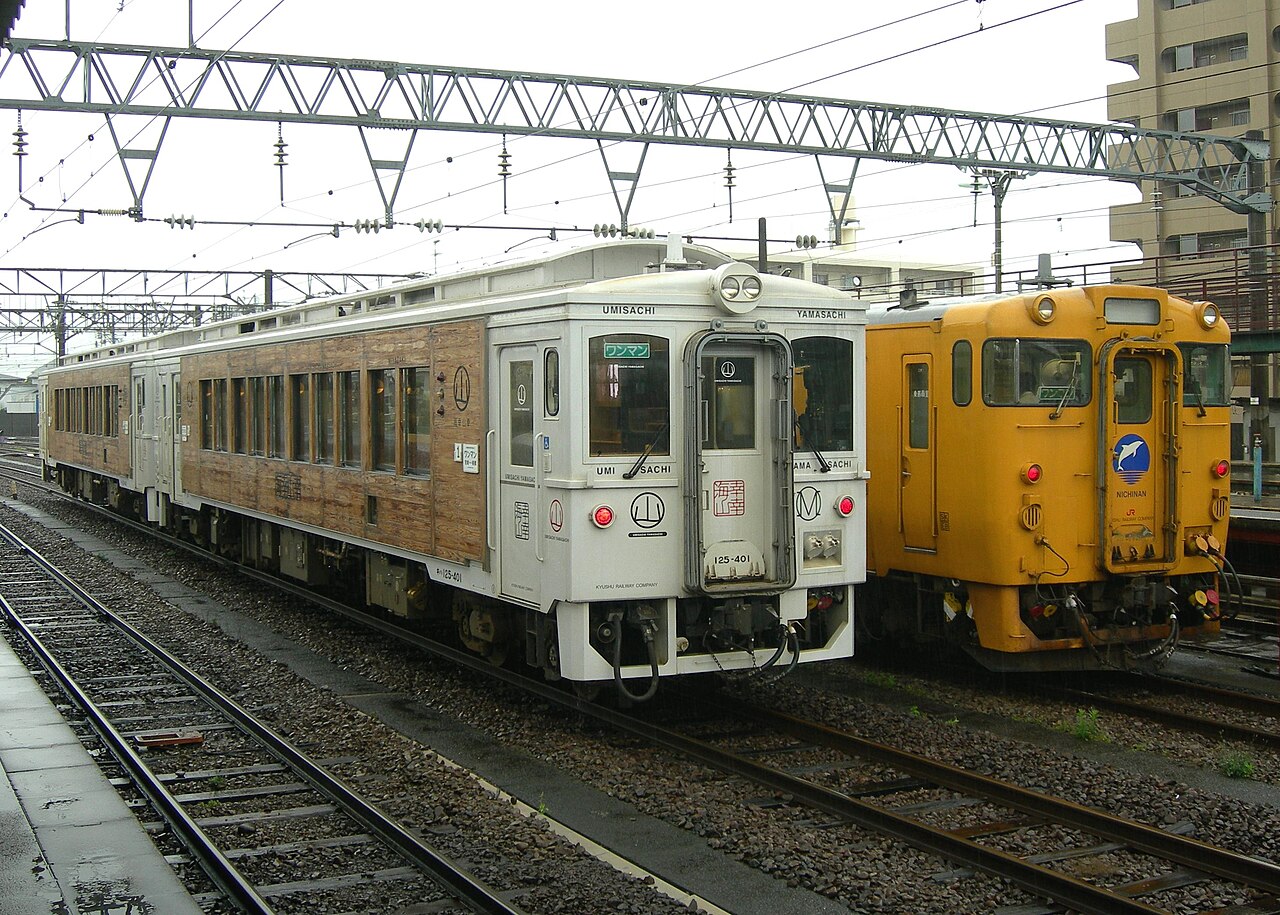
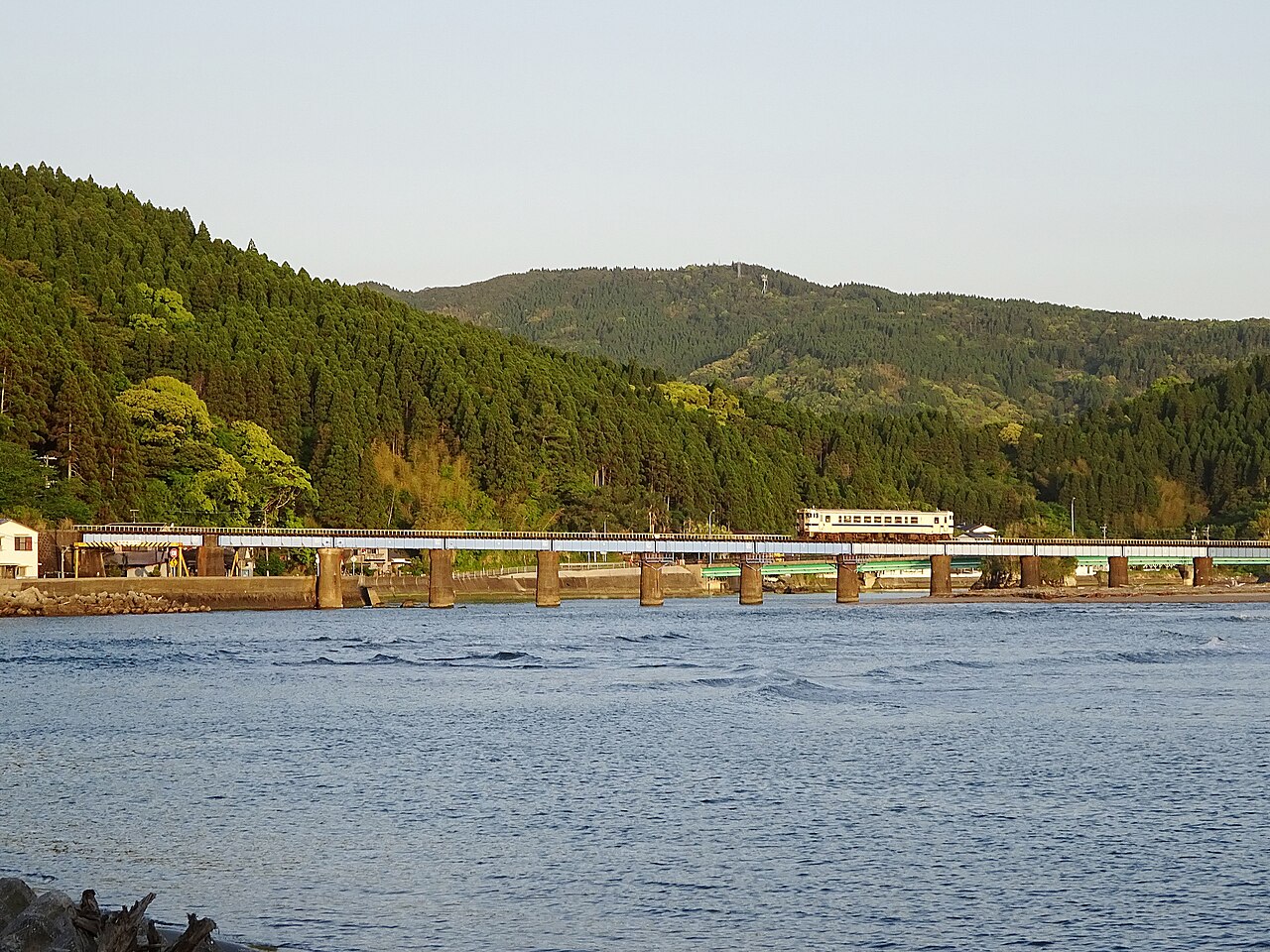
Today ordinary services are worked by KiHa 40 and KiHa 47 diesel railcars, while the sightseeing limited express "Umisachi-Yamasachi" — introduced on 10 October 2009 between Miyazaki and Nango using KiHa 125-400 cars rebuilt from former Takachiho Railway TR-400 stock — was the first limited express to run south of Tayoshi toward Aburatsu and Nango. A single daily "Nichinan Marine" rapid service, descended from the former Osumi Line through-rapid "Sata," also runs on the line. The Nichinan Line is one of JR Kyushu's most lightly used routes: in fiscal 2008 its transport density was 851 passengers per day, the third lowest of all JR Kyushu lines (after the Kitto Line and the Hisatsu Line). It was selected in 1968 as one of the "83 deficit lines" but escaped closure, and although later earmarked for third-round deficit-line conversion it was excluded in 1987 because substitute road transport was not yet in place. The southern part of the line has proved highly vulnerable to weather: the article notes that since 2020 it had been damaged by heavy rain for four consecutive years, with extended closures of the Nango–Shibushi and Aoshima–Shibushi sections following the July 2020 rains, Typhoon No. 14 in September 2021, Typhoon No. 14 in September 2022 (the line not fully reopening until 15 March 2023), and a linear-rainband downpour in October 2024.
Timeline
- 191318 August: the Miyazaki Prefectural Railway's Obi Line opens between Obi and Aburatsu as a 762 mm-gauge light railway; the same year the Miyazaki Light Railway opens from Akae (later Minami-Miyazaki) to Uchiumi.
- 19351 July: the Obi Line is nationalised as the Aburatsu Line, then rebuilt to 1,067 mm gauge and folded into the new Shibushi Line. 15 April: the Shibushi Line opens Shibushi–Yowara.
- 194128 October: the Shibushi Line is extended to Kitago.
- 19638 May: the Nichinan Line is created — Minami-Miyazaki–Kitago opens (passenger only, reusing the 1962-abolished Miyazaki Kotsu trackbed) and the Shibushi–Kitago section is incorporated, making Minami-Miyazaki–Shibushi the Nichinan Line.
- 196430 March: freight service begins on the Minami-Miyazaki–Kitago section.
- 1968The line is selected as one of the '83 deficit lines' but is not abolished.
- 197520 January: steam locomotive operation ends under the national dieselisation programme. (EN Wikipedia states 1973; the cited JA edition gives 1975-01-20.)
- 198215 November: freight service is discontinued over the entire line.
- 19871 April: with JNR's privatisation the line passes to JR Kyushu (Class 1 railway operator). The connecting Osumi Line and Shibushi Line, which met at Shibushi, are abolished as designated deficit-conversion lines.
- 1990February: Shibushi Station is relocated eastward and reduced to a single track, shortening the line by 0.1 km.
- 19941 March: one-man operation begins.
- 199618 July: the Miyazaki Airport Line opens and the Minami-Miyazaki–Tayoshi section is electrified (AC 20,000 V, 60 Hz).
- 200910 October: the sightseeing limited express 'Umisachi-Yamasachi' begins running Miyazaki–Nango, using KiHa 125-400 cars rebuilt from former Takachiho Railway TR-400 stock — the first limited express south of Tayoshi.
- 202315 March: the line fully reopens after the September 2022 Typhoon No. 14 closure of the Aoshima–Shibushi section.
Sources
Facts last verified 3 June 2026.
Gallery 2 photos
Every photo for this page — tap any image to view it full-size. All from Wikimedia Commons (credit under each).