History
The line was assembled over nearly three decades from several separately built railways. At the northern end, the Kyushu Railway opened the first section from Kokura to Gyōji on 1 April 1895, and the Hōshū Railway opened the Yukuhashi–Nagasu (later Yanagigaura) section on 25 September 1897. The Kyushu Railway absorbed the Hōshū Railway on 3 September 1901 and was itself nationalised on 1 July 1907 under the Railway Nationalization Act. In 1909 the route became the Hōshū Main Line, and it was extended steadily southward: reaching Usa in 1909, Beppu and Ōita in 1911, Usuki in 1915 and Shigeoka in 1922. From the south, a separate set of lines — the Miyazaki Line and the Miyazaki Prefectural Railway (the latter acquired and incorporated) — were built up the coast from the Yoshimatsu direction. On 15 December 1923 the Hōshū Main Line and the Miyazaki Main Line were joined and the through route from Kokura to Yoshimatsu became the Nippō Main Line. The Kokubu (now Hayato)–Kagoshima section had opened separately as the Kagoshima Line in 1901; when the Miyakonojō–Hayato section opened on 6 December 1932, the present Kokura–Miyakonojō–Hayato–Kagoshima alignment was completed and designated the Nippō Main Line, while the Yoshimatsu–Miyakonojō portion became the Kitto Line.
Development of the line proceeded in three long campaigns. Double-tracking began modestly: the Obase–Yukuhashi section was the first to be duplicated, in 1956, and the Kokura–Jōno section was double-tracked by 1958, with further duplication continuing south to Tateishi by 1983; substantial stretches of the line nonetheless remain single track to this day. Electrification likewise advanced from north to south — the Kokura–Shindenbaru section was energised on 1 October 1966, electrification reached Kōzaki in 1967 and Minami-Miyazaki on 13 March 1974, and on 25 September 1979 the Minami-Miyazaki–Kagoshima section was electrified, completing electrification of the entire line. A small realignment around Shindenbaru, made when that section was double-tracked and electrified, was routed to the west to avoid interfering with aircraft at the JASDF Tsuiki air base. A minor distance correction in 1980, when the Bungo-Toyooka–Kamegawa section was duplicated, shortened the Kokura–Kagoshima figure by 0.1 km from 462.7 km to 462.6 km.
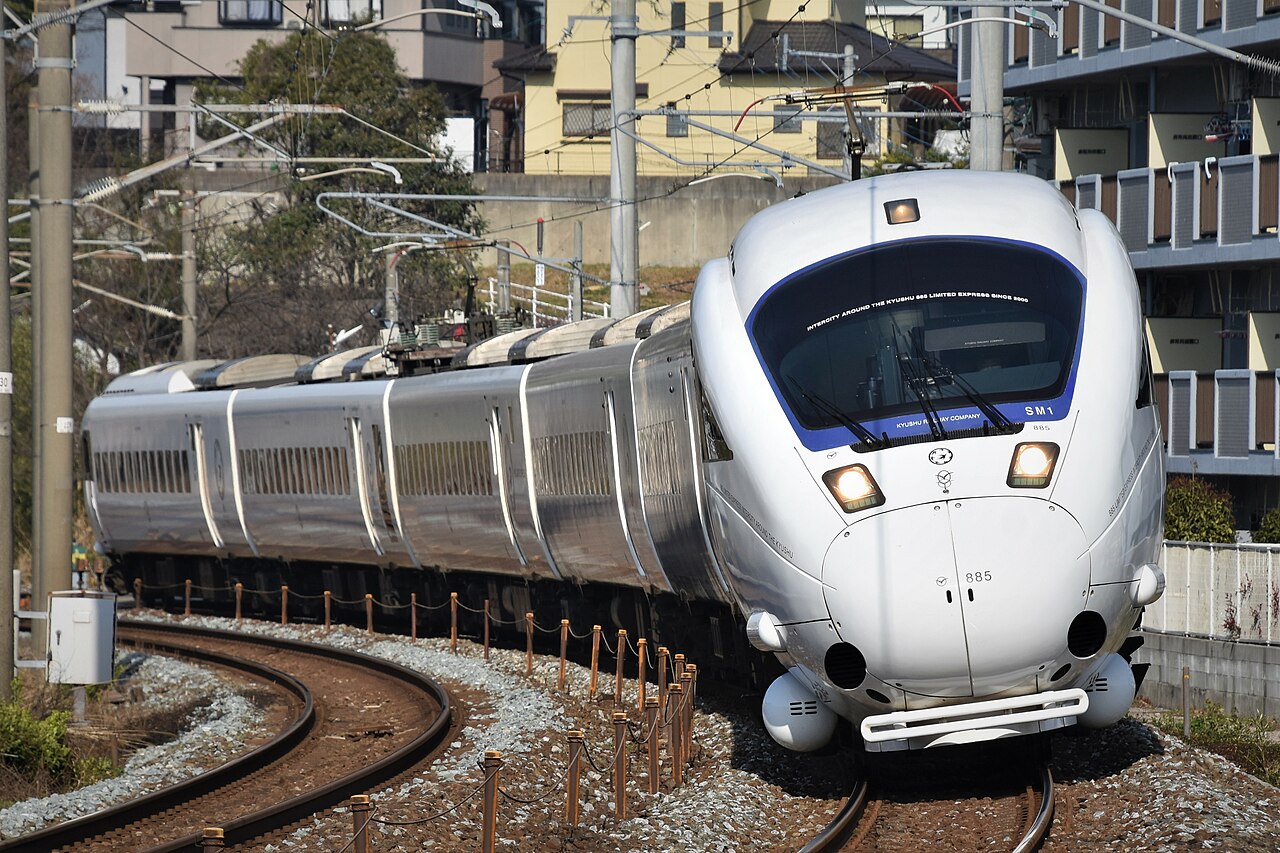
The Nippō Main Line passed to JR Kyushu on 1 April 1987 with the privatization of Japanese National Railways; Japan Freight Railway (JR Freight) took over freight operations over part of the route. Since then JR Kyushu has pursued speed-up works in stages — the Nobeoka–Miyazaki section was upgraded so that its maximum speed rose from 85 km/h to 110 km/h on 15 July 1992, and the Ōita–Saiki speed-up was completed on 13 March 2004, raising that section from 85 km/h to 110 km/h. Today the line carries a network of limited express services rather than long through trains: "Sonic" between the Hakata/Kokura area and Ōita and Saiki, "Nichirin" (and the Hakata-originating "Nichirin Seagaia") covering the Ōita–Miyazaki stretch, "Hyūga" between Nobeoka and Miyazaki, and "Kirishima" between Miyazaki and Kagoshima. Through limited expresses to Honshu ended with the discontinuation of the Tokyo–Ōita sleeper express "Fuji" on 14 March 2009. Station numbering with the line symbol "JF" and a blue line colour was introduced on the Kokura–Yukuhashi section on 28 September 2018. In fiscal year 2023 the line's average transport density across the whole route was 7,941 passengers per day.
The line has suffered several serious incidents. On 24 November 1970 a dump truck fell from a parallel prefectural road onto the track between Ryūgamizu and Kagoshima and collided with the express "Kinkō No. 1"; two passengers were killed and 40 injured. During the heavy rain of August 1993, a large-scale debris flow buried Ryūgamizu Station on 6 August, destroying two train sets stopped there and killing three passengers, and severing the line south of Nishi-Miyakonojō for weeks. Typhoon No. 18 in September 2017 caused major damage including a large landslide near Tokuura signal box and flooding at Tsukumi Station, with the Usuki–Saiki section reopening only on 18 December 2017 after roughly three months.
Timeline
- 18951 April: the Kyushu Railway opens the first section, Kokura–Gyōji.
- 189725 September: the Hōshū Railway opens the Yukuhashi–Nagasu (later Yanagigaura) section.
- 19013 September: the Kyushu Railway absorbs the Hōshū Railway. The Kokubu (now Hayato)–Kagoshima section opens separately as the Kagoshima Line (10 June).
- 19071 July: the Kyushu Railway is nationalised under the Railway Nationalization Act.
- 1909The Kokura–Yanagigaura route becomes the Hōshū Main Line and is extended south to Usa.
- 1911The line reaches Beppu and Ōita.
- 192315 December: the Hōshū Main Line and Miyazaki Main Line are merged; Kokura–Yoshimatsu becomes the Nippō Main Line.
- 19326 December: the Miyakonojō–Hayato section opens, completing the Kokura–Kagoshima alignment as the Nippō Main Line; the Yoshimatsu–Miyakonojō portion becomes the Kitto Line.
- 195620 February: the Obase–Yukuhashi section is the first to be double-tracked.
- 19661 October: the Kokura–Shindenbaru section is electrified, beginning electrification of the line.
- 197024 November: a dump truck falls onto the track between Ryūgamizu and Kagoshima and collides with the express 'Kinkō No. 1'; 2 killed, 40 injured.
- 197413 March: electrification reaches Minami-Miyazaki.
- 197925 September: the Minami-Miyazaki–Kagoshima section is electrified, completing electrification of the entire line.
- 1980Distance correction: Kokura–Kagoshima shortened by 0.1 km, 462.7→462.6 km, when Bungo-Toyooka–Kamegawa was double-tracked.
- 19871 April: JNR is privatised; the Nippō Main Line transfers to JR Kyushu, with JR Freight taking over freight operations over part of the route.
- 199215 July: the Nobeoka–Miyazaki section is upgraded, raising its maximum speed from 85 km/h to 110 km/h.
- 19936 August: an August-rainfall debris flow buries Ryūgamizu Station, destroying two train sets and killing 3 passengers; the line south of Nishi-Miyakonojō is severed for weeks.
- 200413 March: the Ōita–Saiki speed-up is completed, raising that section from 85 km/h to 110 km/h.
- 200617 September: the limited express 'Nichirin No. 9' derails near Minami-Nobeoka Station, causing some injuries (EN article; citation-needed tag).
- 200914 March: the Tokyo–Ōita sleeper express 'Fuji' is discontinued, ending through limited expresses to Honshu.
- 2017September: Typhoon No. 18 damages the line (landslide near Tokuura signal box, flooding at Tsukumi); Usuki–Saiki reopens 18 December after ~3 months.
- 201828 September: station numbering (line symbol JF, blue line colour) is introduced on the Kokura–Yukuhashi section.
Sources
Facts last verified 3 June 2026.
Gallery 4 photos
Every photo for this page — tap any image to view it full-size. All from Wikimedia Commons (credit under each).