History
The loop was not built as a single project but assembled from four older segments plus one new connecting section. The eastern half, from Ōsaka Station to Tennōji via Kyōbashi, was opened by the private Osaka Railway in two stages in 1895: Tennōji–Tamatsukuri (about 3.8 km) on 28 May, and Tamatsukuri–Umeda (about 7.0 km) on 17 October, to link the company to the government railway network. Osaka Railway merged into the Kansai Railway in 1900, which was nationalised in 1907 under the Railway Nationalization Act; in 1909 this eastern section was named the Jōtō Line. It was converted to metric in 1930 (becoming 10.7 km) and electrified in 1933. The north-western quarter, Osaka to Nishi-Kujō, was built by the Nishinari Railway, which opened its Osaka–Ajikawaguchi line in 1898 to give the port rail access; that railway was leased to the government in 1904, nationalised in 1906, named the Nishinari Line in 1909, and electrified in 1941. The south-western portion, Tennōji to the Sakaigawa signal box, was constructed by the government railway in 1928 as a freight line serving the port area, connecting to a freight branch of the Kansai Main Line.
To complete the circle, Japanese National Railways (JNR) built a new section of track between Nishi-Kujō and the Sakaigawa signal box. This section opened in 1961, and the combined route — the former Jōtō Line, the Osaka–Nishi-Kujō part of the Nishinari Line, and the new Nishi-Kujō–Taishō–Tennōji section — was named the Osaka Loop Line; the remaining Nishi-Kujō–Sakurajima stretch of the old Nishinari Line was split off as the Sakurajima Line. The new connecting section, Nishi-Kujō–Taishō–Tennōji (7.4 km), opened on 25 April 1961, and Bentenchō and Taishō stations opened with it. At first the tracks were not joined at Nishi-Kujō, so services ran in the shape of a mirrored figure (Sakurajima–Nishi-Kujō–Osaka–Kyōbashi–Tennōji–Nishi-Kujō); continuous loop operation began in 1964 once elevated double track around Nishi-Kujō was completed, at which point Shin-Imamiya Station also opened. In 1968 the Tennōji–Shin-Imamiya section was quadrupled to separate Loop Line operations from the Kansai Main Line.
Today JR West runs a layered service pattern. Local trains operate all day, some making the complete circuit and some serving only the busier eastern half between Osaka and Tennōji via Kyōbashi. The line also acts as a bypass linking the Tōkaidō Main Line in the north with the Hanwa Line in the south: "Yamatoji Rapid" and "Regional Rapid" trains to the Kansai Main Line (Yamatoji Line) began running through in 1973, and rapid services toward the Hanwa Line followed a pattern introduced in 1989 that expanded significantly in 1994 with the opening of Kansai Airport, when the limited express Haruka and the Kansai Airport Rapid began using the loop. The charged limited expresses Haruka (for Kansai International Airport) and Kuroshio (southbound toward Wakayama) stop on the loop generally only at Tennōji and Nishi-Kujō. Traffic is heavier on the eastern half than on the western half via Nishi-Kujō, and freight trains, operated by JR Freight, now run only between Fukushima and Nishikujō.
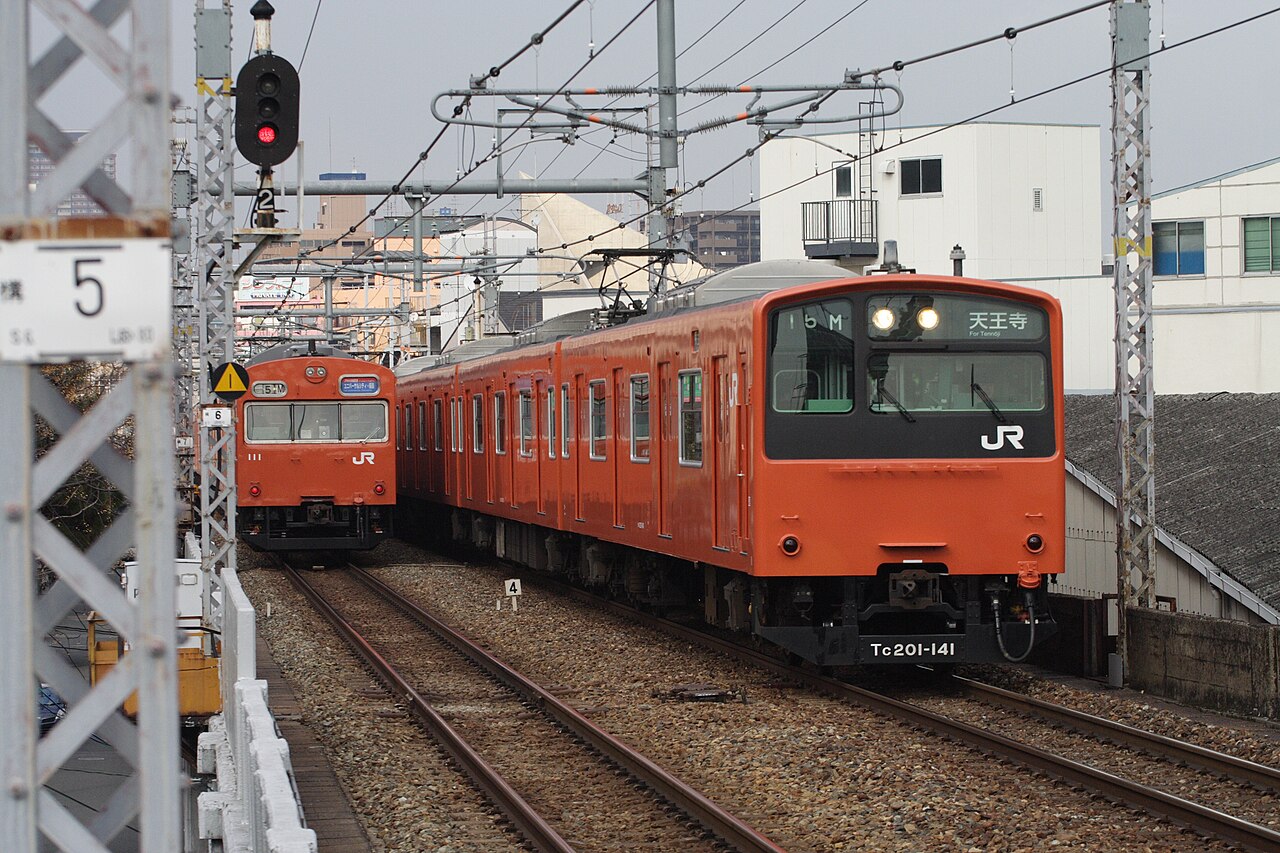
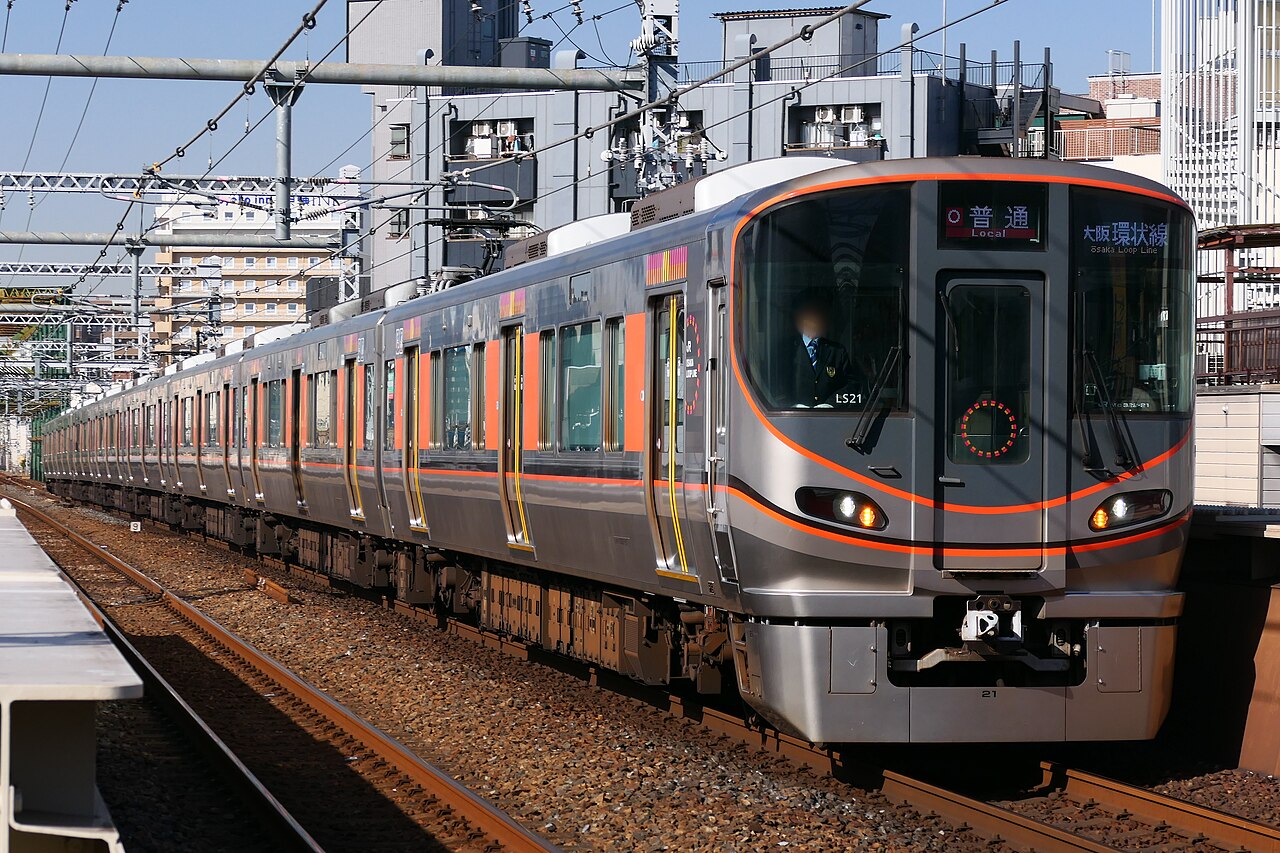
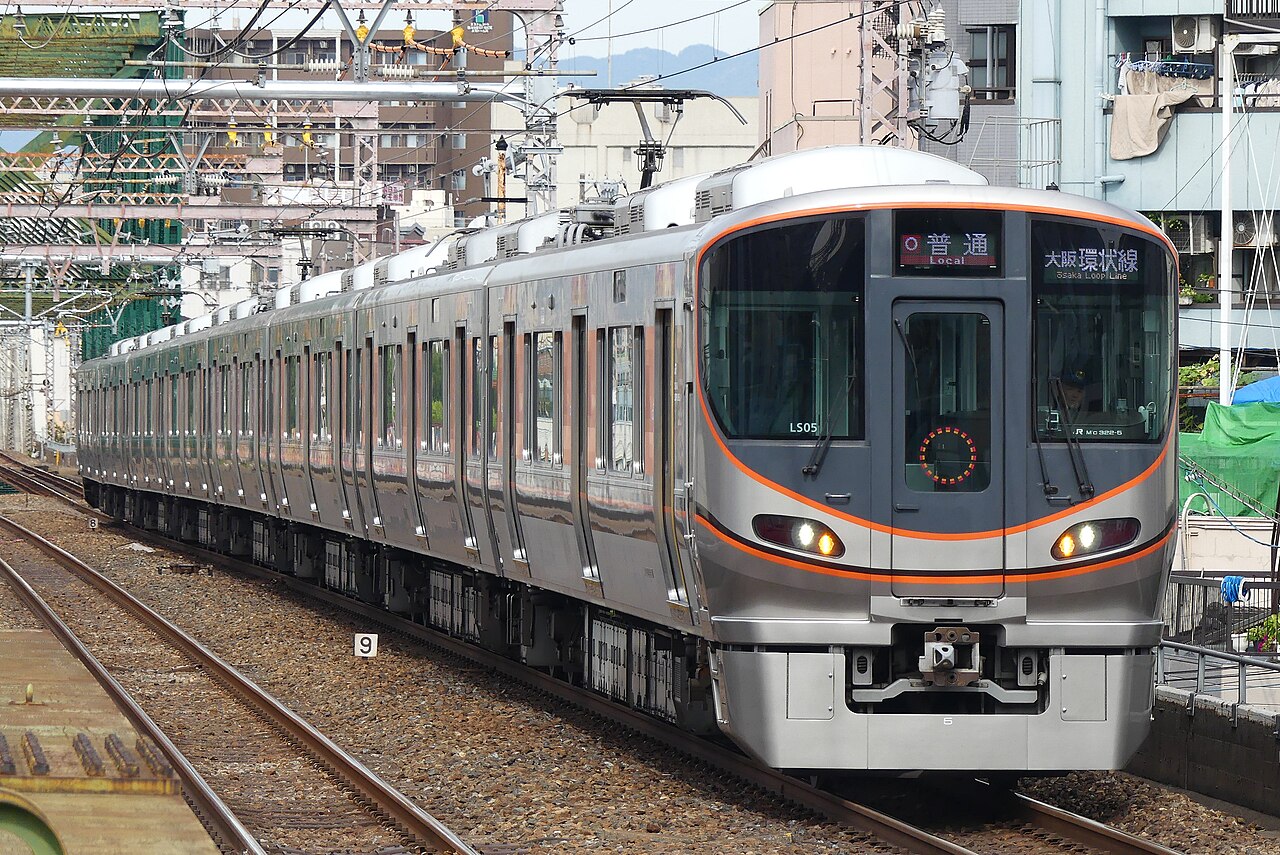
The Osaka Loop Line functions as the central line of JR West's urban network, and in terms of ridership it ranks second among JR West's conventional lines, after the Tōkaidō Main Line. Reported usage was 984,395 daily passengers in fiscal year 2015, and the average number of passengers passing along the line in fiscal year 2019 was 292,574 per day. Its rolling stock has turned over across the decades, from the 103 series of 1969 through the 201 series to the 323 series — the first train type built specifically for the Osaka Loop Line — which entered service on 24 December 2016 as the leading element of a fleet of 21 eight-car sets intended to replace the older 103 and 201 series. The 103 series ended Loop Line service in 2017 and the 201 series in 2019, and JR West began test running of automated-operation trains on the line in February 2020.
Timeline
- 188914 May: Osaka Railway opens its main line Kashiwara–Tennōji–Minatomachi (present JR Namba), a short part of which (Tennōji–Imamiya) lies on the present loop.
- 1895Osaka Railway opens the eastern half (future Jōtō Line) in two stages: Tennōji–Tamatsukuri (~3.8 km) on 28 May and Tamatsukuri–Umeda (~7.0 km) on 17 October.
- 18985 April: the Nishinari Railway opens the Osaka–Ajikawaguchi line (future Nishinari Line), giving the port rail access; Fukushima and Noda stations open on the present loop.
- 19006 June: Osaka Railway merges into the Kansai Railway, unifying the Tennōji–Ōsaka line.
- 19061 December: the Nishinari Railway is nationalised under the Railway Nationalization Act.
- 19071 October: the Kansai Railway is nationalised under the Railway Nationalization Act.
- 190912 October: under the national line-naming, the eastern section is named the Jōtō Line and the Osaka–Nishi-Kujō section the Nishinari Line.
- 19281 December: the government railway opens the Kansai Main Line freight branch (Ōsaka Rinkō line) to the port area, forming the south-western portion of the future loop.
- 193316 February: the Jōtō Line (Tennōji–Ōsaka) is electrified and electric-train operation begins.
- 19411 May: the Nishinari Line (Ōsaka–Nishi-Kujō–Sakurajima) is electrified.
- 196125 April: the new Nishi-Kujō–Taishō–Tennōji section (7.4 km) opens and the combined route is named the Osaka Loop Line; the Nishi-Kujō–Sakurajima stretch is split off as the Sakurajima Line. Bentenchō and Taishō stations open.
- 196422 March: with the Nishi-Kujō elevation and full double-tracking complete, continuous loop operation begins and Shin-Imamiya Station opens.
- 196825 March: the Tennōji–Shin-Imamiya section is quadrupled, separating Loop Line operation from the Kansai Main Line.
- 196910 December: 103 series EMUs enter service on the line.
- 1973Through-running of Kansai Main Line (Yamatoji Line) rapid trains onto the loop begins.
- 1989The Hanwa Line rapid through-service pattern via the loop commences (Tennōji bypass track to the Kansai Main Line platforms completed).
- 19944 September: Kansai International Airport opens; the limited express Haruka and the Kansai Airport Rapid begin operating via the Osaka Loop Line.
- 201624 December: the 323 series — the first train type built specifically for the Osaka Loop Line — enters service, leading a fleet of 21 eight-car sets to replace the 103 and 201 series.
- 20173 October: the 103 series ends regular service on the line.
- 201817 March: station numbering (line symbol O) is introduced on the line.
- 20197 June: the 201 series ends service on the line; 323 series deployment is completed on 8 June.
- 2020February: JR West begins test running of automated-operation trains on the line. From 14 March all local and rapid services become eight-car formations.
Sources
Facts last verified 3 June 2026.
Gallery 3 photos
Every photo for this page — tap any image to view it full-size. All from Wikimedia Commons (credit under each).