History
The line's origins lie with a private company, the Boso Railway (Bōsō Tetsudō), conceived as a railway encircling the Pacific side of the Bōsō Peninsula. It opened its first section, between Soga and Ōami, in January 1896, and extended to Chiba (connecting there with the Sōbu Railway) in February 1896. The line was pushed on to Ichinomiya — today's Kazusa-Ichinomiya — in 1897 and to Ōhara in 1899. In 1907 the Boso Railway was nationalised under the Railway Nationalization Act, becoming the government-operated Boso Line. Extensions then continued down the coast: to Katsuura in 1913, to Kazusa-Okitsu in 1927, and finally to Awa-Kamogawa in 1929, at which point the route was complete and was joined to the Hōjō Line (the forerunner of today's Uchibō Line). The naming of the line shifted with this growth: in 1933 the Chiba–Ōami–Awa-Kamogawa portion was separated out as the Boso East Line (Bōsō-tōsen), and that name lasted until 1972, when the line was renamed the Sotobō Line.
The railway was rebuilt and modernised in stages through the twentieth century. A new tunnel and an associated deviation were opened at Toke to improve the line's loading gauge, replacing an older, narrow and ageing bore. Track-doubling was carried out piecemeal over decades: the Chiba–Soga section was double-tracked between 1960 and 1963 — work bound up with the 1963 relocation of Chiba Station, which eliminated a reversing (switchback) movement and allowed trains to run through toward Ōhara without changing direction. Double track was extended toward Nagata in the early 1970s, and the line as far as Kazusa-Ichinomiya was progressively doubled between 1980 and 1986; further double-track sections followed, with the Onjuku–Katsuura stretch doubled in 1995 and the Torami–Chōjamachi stretch in 1996. Even so, the line remains only partially double-tracked: the section south of Kazusa-Ichinomiya is single track, while the busier section north of Kazusa-Ichinomiya is double track. Centralized Traffic Control (CTC) was commissioned over the Soga–Awa-Kamogawa section in 1972. Electrification came in two phases — the Chiba–Soga section was electrified in July 1968, and the remaining Soga–Awa-Kamogawa section was electrified in July 1972, on the same day the line was renamed the Sotobō Line and the 183-series limited express "Wakashio" began operating. Both phases used 1,500 V DC overhead. Freight operations were progressively withdrawn, with services ceasing across the line between 1982 and 1987.
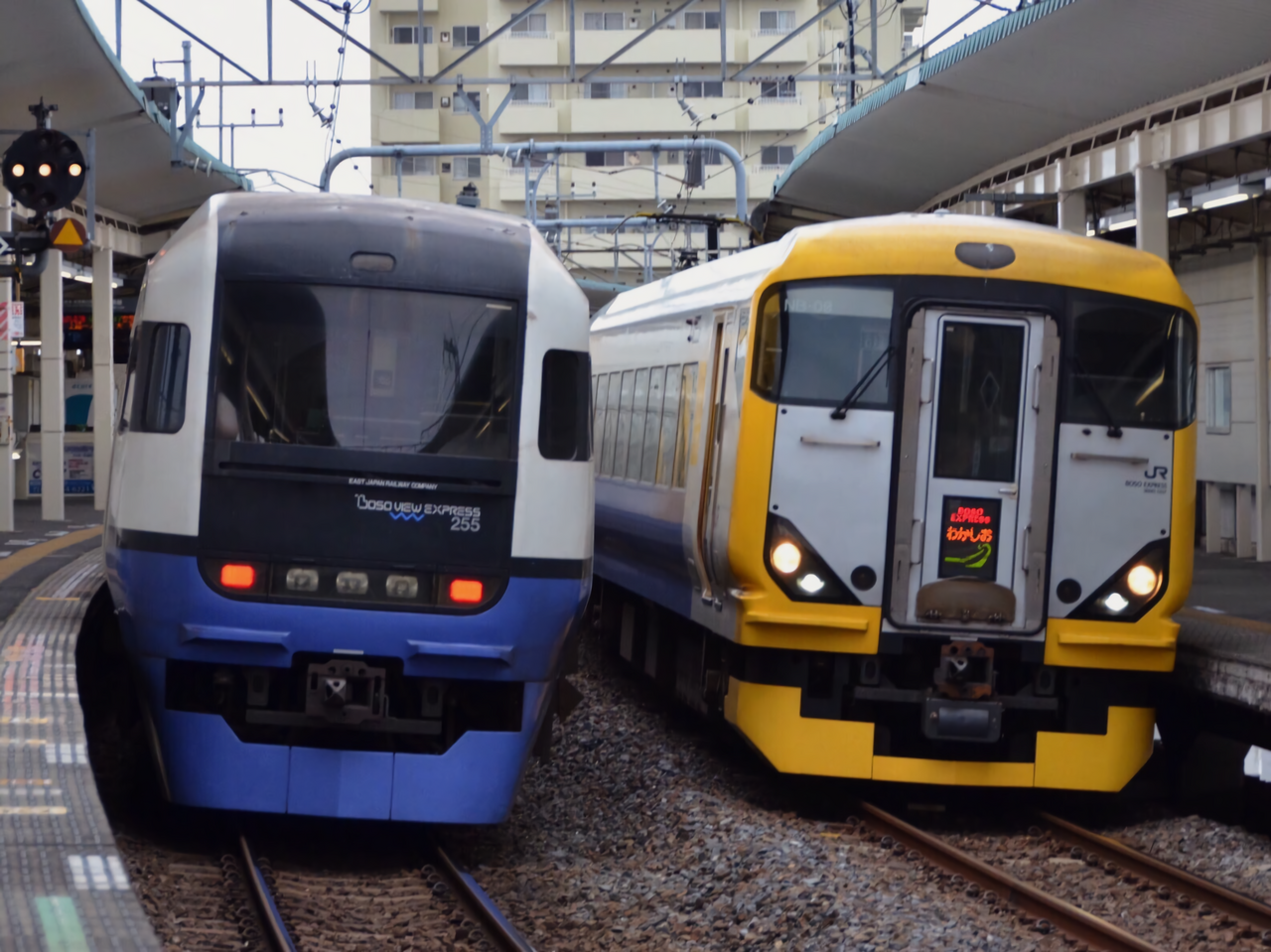
Today JR East operates local services together with Rapid and limited express services. The flagship limited express is the "Wakashio," which runs from Tokyo via the Keiyō Line and Soga to Awa-Kamogawa; a weekend "Shinjuku Wakashio" also operates. Rapid services run through from the Sōbu Line (Rapid) and Yokosuka Line and from the Keiyō Line. The northern, double-tracked Chiba–Kazusa-Ichinomiya section carries comparatively frequent service, including through trains from the Tōkyō direction and all-stations services from the Tōgane Line, whereas service thins out on the single-track section to the south. Commuter Rapid services that once ran through to and from the Keiyō Line were discontinued on 16 March 2024. Among the rail lines of the Bōsō area, the Sotobō Line is the busiest, ranking first in passenger-kilometres, average number of passengers carried, and passenger revenue (per the Japanese Wikipedia article, citing a published analysis of JR East).
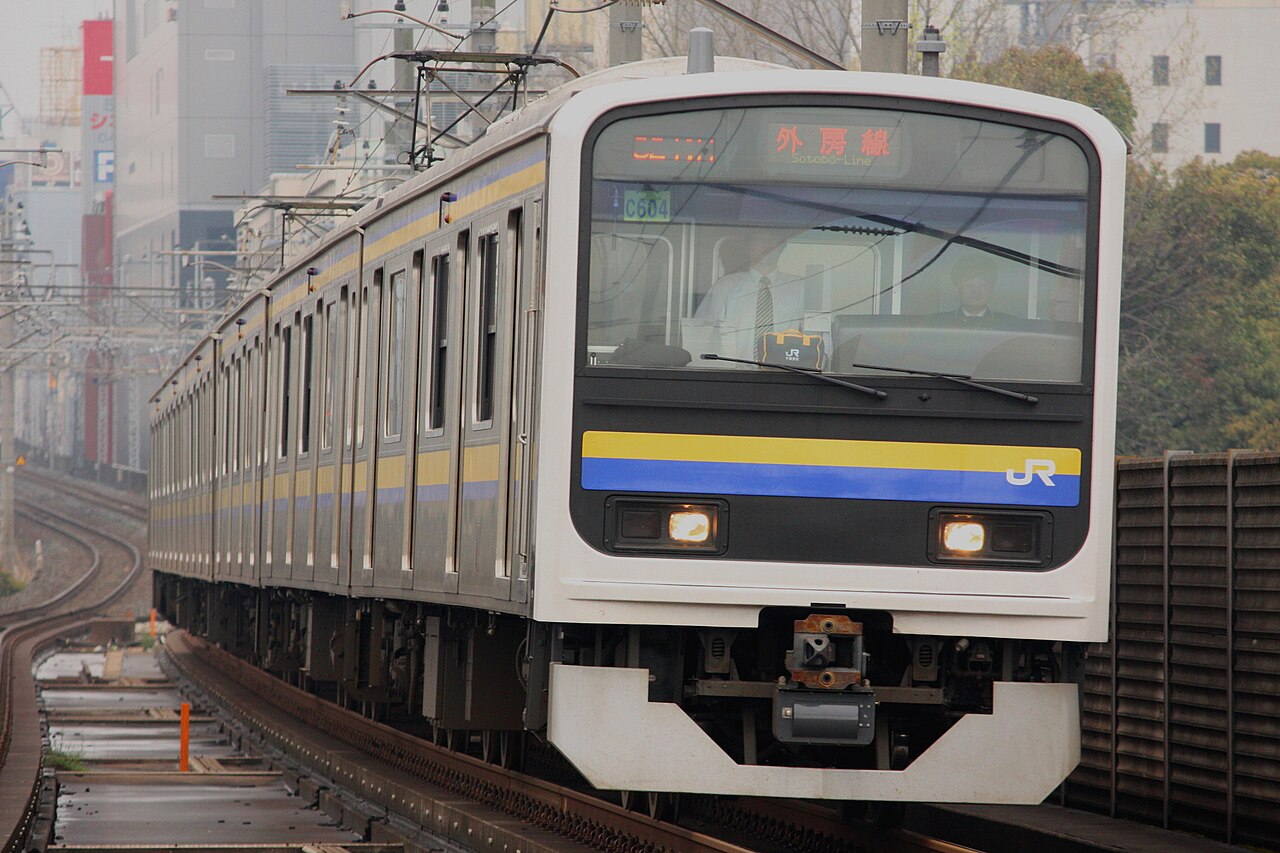
The line has seen one notable recent incident. On 8 May 2020, at 3:55 pm, the front carriage of a local 209-series service derailed between Awa-Kamogawa and Awa-Amatsu stations; around 20 passengers and crew were aboard, and one person was taken to hospital. The derailment was later attributed to a stone placed on the track by a ten-year-old child.
Timeline
- 1896January: the Boso Railway opens its first section, Soga–Ōami. In February the line is extended to Chiba, connecting with the Sōbu Railway.
- 1897The line is extended to Ichinomiya (present-day Kazusa-Ichinomiya).
- 1899The line is extended to Ōhara.
- 19071 September: the Boso Railway is nationalised under the Railway Nationalization Act and becomes the government Boso Line.
- 191320 June: the line is extended from Ōhara to Katsuura.
- 19271 April: the line is extended from Katsuura to Kazusa-Okitsu.
- 192915 April: the line is extended from Kazusa-Okitsu to Awa-Kamogawa, completing the route and joining the Hōjō Line (forerunner of the Uchibō Line).
- 19331 April: the Chiba–Ōami–Awa-Kamogawa section is separated out as the Boso East Line (Bōsō-tōsen).
- 1954A new tunnel and deviation are opened at Toke to improve the line's loading gauge (work begun 1952, completed 1954).
- 196328 April: Chiba Station is relocated, eliminating the line's switchback; the Chiba–Soga section is double-tracked (completed 1960–1963).
- 196813 July: the Chiba–Soga section is electrified (1,500 V DC).
- 197215 July: the line is renamed the Sotobō Line; the Soga–Awa-Kamogawa section is electrified; the 183-series limited express 'Wakashio' begins operating. CTC is commissioned over Soga–Awa-Kamogawa earlier the same year (1 July).
- 1986The line to Kazusa-Ichinomiya is fully double-tracked (progressive doubling 1980–1986).
- 19871 April: JNR is privatised; the line transfers to JR East. JR Freight becomes a Type II operator on the Chiba–Soga section.
- 199526 November: the Onjuku–Katsuura section is double-tracked. 1 December: the maximum speed on Soga–Katsuura is raised to 120 km/h.
- 199617 November: the Torami–Chōjamachi section is double-tracked.
- 200416 October: E257-500 series EMUs are introduced on the 'Wakashio' limited express.
- 20208 May, 3:55 pm: the front carriage of a local 209-series service derails between Awa-Kamogawa and Awa-Amatsu; around 20 aboard, one hospitalised. Later attributed to a stone placed on the track by a ten-year-old child.
- 202113 March: E131 series EMUs are introduced on Kazusa-Ichinomiya–Awa-Kamogawa with one-man operation and through service to the Uchibō Line.
- 202416 March: Commuter Rapid services through to/from the Keiyō Line are discontinued.
Sources
Facts last verified 3 June 2026.
Gallery 3 photos
Every photo for this page — tap any image to view it full-size. All from Wikimedia Commons (credit under each).