History
The line was built as two separate railways converging on the Hida mountains from opposite ends: the southern Takayama Line and the northern Hietsu Line. Around Mino-Ōta the route had first been planned to run directly north from Nagoya, a scheme backed by the Rikken Seiyūkai, but the Kenseikai pressured the House of Representatives' Railway Construction Committee into rerouting it through Gifu; the revised plan passed the House of Representatives on 9 February 1918 and the House of Peers on 1 March 1918. The Takayama Line's first section, Gifu to Kakamigahara, opened on 1 November 1920, and the line was extended in stages through Mino-Ōta, Hida-Kanayama, Gero and Hida-Hagiwara between 1921 and 1931, with the last southern section to Hida-Osaka opening on 25 August 1933.
From the north, the Hietsu Line began extending south from Toyama, the section to Etchū-Yatsuo opening on 1 September 1927; it then reached Sasazu (1929), Inotani (1930), Sugihara (1932) and Sakakami (12 November 1933). The two lines were joined on 25 October 1934; on the same date the Hietsu Line was merged into the Takayama Line and the combined route was renamed the Takayama Main Line.
The line was built to give the Chūkyō metropolitan area (greater Nagoya) a direct rail link toward the Hokuriku region. The English Wikipedia article notes that, while the Takayama route is shorter in distance than going via the Tōkaidō Shinkansen and the Hokuriku Main Line, it takes longer in travel time; today it functions primarily as an access route to the scenic Hida area, including the Gero hot spring (onsen), Takayama, Shirakawa-gō and the Kiso River. The Japanese Wikipedia article records that during the 1960s tourism boom under Japanese National Railways (JNR), passenger numbers surged and freight traffic grew with lineside development; in the late 1960s JNR ended steam haulage, added passing facilities, and introduced Centralised Traffic Control (CTC) in a transport-modernisation programme concentrated in fiscal years 1967–1969. The Japanese Wikipedia article states that this was JNR's first introduction of CTC to a conventional line longer than 200 km.
After the 1987 privatisation of JNR, the Gifu–Takayama section was upgraded for faster limited-express running, including the replacement of passing-loop turnouts with types that allow 110 km/h running through the diverging route. In the 1990s the Hida limited express was re-equipped with KiHa 85 series cars and sped up, according to the Japanese Wikipedia article. The line introduced station numbering and line colouring in March 2018, when it was assigned the colour dark red and the line code CG.
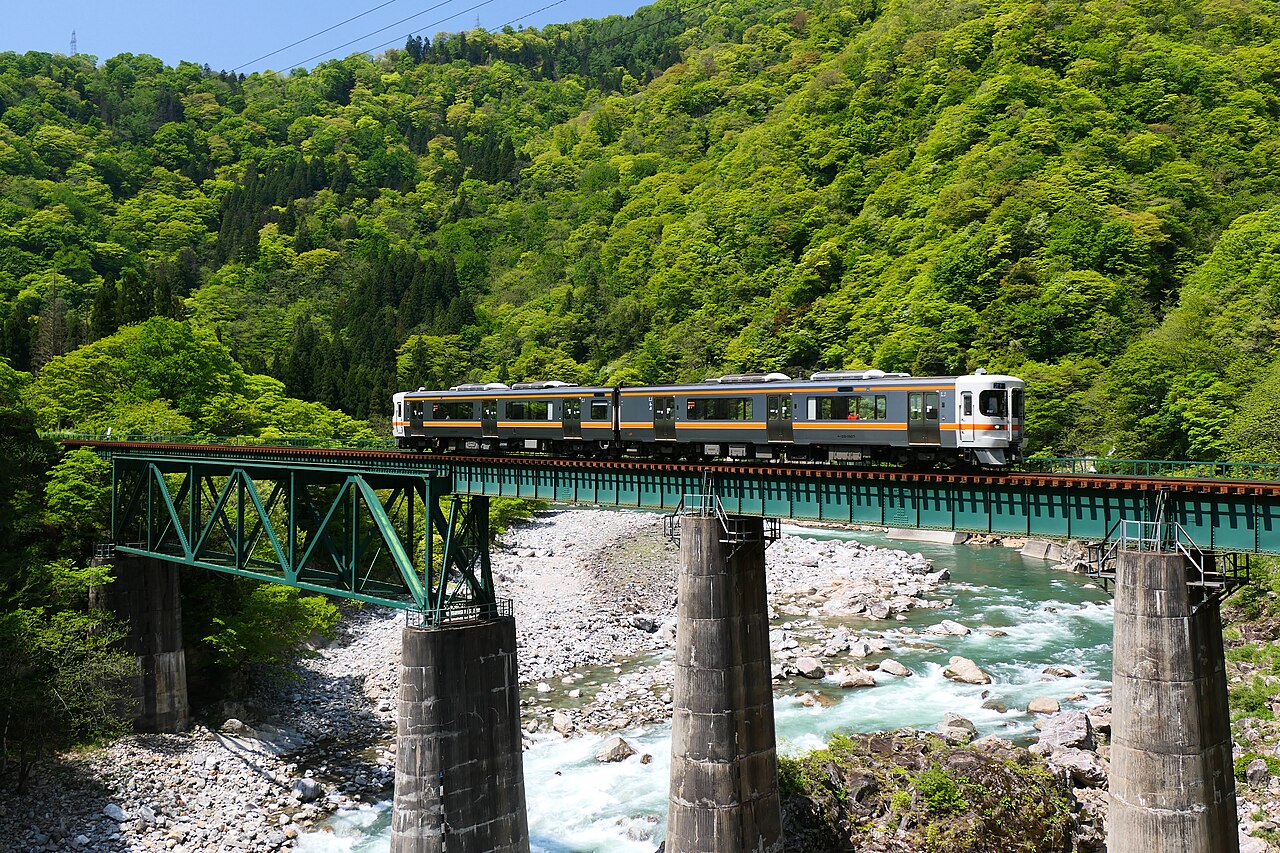
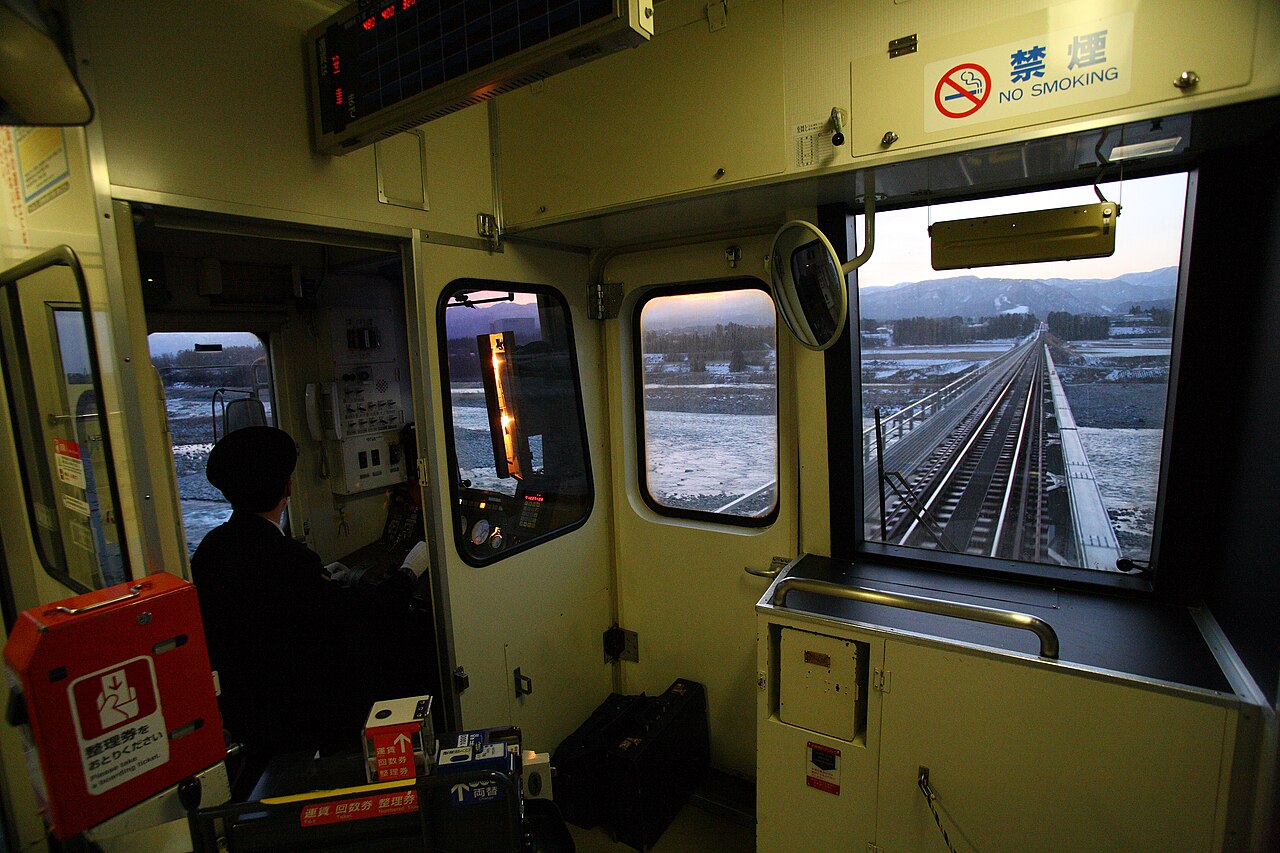
Today the principal service is the limited express Hida, which runs between Nagoya and Takayama, Hida-Furukawa and Toyama with ten return services a day, the Nagoya trains reversing direction at Gifu en route; the English Wikipedia article states the Hida is worked by HC85 series trains. All other trains stop at every station, are sometimes one-person operated, and some through-run to Tajimi Station via the Taita Line. On the JR Central section, local service thins out toward Inotani, most local trains terminating at Mino-Ōta or continuing onto the Taita Line; on the JR West section trains terminate at Etchū-Yatsuo or Inotani. JR Central uses KiHa 25 and KiHa 75 series DMUs and JR West uses KiHa 120 DMUs; the last KiHa 40 series cars were withdrawn from the line on 30 June 2015. The Japanese Wikipedia article notes that the Takayama Main Line is the only line on Honshū designated a “Main Line” (honsen) that is nonetheless classified as a local (regional) line.
The mountainous route has repeatedly been damaged by heavy rain and typhoons. The English Wikipedia article records that from 22 October 2004 the section between Tsunogawa and Inotani was closed by flood damage from Typhoon Tokage, reopening in stages with the final section returning to service on 8 September 2007. During the 2018 Japan floods, a landslide on 29 June closed the section between Hida-Hagiwara and Hida-Osaka; the disruption spread, and by 8 July the section between Mino-Ōta and Toyama was affected, with the segment between Sakakami and Inotani not reopening until 21 November 2018. As a social experiment, the city of Toyama opened Fuchū-Usaka Station as a temporary station on 15 March 2008; it proved popular enough to be retained after the experiment ended in 2011 and was made permanent on 15 March 2014.
Timeline
- 1918The Gifu-routed plan passes the House of Representatives (9 February) and the House of Peers (1 March), settling the route via Gifu rather than directly from Nagoya.
- 19201 November: the Takayama Line's first section, Gifu–Kakamigahara, opens.
- 19271 September: the Hietsu Line opens its first section, Toyama–Etchū-Yatsuo, extending south from Toyama.
- 1933The southern Takayama Line reaches Hida-Osaka (25 August); the northern Hietsu Line reaches Sakakami (12 November).
- 193425 October: the two lines are joined; the Hietsu Line is merged into the Takayama Line and the whole route is renamed the Takayama Main Line.
- 1967Late 1960s: under JNR, steam haulage ends and CTC plus added passing facilities modernise the line (concentrated FY1967–1969); per JA, JNR's first CTC on a conventional line over 200 km.
- 200422 October: the Tsunogawa–Inotani section closes due to flooding from Typhoon Tokage; the last section reopens 8 September 2007.
- 200815 March: Toyama opens Fuchū-Usaka Station as a temporary station under a social experiment.
- 201415 March: Fuchū-Usaka Station is made permanent.
- 201530 June: the last KiHa 40 series DMUs are withdrawn from the line (KiHa 25 series phased in from the March 2015 timetable).
- 2018March: station numbering and line colouring introduced (dark red, line code CG). June–November: the 2018 Japan floods close sections; Sakakami–Inotani reopens 21 November.
Sources
Facts last verified 3 June 2026.
Gallery 4 photos
Every photo for this page — tap any image to view it full-size. All from Wikimedia Commons (credit under each).