History
The line was opened by the Ikegami Electric Railway (Ikegami Denki Tetsudo) for the purpose of carrying worshippers to Ikegami Honmon-ji, the major Buddhist temple near present-day Ikegami Station. The first section opened on 6 October 1922 between Kamata and Ikegami, a distance of 1.8 km. According to the Japanese-language account, the original Kamata-Ikegami section is the earliest-opened stretch still in service among Tokyu Corporation's present railway lines (a footnote there notes that, if now-defunct former lines are counted as well -- setting aside the other-company lines that were merged in during the wartime "Dai-Tokyu" period and later split off again -- the Sangenjaya-Dogenzaka-ue portion of the old Tamagawa Line, opened in 1907, is the earliest). The line was extended from Ikegami to Yukigaya in 1923, and reached its full length on 17 June 1928 with the short 0.3 km opening between Osakihirokoji and Gotanda, completing the line.
The Ikegami Electric Railway later came under the Tokyo-Kawasaki zaibatsu. Aiming to extend toward Kokubunji on the Chuo Main Line, it opened the Shin-Okusawa Line, branching from Yukigaya Station (now Yukigaya-otsuka), in 1928. In 1934, however, the company was bought out by Keita Goto of the rival Meguro-Kamata Electric Railway -- the predecessor of Tokyu -- which absorbed the Ikegami Electric Railway on 1 October 1934; the unprofitable Shin-Okusawa Line was abandoned in 1935. A legacy of the two companies once having been competitors was that, for many years, no interchange station was provided where the Ikegami Line crossed the Oimachi Line; this was finally remedied in 1951, when the line's Hatagaoka Station was consolidated into Hatanodai Station on the Oimachi Line.
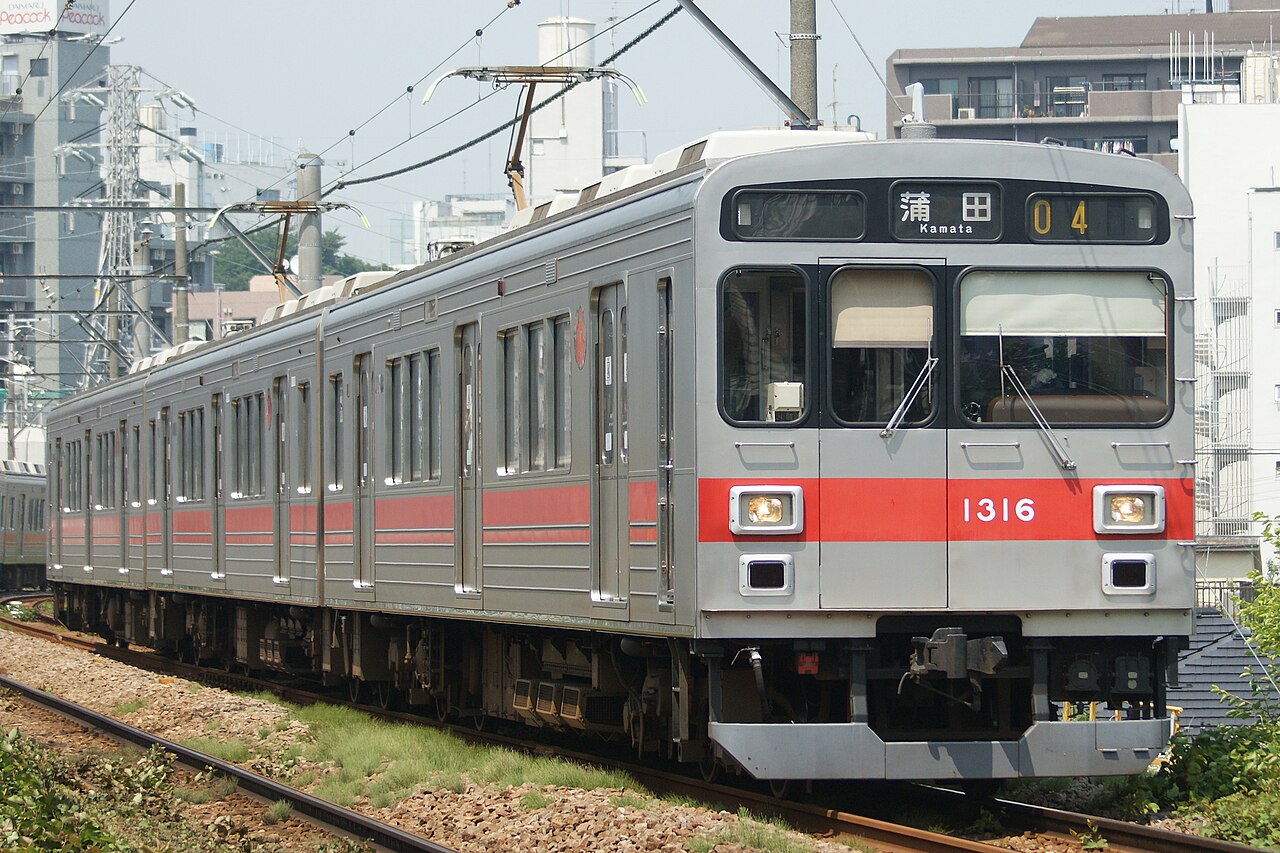
The line was progressively upgraded over the following decades. Three-car operation, introduced on some services from December 1953, became standard for all trains on 1 April 1956. The line voltage was raised from 600 V to 1,500 V DC on 10 August 1957. A forerunner of automatic train stop, an in-cab warning device, was introduced on 1 December 1963 to improve safety, and Tokyu's own ATS followed from 1 April 1970. Nagahara Station was placed underground on 9 June 1968, and Ebara-nakanobu Station was moved underground on 19 March 1989. The ageing first-generation 3000 series trains -- many of them prewar-built cars -- ran their last service on 9 March 1989, after which the line was operated solely by stainless-steel 7200 and 7600 series stock. From 16 March 1998 the line adopted wanman driver-only operation.
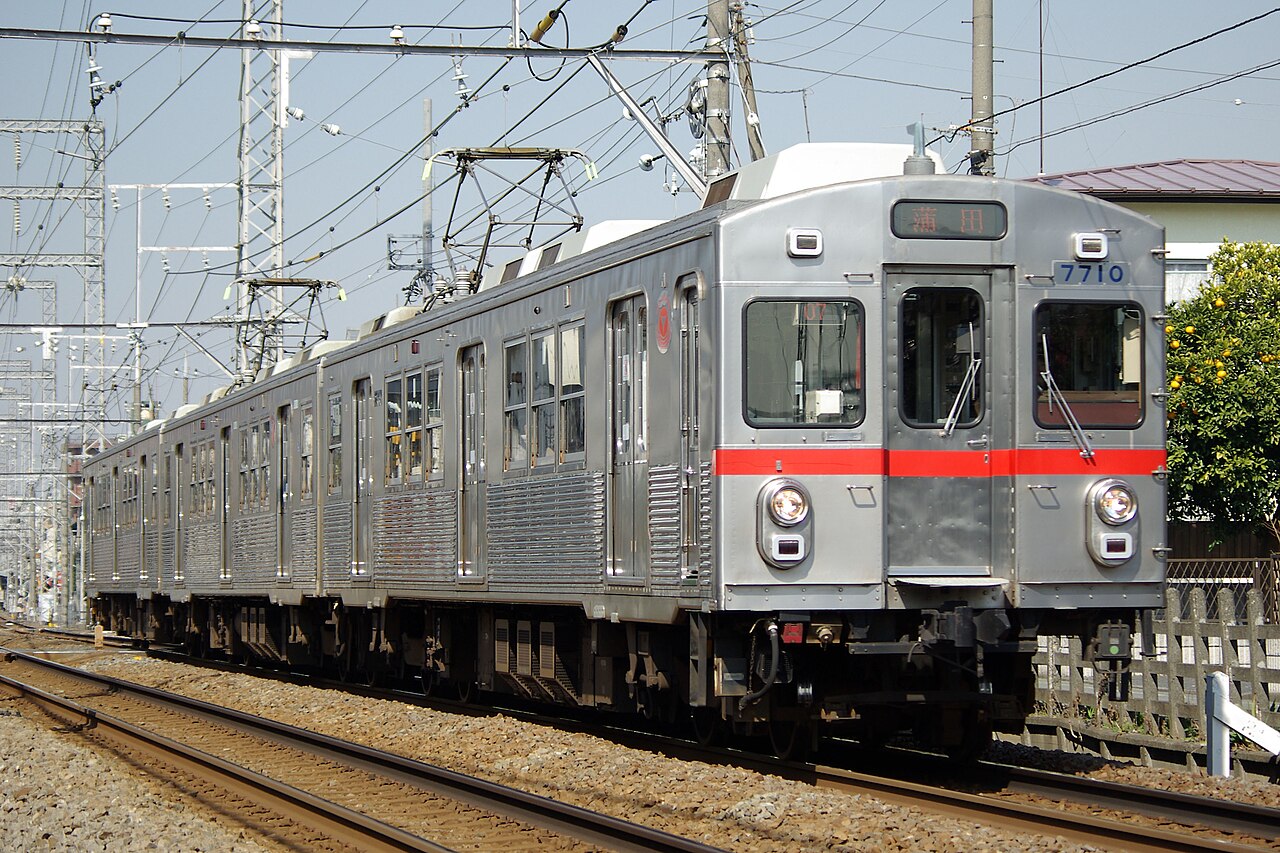
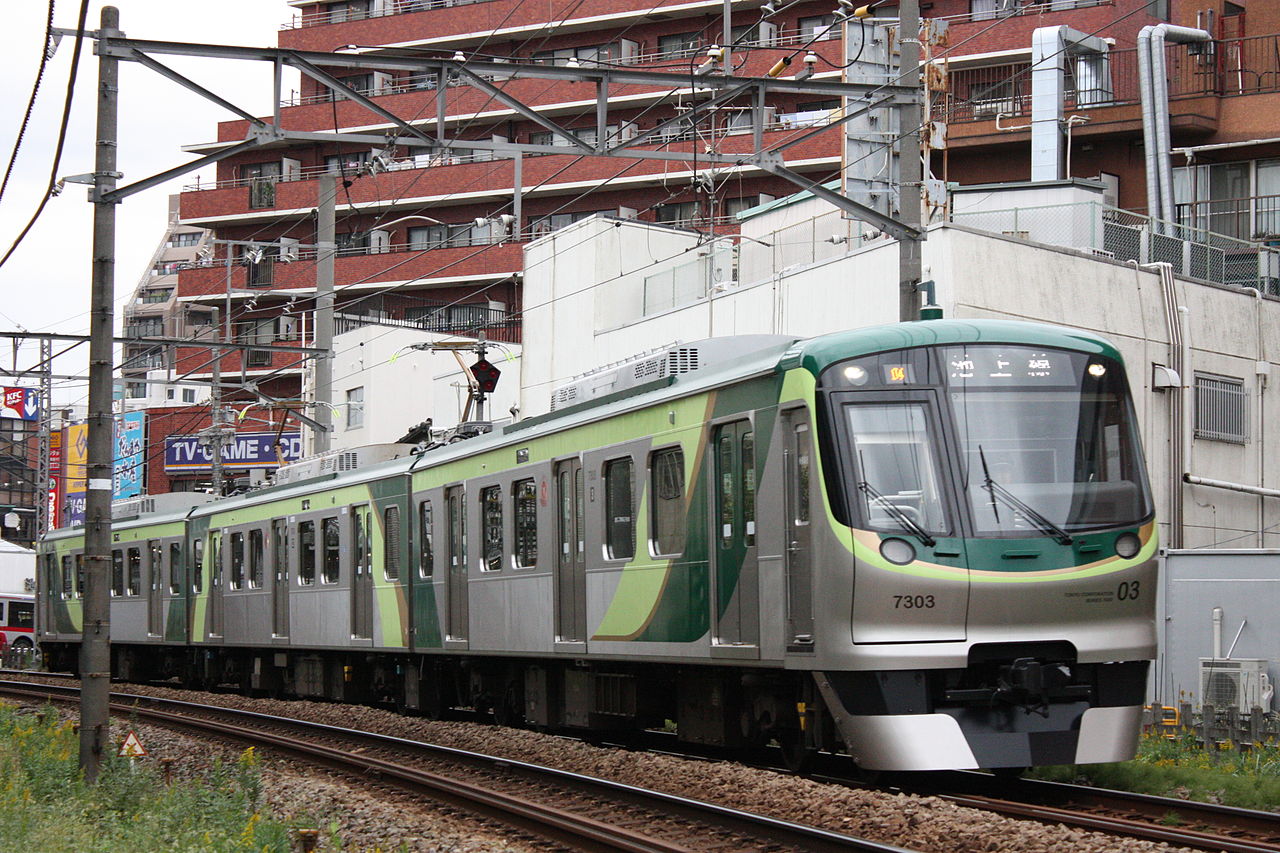
In popular culture the line gained nationwide fame through the 1976 hit song "Ikegami-sen," composed and sung by Mieko Nishijima; lyrics evoking the age and condition of the line's rolling stock prompted Tokyu to issue a public rebuttal. To mark the line's 80th anniversary, a special train named "Meikyoku Ikegami-sen-go" was run on 16 December 2007, with Nishijima herself aboard, and on 25 December 2007 -- the first new train type delivered for the line in fourteen years -- the second-generation 7000 series entered revenue service.
Today the Ikegami Line links Gotanda, a commercial centre in Shinagawa, with Kamata, the administrative and commercial centre of Ota, by way of the inland districts on the outskirts of each ward. All services are local, calling at every station, operated by three-car 18-metre trains shared with the Tokyu Tamagawa Line; the current rolling stock comprises the 1000 series (on the line since 1993) and the 7000 series (since December 2007). The fastest Gotanda-Kamata journey takes 22 minutes, around 30 minutes including boarding and waiting time. Owing to its older, smaller-profile equipment and the small station-front shopping streets that have formed at each stop, the line has been characterised in Japanese sources as a "local line in the heart of the city."
Timeline
- 19226 October: the Ikegami Electric Railway opens the first section, Kamata-Ikegami (1.8 km), to carry worshippers to Ikegami Honmon-ji temple.
- 19234 May: the line is extended from Ikegami to Yukigaya (now Yukigaya-otsuka).
- 192817 June: the 0.3 km Osakihirokoji-Gotanda section opens, completing the line. The operator also opens the Shin-Okusawa Line branch the same year.
- 19341 October: the Ikegami Electric Railway is absorbed by the Meguro-Kamata Electric Railway (predecessor of Tokyu) under Keita Goto.
- 1935The unprofitable Shin-Okusawa Line is abandoned.
- 19511 May: Hatagaoka Station is consolidated into Hatanodai Station on the Oimachi Line, creating an interchange.
- 19561 April: all trains become three-car formations (three-car operation had begun on some services in December 1953).
- 195710 August: line voltage is raised from 600 V to 1,500 V DC.
- 19689 June: Nagahara Station is placed underground.
- 1976The hit song "Ikegami-sen" by Mieko Nishijima spreads the line's name nationwide.
- 19899 March: the first-generation 3000 series (largely prewar cars) runs its last service. 19 March: Ebara-nakanobu Station is moved underground.
- 199816 March: wanman driver-only operation commences on the line.
- 200716 December: an 80th-anniversary special, "Meikyoku Ikegami-sen-go," is run. 25 December: the second-generation 7000 series enters revenue service, the first new type in 14 years.
Sources
Facts last verified 3 June 2026.
Gallery 4 photos
Every photo for this page — tap any image to view it full-size. All from Wikimedia Commons (credit under each).