History
The line did not begin as a loop. Its predecessor opened on 1 March 1885, built by the private Nippon Railway Company between Shinagawa Station in the south and Akabane Station in the north. A principal purpose was freight: until the later opening of the Musashino Line, the route was the main artery carrying exports — notably raw silk from the producing regions of Tochigi and Gunma — toward the port of Yokohama, with imports moving the other way. A second piece, the 3.3 km link between Ikebukuro and Tabata, opened on 1 April 1903, and the two were brought together under the route name "Yamanote Line" on 12 October 1909.
Electrification and double-tracking followed quickly. The Ōsaki–Shinagawa section was double-tracked on 30 November 1909, and the line was electrified on 16 December 1909. The loop itself was completed in 1925, when the double-track, electrified section between Kanda and Ueno opened on 1 November, creating a north–south link via Tokyo Station through the city's business centre; land acquisition for that final segment had been eased by the devastation of the 1923 Great Kantō Earthquake. A parallel freight line, also completed in 1925, ran along the inner side of the loop between Shinagawa and Tabata. During the prewar era the Ministry of Railways declined to let private suburban railways cross the Yamanote Line into central Tokyo, forcing them to terminate at its stations — a policy that fostered the growth of new urban centres at the major transfer points, most notably Shinjuku and Ikebukuro, which the article notes are now the two busiest passenger railway stations in the world.
The contemporary configuration dates to 19 November 1956, when the Yamanote Line was separated from the Keihin-Tōhoku Line and given its own pair of tracks along the eastern side of the loop between Shinagawa and Tabata. A major explosion on the Yamanote Freight Line at Shinjuku in 1967 diverted freight to the more distant Musashino Line, after which the freight line was repurposed for Saikyō Line and Shōnan-Shinjuku Line trains, certain limited expresses such as the Narita Express, and some liner services. The line's name also carries a quirk: after World War II a romanisation error rendered it the "Yamate Line," and it was known as both "Yamanote" and "Yamate" until 1971, when Japanese National Railways settled the reading back to "Yamanote."
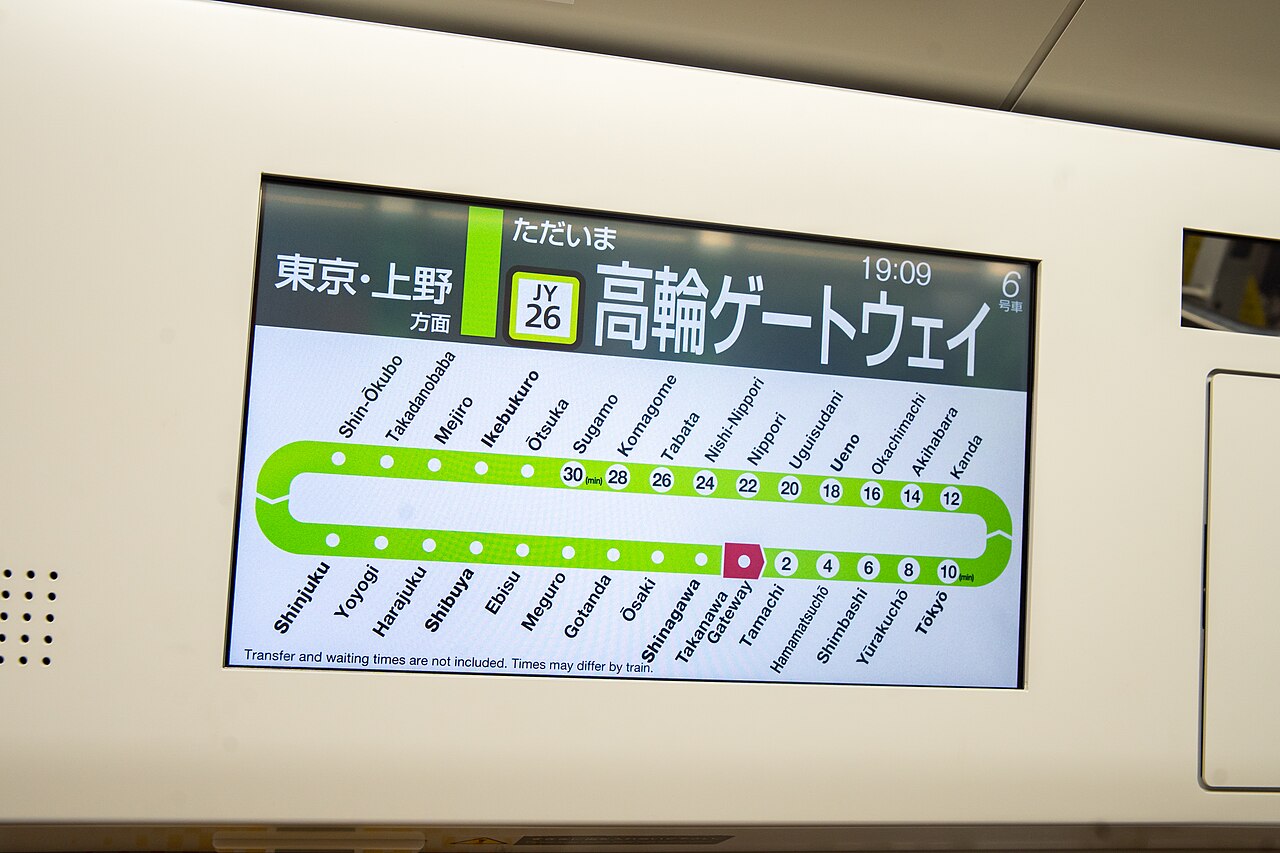
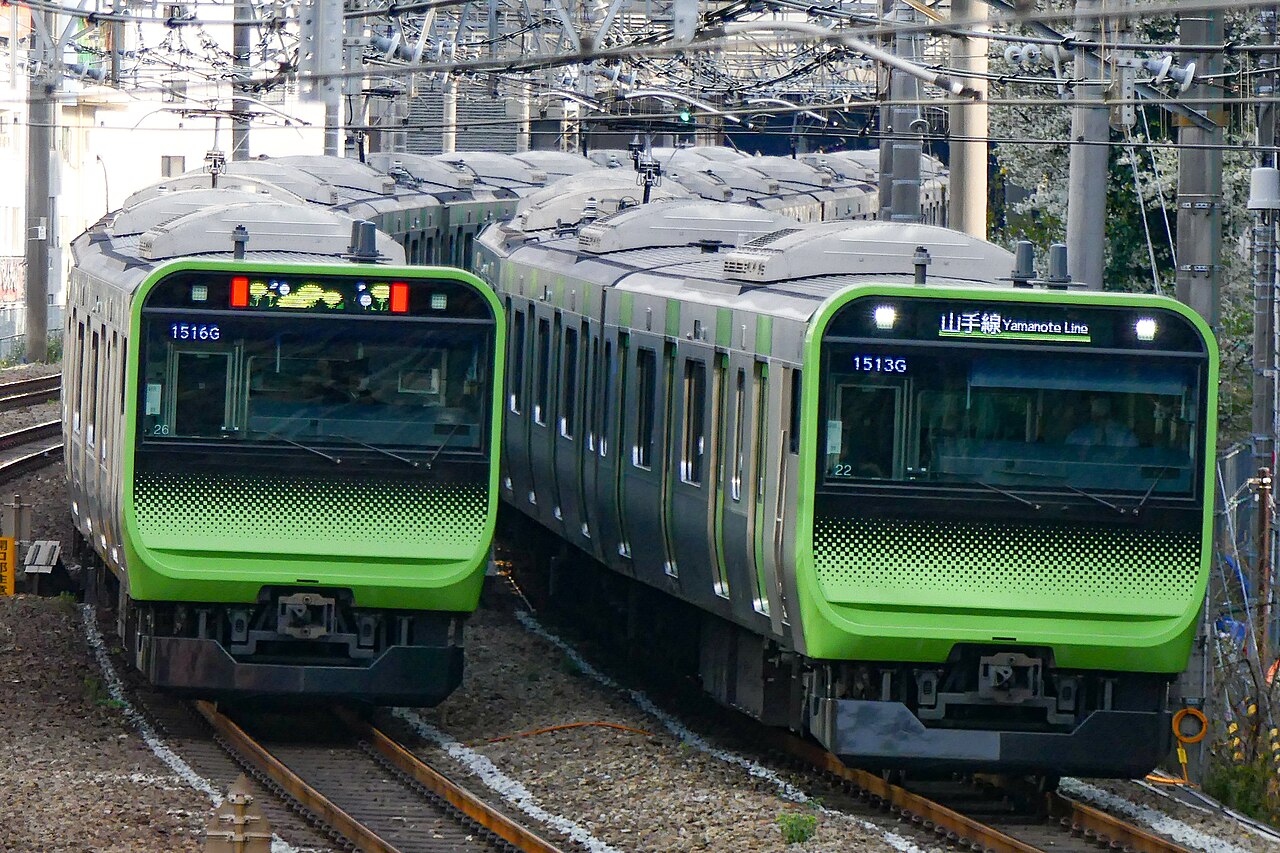
Train protection was modernised in stages — automatic train control (ATC) from 6 December 1981 and digital ATC (D-ATC) from 30 July 2006 — and station numbering with the "JY" prefix was introduced across JR East's Tokyo-area stations from 20 August 2016. Congestion, which exceeded 250 percent on some sections in the 1990s, had eased to 125 percent on the outer loop and 131 percent on the inner loop by 2023, helped by larger and more frequent trains and parallel relief routes such as the Ueno-Tokyo Line, which opened on 14 March 2015. As of January 2020 the line's services are operated exclusively by a fleet of fifty eleven-car E235 series electric multiple units, the first of which entered service on 30 November 2015; all are based at the Tokyo General Rolling Stock Centre near Ōsaki Station. Earlier fleets included the 103 series in its distinctive uguisu (warbler) green, the 205 series, and the E231-500 series. Takanawa Gateway Station opened on 14 March 2020 between Shinagawa and Tamachi — the first new station on the line since Nishi-Nippori in 1971. In October 2022 JR East began trial runs for driverless operation, aiming to begin some time in 2028, which would make the Yamanote Line its first line with driverless trains. In August 2025 JR East obtained approval to raise fares by an average of 7.1 percent from March 2026, its first blanket increase since 1987, and in September 2025 announced specially decorated E235 sets marking 100 years of the loop's circular operation.
Timeline
- 18851 March: a predecessor line opens, built by the Nippon Railway Company between Shinagawa (south) and Akabane (north), partly to carry export goods such as raw silk toward Yokohama.
- 19031 April: the 3.3 km Ikebukuro–Tabata link opens.
- 190912 October: the two lines are merged under the route name 'Yamanote Line'. The Ōsaki–Shinagawa section is double-tracked (30 November) and the line is electrified (16 December).
- 19251 November: the Kanda–Ueno section opens, completing the loop via Tokyo Station; a parallel inner freight line is also completed. Land acquisition was eased by the 1923 Great Kantō Earthquake.
- 195619 November: the Yamanote Line is separated from the Keihin-Tōhoku Line and given its own tracks on the eastern side of the loop (Shinagawa–Tabata).
- 1967A major explosion on the Yamanote Freight Line at Shinjuku diverts freight to the Musashino Line; the freight line is later repurposed for Saikyō and Shōnan-Shinjuku services and some limited expresses.
- 1971Japanese National Railways settles the line's reading back to 'Yamanote' (after a postwar romanisation error had produced 'Yamate'). Nishi-Nippori Station opens this year.
- 19816 December: automatic train control (ATC) introduced.
- 1988The 103 series (uguisu green, in service since December 1963) is withdrawn in June; rapid services begin on the Keihin-Tōhoku Line.
- 200221 April: E231-500 series enters service (used until 20 January 2020).
- 200630 July: digital ATC (D-ATC) introduced.
- 201530 November: first E235 series enters service. The Ueno-Tokyo Line opened on 14 March, relieving the busiest Ueno–Tokyo segment.
- 201620 August: station numbering introduced on JR East's Tokyo-area stations; Yamanote stations use the 'JY' prefix.
- 202014 March: Takanawa Gateway Station opens between Shinagawa and Tamachi — the first new station on the line since Nishi-Nippori (1971). E235 series becomes the sole fleet (E231-500 withdrawn 20 January).
- 2022October: JR East begins trial runs for driverless operation, aiming to begin some time in 2028 (would be its first line with driverless trains).
- 2023Congestion has eased to 125% on the outer loop and 131% on the inner loop.
- 2025August: JR East obtains approval to raise fares by an average 7.1% from March 2026 (first blanket hike since 1987). September: announces specially decorated E235 sets marking 100 years of loop operation.
Sources
Facts last verified 3 June 2026.
Gallery 6 photos
Every photo for this page — tap any image to view it full-size. All from Wikimedia Commons (credit under each).