History
The line owes its existence to the military. Yokosuka was the seat of an Imperial Japanese Navy district headquarters and naval port, and the army held coastal fortifications guarding Tokyo Bay; the railway was built at the joint request of the navy and army, citing the lack of overland transport to one of the country's most important military bases. In a petition dated 22 June 1886, Navy Minister Saigō Tsugumichi and Army Minister Ōyama Iwao asked Prime Minister Itō Hirobumi to authorise the line as a matter of military strategy. The Cabinet approved construction on 10 March 1887, surveying began that April, and the budget was diverted from the funds set aside for the Tōkaidō Line; on 22 April 1887 the Cabinet ordered the Government Railways to build it. Work on the Ōfuna–Yokosuka section ran from January 1888 to June 1889 and was in places driven through with little ceremony — cutting across the precincts of Engaku-ji near present-day Kita-Kamakura and severing the dankazura approach of Tsurugaoka Hachimangū near Kamakura. It cost 408,480 yen in total.
The Ōfuna–Yokosuka line opened on 16 June 1889 with intermediate stations at Kamakura and Zushi; four round-trip passenger trains (about 45 minutes) and one freight working were timetabled, hauled by small steam locomotives. On 1 April 1895 the line was absorbed into the Tōkaidō Line under a new naming scheme, and on 12 October 1909 it was formally designated the Yokosuka Line, with through running to Tokyo Station beginning when that station opened on 20 December 1909. Double-tracking proceeded section by section between 1914 and 1924. The line was electrified in 1925, with electric-locomotive-hauled operation beginning on 13 December 1925; before electrification the fastest Tokyo–Yokosuka time was 110 minutes. Electric multiple unit (EMU) service began on 15 March 1930, cutting that time to 68 minutes. The 32 series cars built for the line from 1930 introduced fixed cross-seats and continued its long tradition of second-class (later first-class, then Green) accommodation, carried from early on for the naval elite and the well-to-do villa districts of Kamakura and Zushi.
During the Second World War the Yokosuka Line was treated as strategic even as other lines were singled-tracked or closed: on 1 April 1944 it was extended from Yokosuka to Kurihama (8.0 km), with Kinugasa and Kurihama stations opening — the rails reportedly salvaged from the Gotemba Line when that route was reduced to a single track. The line also long served as a holiday route, carrying bathers to the beaches along Sagami Bay. After the war, surging commuter and student traffic strained the tracks shared with the Tōkaidō Line north of Ōfuna. The bottleneck was resolved on 1 October 1980 in the reorganisation known as the "SM separation," which split the two lines' operations: a new tunnel was bored between Tokyo and Shinagawa, the Shinagawa–Tsurumi route was shifted onto the freight-only Hinkaku Line, and the Yokosuka Line began through service with the Sōbu Line (Rapid) toward Chiba and beyond.
Through the 1990s the Narita Express limited express began reaching Ōfuna, and from 1 December 2001 the Shōnan–Shinjuku Line introduced through trains running via Shibuya, Shinjuku and Ikebukuro to the Utsunomiya Line (Tōhoku Main Line); no through service to the Ueno–Tokyo Line is operated. Originally state-run — by Japanese National Railways (JNR) after the war — the line passed to JR East on 1 April 1987 with the privatisation of JNR, when JR Freight became a Class II operator over the Ōfuna–Taura section. Today JR East operates the line, with freight services by JR Freight on part of the route. It serves both as a Tokyo and Yokohama commuter artery and as a sightseeing route to Kamakura and the Shōnan coast, and it competes with the more direct Keikyū Main Line, which holds the advantage in time, fare and frequency between Tokyo or Yokohama and Yokosuka. Reported ridership was 758,258 passengers on an average day in 2015.
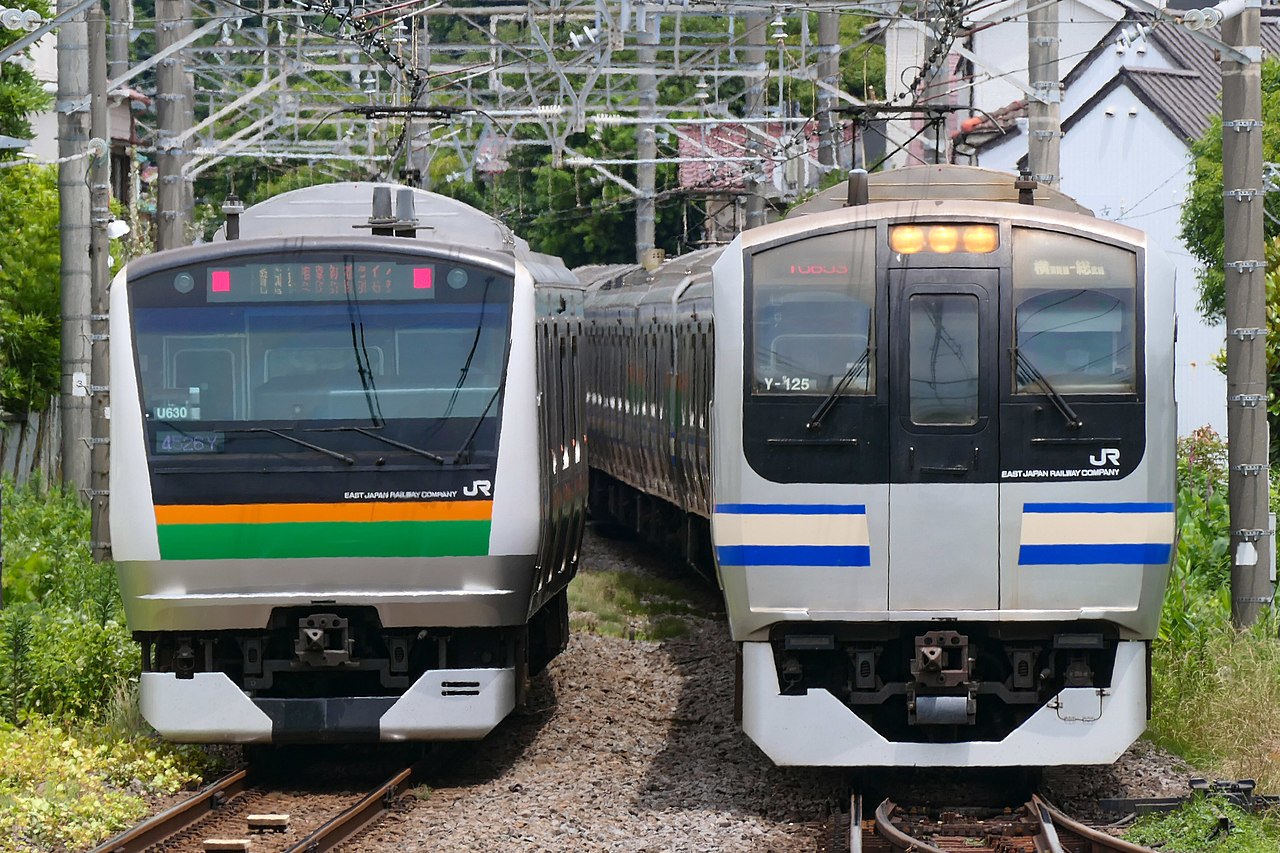
The line has seen two notable incidents. On 9 November 1963 inbound and outbound Yokosuka Line EMUs collided with a derailed freight train in Tsurumi-ku, Yokohama — the Tsurumi rail accident — leaving 161 dead and 120 injured. On 16 June 1968 luggage aboard a train exploded near Ōfuna Station, killing one passenger and injuring fourteen. The rolling stock has since been standardised: the E217 series, introduced on 3 December 1994, ran for three decades until it ended regular service on 8 March 2025, after which the E235-1000 series (introduced 21 December 2020) took over all workings, while Shōnan–Shinjuku Line through services use E231-1000 and E233-3000 series EMUs. The traditional blue-and-cream "Yokosuka colour" (suka-iro) livery, carried since around 1950, remains an emblem of the route.
Timeline
- 188622 June: Navy Minister Saigō Tsugumichi and Army Minister Ōyama Iwao petition Prime Minister Itō Hirobumi to build a railway to the Yokosuka naval base as a military-strategic necessity.
- 188710 March: the Cabinet decides in favour of building the Ōfuna–Yokosuka railway; surveying begins in April, with the budget diverted from the Tōkaidō Line. 22 April: the Cabinet orders the Government Railways to build the line.
- 1888January: construction of the Ōfuna–Yokosuka section begins.
- 188916 June: the Ōfuna–Yokosuka line opens with intermediate stations at Kamakura and Zushi; four round-trip passenger trains (about 45 minutes) and one freight working are timetabled. Total construction cost 408,480 yen.
- 18951 April: the line becomes part of the Tōkaidō Line under the new line-naming scheme.
- 190912 October: the line is formally renamed the Yokosuka Line. 20 December: Tokyo Station opens and Yokosuka Line trains begin running into it.
- 1925The entire line is electrified; electric-locomotive-hauled operation begins on 13 December.
- 193015 March: electric multiple unit (EMU) service begins, cutting the Tokyo–Yokosuka time to 68 minutes.
- 19441 April: the line is extended from Yokosuka to Kurihama (8.0 km); Kinugasa and Kurihama stations open.
- 19639 November: inbound and outbound Yokosuka Line EMUs collide with a derailed freight train in Tsurumi-ku, Yokohama (the Tsurumi rail accident); 161 people are killed and 120 injured.
- 196816 June: luggage aboard a Yokosuka Line train explodes near Ōfuna Station, killing one passenger and injuring fourteen.
- 19801 October: the "SM separation" splits Yokosuka Line and Tōkaidō Line operations; a new Tokyo–Shinagawa tunnel opens, the Shinagawa–Tsurumi route shifts onto the Hinkaku Line, and through service to the Sōbu Line (Rapid) begins.
- 19871 April: with the privatisation of JNR the line transfers to JR East; JR Freight becomes a Class II operator over the Ōfuna–Taura section.
- 19943 December: the E217 series enters service.
- 20011 December: Shōnan–Shinjuku Line through service begins, linking the line via Shibuya, Shinjuku and Ikebukuro to the Utsunomiya Line.
- 202021 December: the E235-1000 series enters service.
- 20258 March: the E217 series ends regular service; all trains are unified to the E235-1000 series.
Sources
Facts last verified 3 June 2026.
Gallery 4 photos
Every photo for this page — tap any image to view it full-size. All from Wikimedia Commons (credit under each).