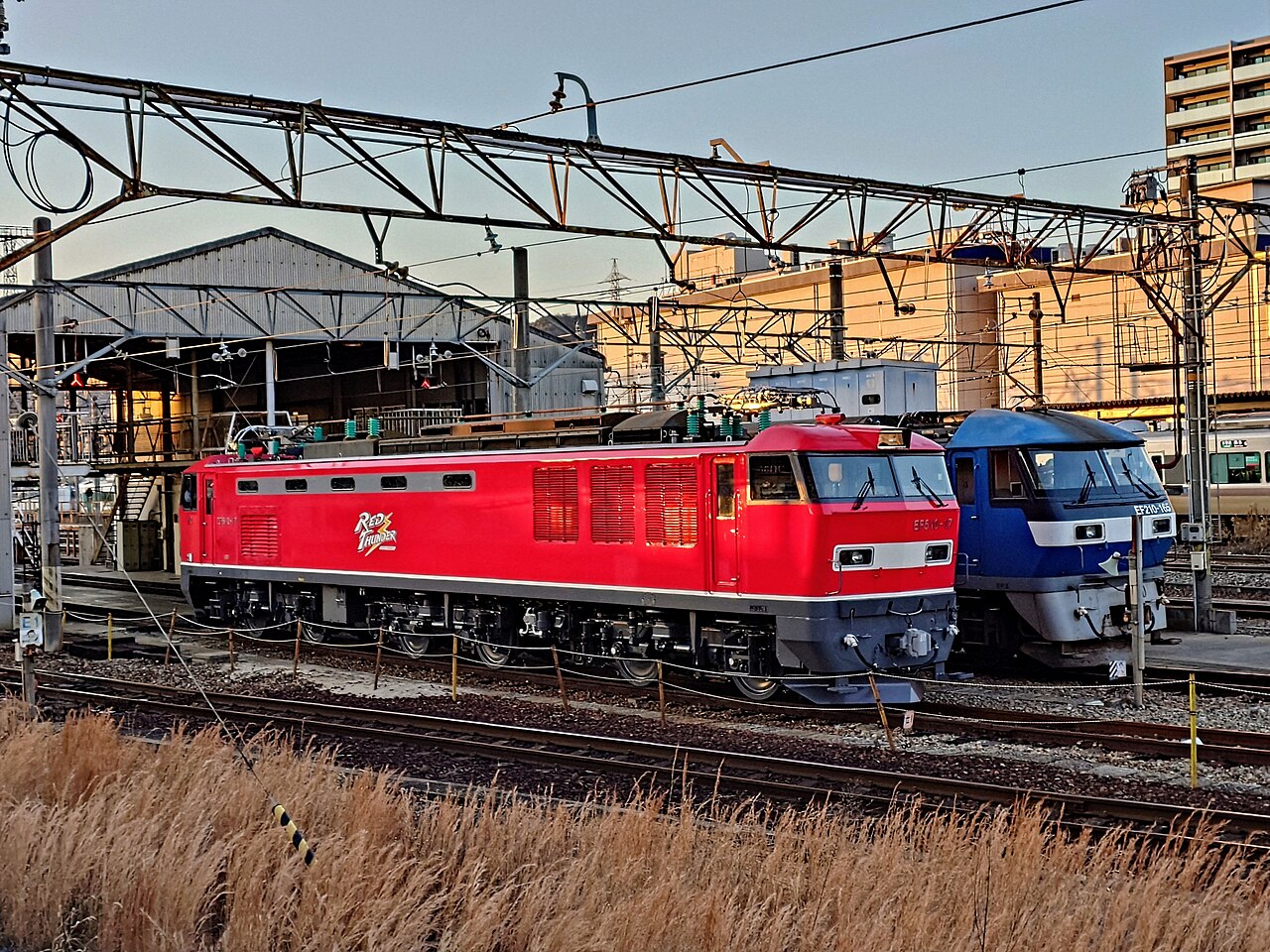
History
Development of a successor for the EF81 had begun shortly after the privatization of Japanese National Railways: an earlier prototype, the EF500, was built in 1990 for the same Sea of Japan trunk route, but with a continuous output of 6,000 kW it proved excessively powerful relative to actual traffic volumes and, together with technical problems, never reached series production. The EF510 was instead developed by adapting the design of the EF210, the DC-only type built at the same period with running costs optimised, into a dual-system AC/DC machine.
The locomotive is a multi-system machine able to run under 1,500 V DC and 20 kV AC at 50/60 Hz overhead supply, collecting current by pantograph, and is built by Kawasaki Heavy Industries, with the electrical equipment supplied by Mitsubishi Electric. Its main circuit uses a Mitsubishi Electric VVVF inverter system with IGBT devices, derived from that of the Class EH500 and configured so that each of the six traction motors is controlled individually by its own inverter (a 1C1M arrangement). The six traction motors are squirrel-cage three-phase induction motors of the FMT4 type, identical to those of the EF210 and each rated at 565 kW (one-hour rating).
As a measure against the cold climate and salt damage of its operating territory, only the pantographs and the protective earthing switch are mounted on the roof, with the isolators, circuit breakers and other high-voltage apparatus that earlier locomotives carried on the roof relocated inside the body. It has a power output of 3,390 kW, a tractive effort of 199 kN and a maximum operating speed of 110 km/h.
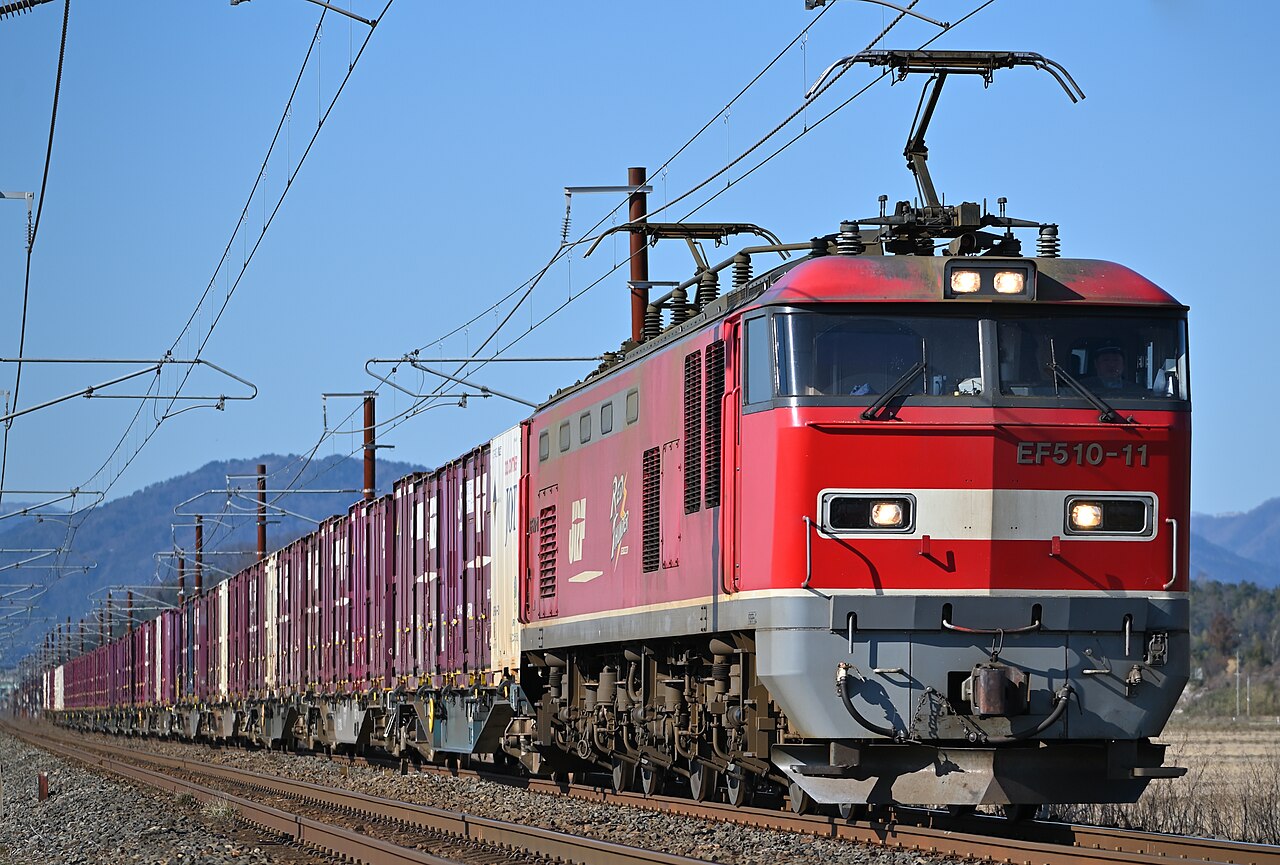
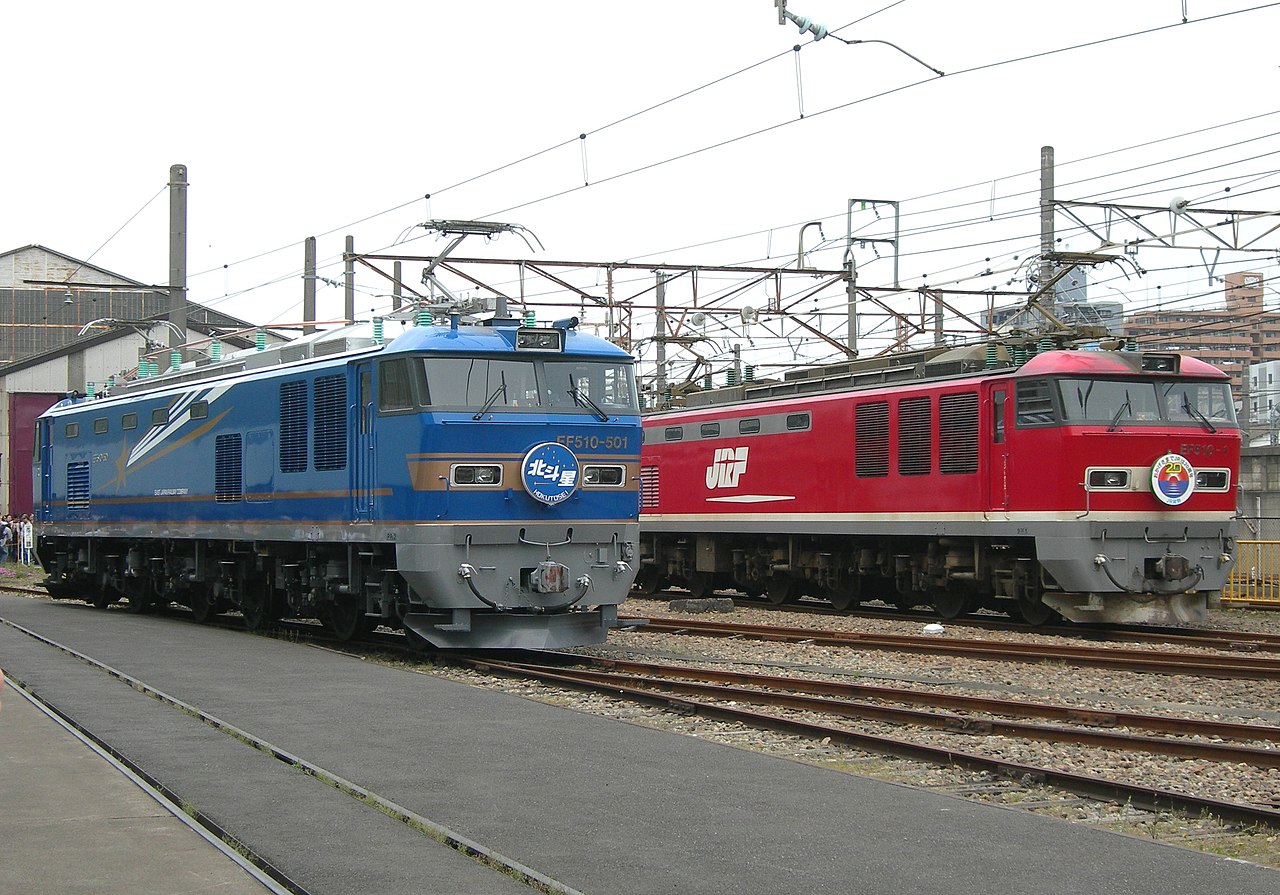
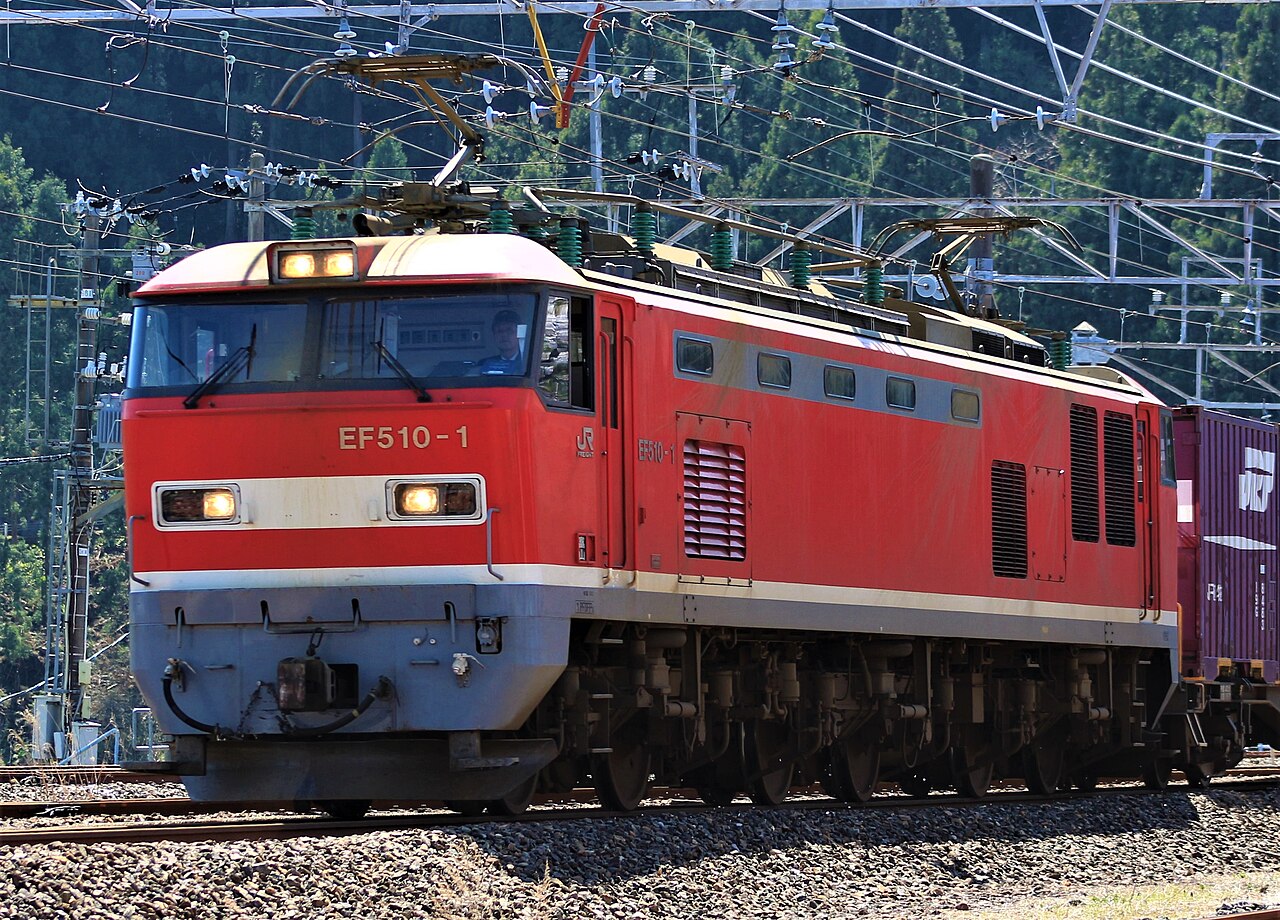
The first locomotive, EF510-1, was delivered in February 2002 and was initially based at Shin-Tsurumi Depot before being transferred to Toyama Depot in 2002. Unusually, although JR Freight normally assigns the 900 number series to its prototype locomotives, the EF510's pre-production unit was numbered EF510-1, so the class is the only one of its kind with no 900-series member. The first full-production locomotive, EF510-2, was delivered in November 2003; this and subsequent locomotives carried "Red Thunder" bodyside branding. The EF510-0 sub-class was given the official nickname "ECO-POWER Red Thunder" through a public competition, forming a pair with the "ECO-POWER Blue Thunder" of the contemporaneous Class EH200.
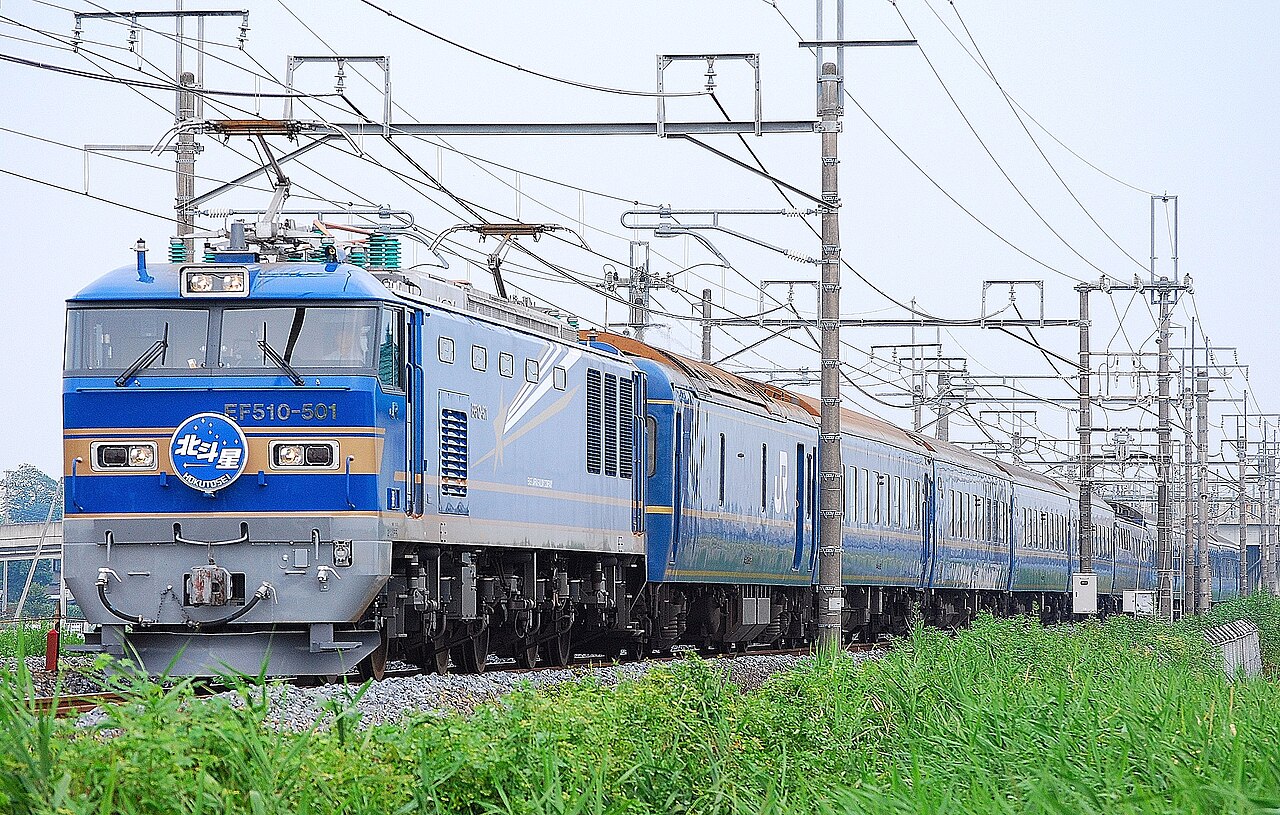
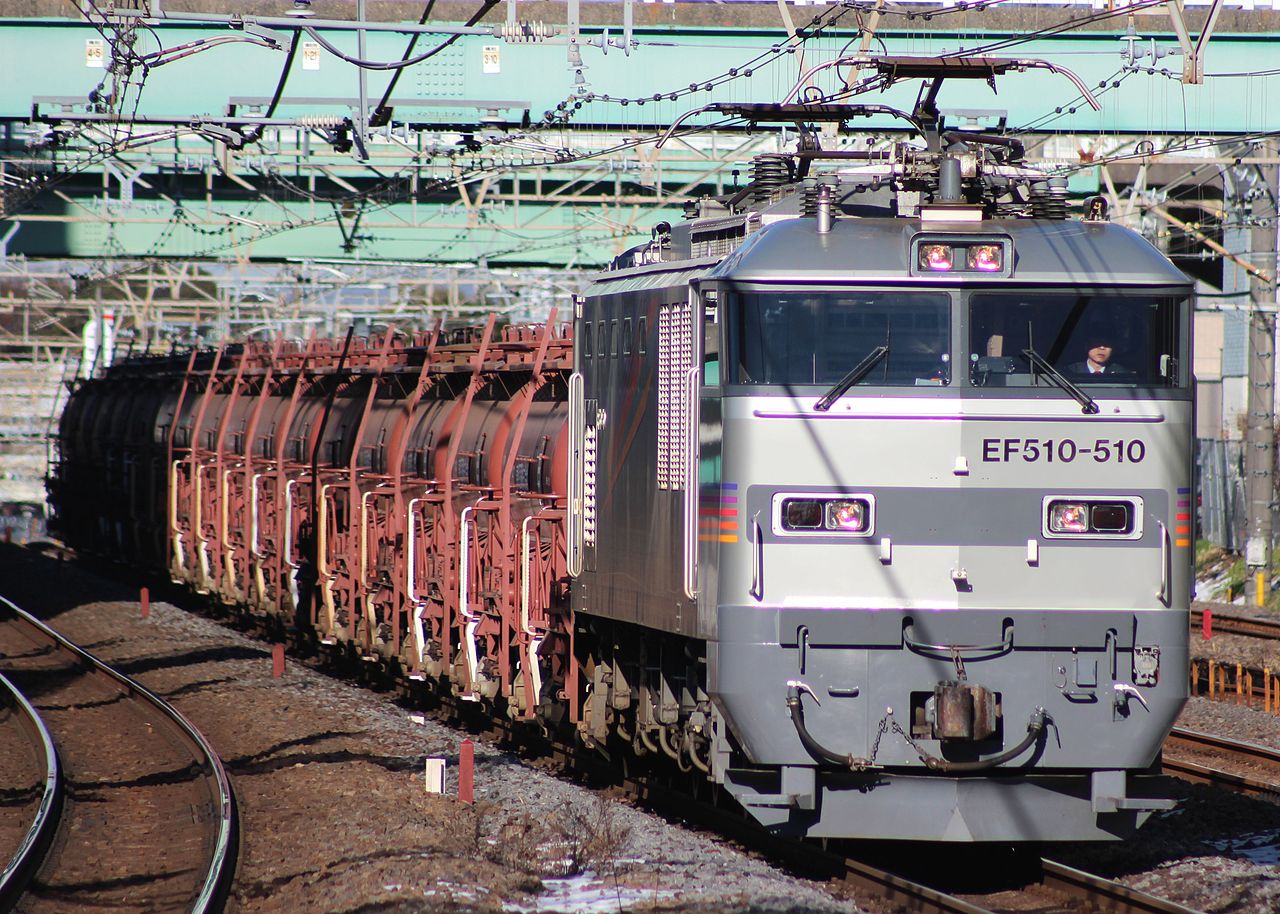
The class is subdivided into the original EF510-0 sub-class operated by JR Freight and fifteen EF510-500 sub-class locomotives ordered by and originally operated on passenger services by JR East. The EF510-500 subclass replaced JR East's fleet of EF81 locomotives formerly used to haul the Cassiopeia and Hokutosei overnight sleeping car trains from June 2010; these were the first locomotives to be ordered by any of the JR passenger operating companies since privatization. The new locomotives cost around 400 million yen each. The first, EF510-501, was delivered from the Kawasaki Heavy Industries factory in Hyogo Prefecture on 18 December 2009, arriving at Tabata Depot in Tokyo on 19 December, and entered service on 25 June 2010. Two of the fifteen (EF510-509 and EF510-510) were painted in a dedicated silver scheme with coloured stripes to match the Cassiopeia rolling stock.
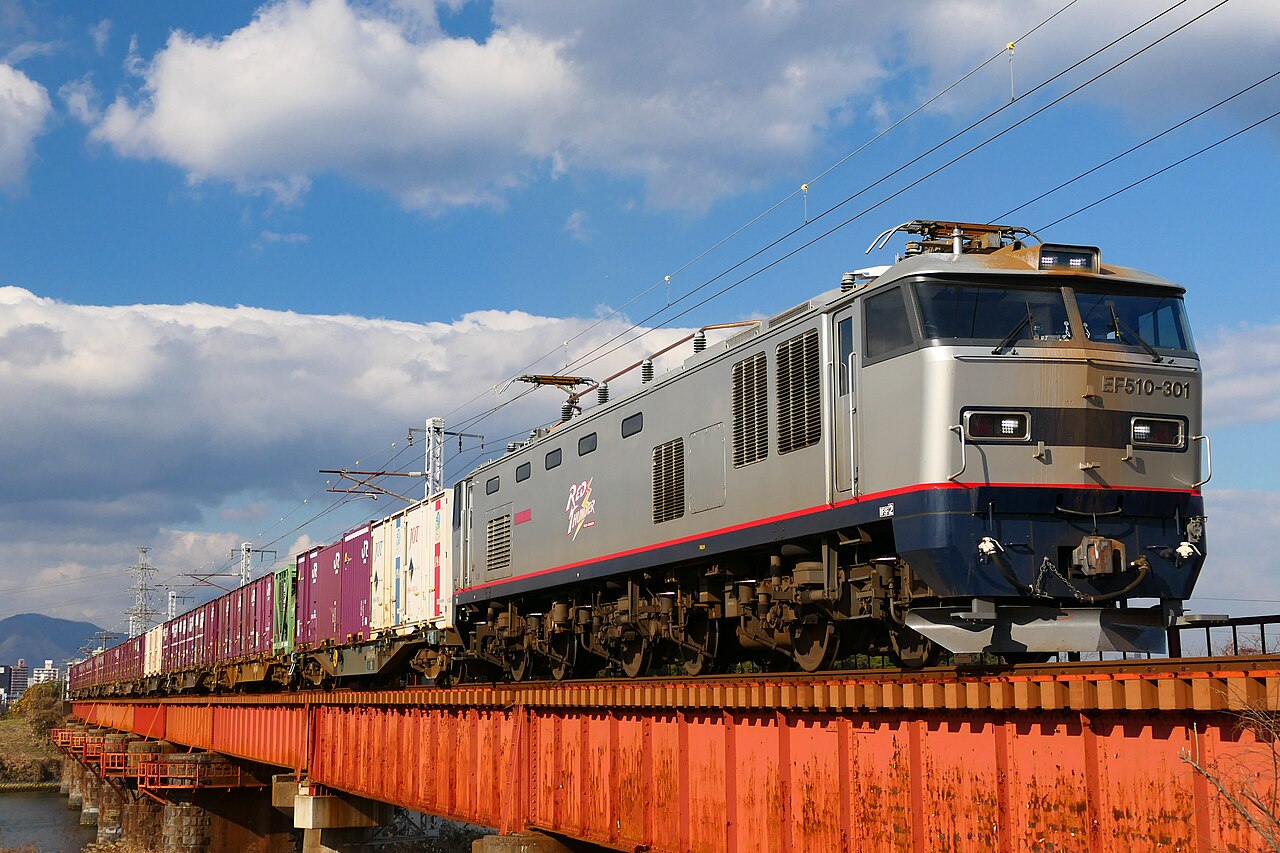
From the start of the revised timetable in March 2013, Joban Line freight duties operated by JR East EF510-500 locomotives were taken over by JR Freight Class EH500 locomotives, and locomotives EF510-501 to 508 and 511 became surplus and were sold to JR Freight in July 2013; EF510-512, 513 and 515 were transferred to JR Freight in December 2015. A further EF510-300 subclass, operated by JR Freight in the Kyushu area, is to comprise 17 locomotives; the first, EF510-301, was completed in 2021 and the subclass entered service on 25 February 2023. The EF510-300 subclass adds AC regenerative braking to the dynamic (rheostatic) braking of the earlier units, usable only on AC-electrified sections, and is fitted with an input-current limiting function that can cap the current drawn from the overhead line to a level comparable to that of the Class EF81, in order to suit the AC feeding equipment in Kyushu.
As of 1 April 2016 the fleet consisted of 40 locomotives (24 EF510-0s and 16 EF510-500s), all based at Toyama Depot. In the EF510 classification, E denotes an electric locomotive, F denotes six driving axles, and 510 denotes an AC/DC locomotive with AC motors.
Timeline
- 2002The first locomotive, EF510-1 (a pre-production locomotive), is delivered in February and initially based at Shin-Tsurumi Depot before transfer to Toyama Depot the same year; JR Freight registration is 15 February 2002.
- 2004Full-scale revenue service begins: EF510-1 together with production locomotives EF510-2 and EF510-3 enter service on the Sea of Japan trunk route (Nihonkai Jukan Line) from 13 March, progressively replacing the ageing Class EF81.
- 2010The EF510-500 subclass enters JR East service: EF510-501 begins haulage on 25 June, replacing EF81 locomotives on the Cassiopeia and Hokutosei overnight sleeping-car trains; two units (EF510-509 and EF510-510) wear a dedicated Cassiopeia silver livery.
- 2013From the March timetable revision, JR East EF510-500 Joban Line freight duties pass to JR Freight Class EH500 locomotives; surplus locomotives EF510-501 to 508 and 511 are sold to JR Freight in July.
- 2016All fifteen JR East EF510-500 locomotives have been sold to JR Freight (the last, EF510-509 and 510, leave Tabata on 31 March), ending JR East operation of the type; the JR Freight fleet stands at 40 locomotives as of 1 April.
- 2023The Kyushu-area EF510-300 subclass (intended to total 17 locomotives) enters service on 25 February, with pre-production EF510-301 working Nippo Main Line freight, replacing ageing Class ED76 and Class EF81 locomotives.
Sources
Facts last verified 6 June 2026.
Gallery 5 photos
Every photo for this page — tap any image to view it full-size. All from Wikimedia Commons (credit under each).