History
The idea of a Shinkansen between Fukuoka and Nagasaki dates to a 1971 outline by the Ministry of Transport, and the route was set in motion by the basic plan promulgated on 12 December 1972 under the Nationwide Shinkansen Railway Development Act, with the development plan for five lines decided on 13 November 1973. From the outset the planned route ran through the city of Saga, branching from the main Kyushu Shinkansen on the Tsukushi Plain and sharing track with it toward Fukuoka. In 1985 Japanese National Railways published a map showing a variant by way of Haiki in Sasebo. What followed, however, was decades of disagreement over how the line should be built and, above all, over how much Saga Prefecture should pay for it.
Several construction standards were considered in turn, each cheaper or less disruptive than a full Shinkansen but each ultimately set aside. In 1992 JR Kyushu studied building the route with Shinkansen-grade structures but conventional narrow-gauge track, the so-called Super Tokkyū approach, and in 2002 the Japan Railway Construction, Transport and Technology Agency (JRTT) sought permission to build the Takeo-Onsen to Nagasaki section to that standard. A breakthrough on the conventional-line question came on 16 December 2007, when JR Kyushu reached an agreement with Saga and Nagasaki prefectures to keep operating the parallel narrow-gauge service for twenty years after the Shinkansen opened, under a vertical-separation arrangement that avoided spinning the line off entirely. With that obstacle eased, JRTT applied in March 2008 to build the roughly 45.7 km Takeo-Onsen to Isahaya segment and was granted permission that month; construction of the segment began on 28 April 2008.
The final stretch between Isahaya and Nagasaki was debated for several more years before the government approved it. On 26 December 2012 the government issued a policy that the Takeo-Onsen to Isahaya segment then under construction and the still-unbuilt Isahaya to Nagasaki segment should be built together as a variable-gauge system. Permission to build the whole Takeo-Onsen to Nagasaki line as a standard-gauge Shinkansen was applied for on 12 June 2012 and granted on 29 June.
The variable-gauge plan was the technical key to running through trains all the way to Hakata without rebuilding the conventional line west of Shin-Tosu. The original scheme would have reused the existing narrow-gauge track from Shin-Tosu to Takeo-Onsen, doubled the roughly 13.7 km between Hizen-Yamaguchi and Takeo-Onsen, and built a new Shinkansen line onward to Nagasaki. It relied on the Gauge Change Train, a trainset able to switch between the narrow gauge of the existing line and the standard gauge of the Shinkansen. That had never been achieved on a powered narrow-gauge axle. Earlier European gauge-changing experience had been between standard and broad gauge, where there is more room; here the brakes, traction motors and gauge-changing mechanism all had to fit into the tight space between narrow-gauge wheels, and on a Shinkansen every axle is motored. The Gauge Change Train was expected to allow a Hakata to Nagasaki time of about one hour twenty minutes, against the one hour fifty minutes then run by 885 series limited expresses, while a route built entirely to Shinkansen standard would have brought that down to fifty-one minutes. Testing instead exposed serious problems, including excessive swaying at high speed, faulty oil seals and heavy axle wear, with projected maintenance costs estimated at about two and a half times those of other Shinkansen trains. The Gauge Change Train was abandoned. With it went the prospect of a direct ride; the current arrangement keeps the existing narrow-gauge line in use with a cross-platform interchange at Takeo-Onsen until the remaining section toward Shin-Tosu is settled. The plan to double 13.7 km between Takeo-Onsen and Hizen-Yamaguchi was also pared back to about 6.3 km between Ōmachi and Takahashi.
The abandonment of the Gauge Change Train reopened the question of how to build the section east of Takeo-Onsen, and that is where the dispute with Saga Prefecture became decisive. The line had been planned to pass through Saga with a stop at Saga Station, but the prefecture refused to allow the full line to Shin-Tosu to be built. Its governor framed the objection in terms of cost against benefit: the prefecture would gain little relative to the price of building and maintaining a full Shinkansen. By Saga's own estimate its burden would exceed 240 billion yen, far above Nagasaki's estimated 100 billion yen, while the time saved between Saga and Hakata would be only about fifteen minutes. There was also the unresolved status of the parallel Nagasaki Main Line: Saga preferred that JR Kyushu keep running it rather than hand it to a third-sector company, the usual outcome elsewhere once a Shinkansen opens. Nagasaki Prefecture, by contrast, pressed for the remaining section to be built to full Shinkansen standard for the better convenience and shorter times it would bring. A decision between full standard and a slower standard-gauge Mini-Shinkansen had been due in the summer of 2018 but was postponed over Saga's financial concerns. A ruling-party committee then decided on 5 August 2019 that the section should be built to full Shinkansen standard; Saga objected strongly and argued that every option — Super Tokkyū, the Gauge Change Train, the relay method, a Mini-Shinkansen and full standard — should be weighed thoroughly. On 28 October 2019 Saga Prefecture and the Ministry of Land, Infrastructure, Transport and Tourism agreed only to keep talking. In 2021 Saga proposed two alternative full-standard alignments, one running north along the Nagasaki Expressway and one running south to Chikugo-Funagoya via Saga Airport. As of 2025 the route east of Takeo-Onsen toward Hakata via Saga has not been finalized and construction has not begun.
Against that unresolved background, the leading section opened. The 66 km line between Takeo-Onsen in Saga Prefecture and Nagasaki entered service on 23 September 2022, the first Shinkansen to open in the Reiwa era. By its actual operating length of about 66 km it is the shortest Shinkansen line in the country, shorter even than the longest single gap between stations elsewhere on the network — the 74.8 km between Okutsugaru-Imabetsu and Kikonai on the Hokkaido Shinkansen. It serves five stations — Takeo-Onsen, Ureshino-Onsen, Shin-Ōmura, Isahaya and Nagasaki — of which Ureshino-Onsen is the only one served by the Shinkansen alone. The fare distance is reckoned at 69.6 km, longer than the physical distance because the parallel conventional line is used as the basis for part of the calculation. The infrastructure is heavily engineered for so short a line, with well over a hundred bridges and dozens of tunnels accounting for roughly seventy percent of the route, and the constructed line is about a kilometre longer than the portion used in service.
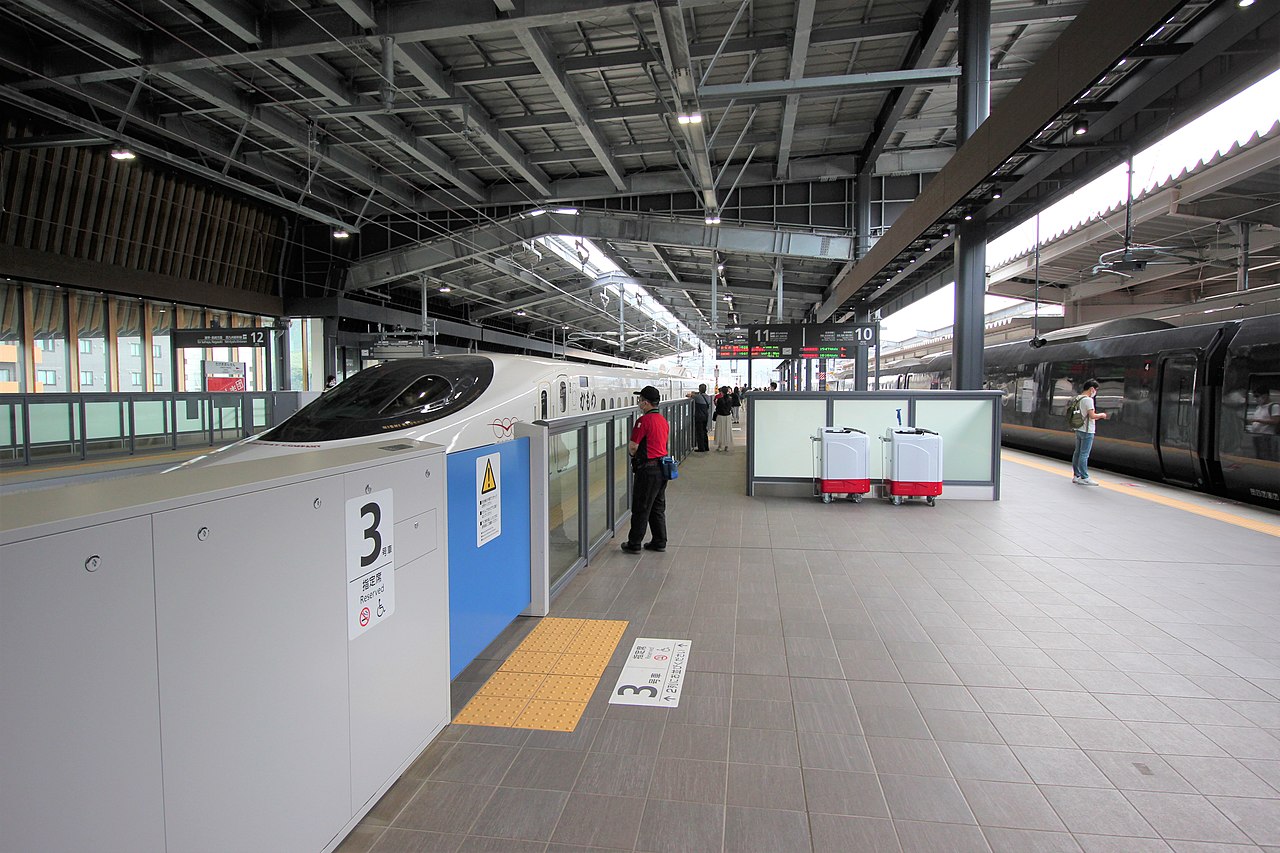
Because only the leading section is built, the line works in tandem with a conventional limited express. At Takeo-Onsen each Kamome Shinkansen meets a Relay Kamome limited express to and from Hakata, with a timed cross-platform transfer of about three minutes; staff are on hand to see passengers across, and the connecting train waits if the Shinkansen runs late, so the two are operated in practice as a single through service. Some Relay Kamome duties are worked by Midori trains to and from Sasebo and appear in timetables under a combined name. Even with this break of gauge in the middle of the trip, the partial opening cut the fastest Hakata to Nagasaki time from about two hours to roughly ninety minutes. Government and agency estimates made before opening put the saving in similar terms: a 2019 estimate based on the transfer method had Hakata to Nagasaki falling from about one hour forty-eight minutes to roughly one hour twenty.
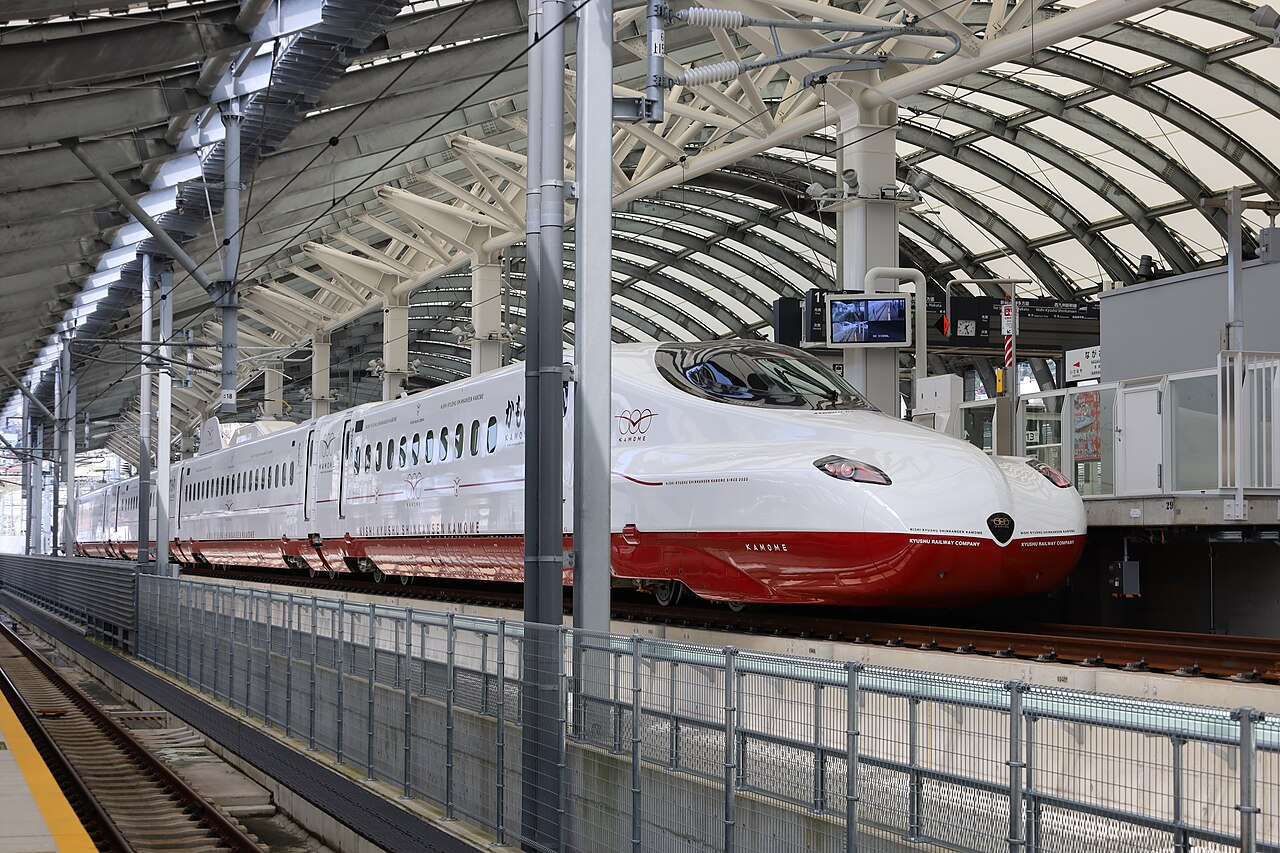
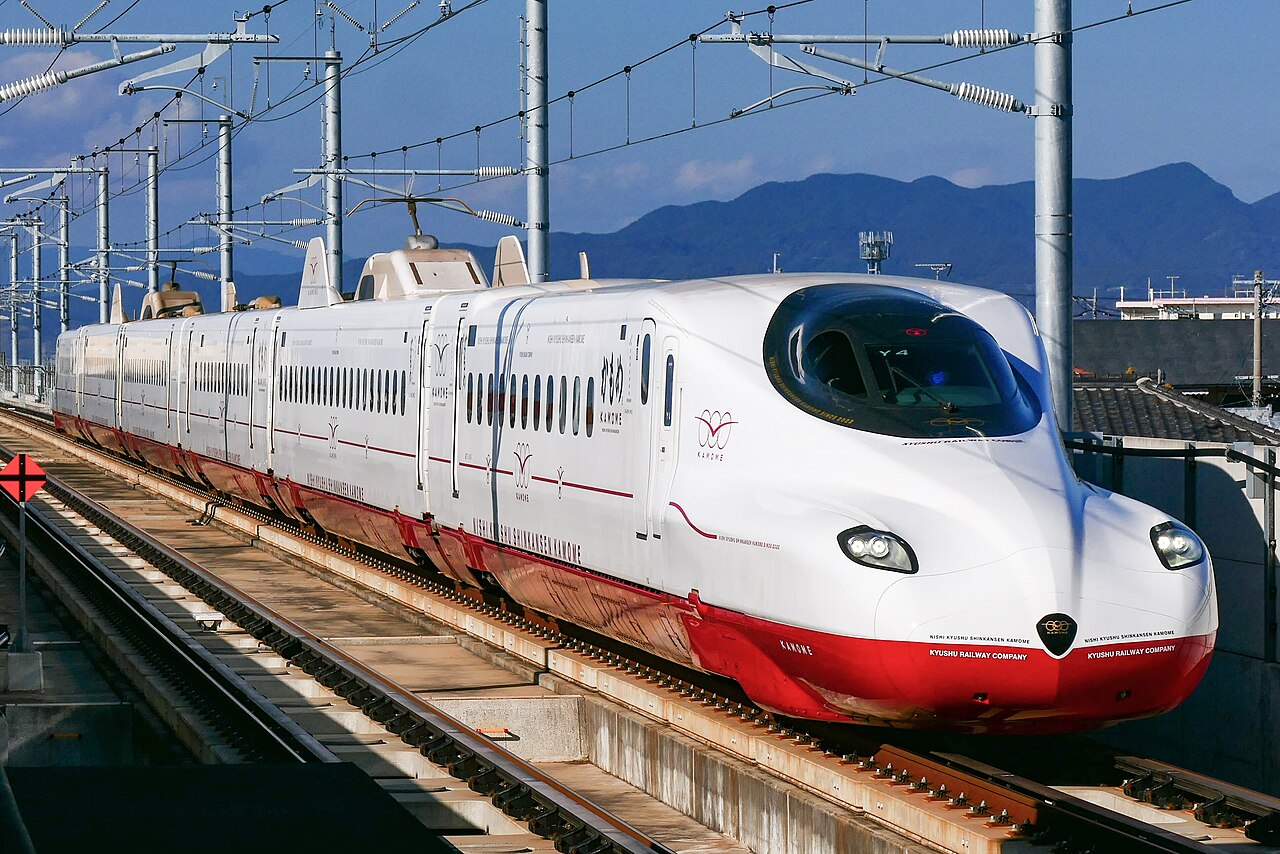
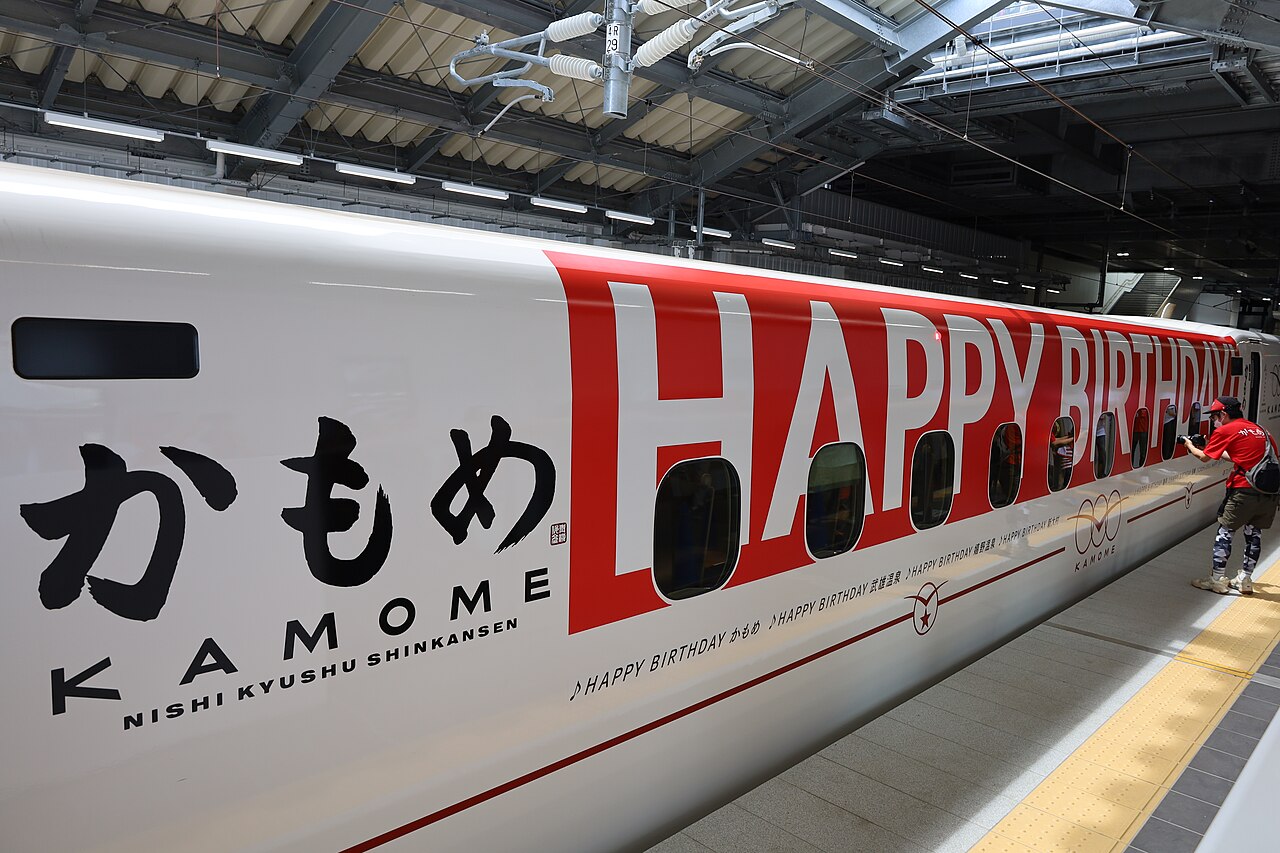
The trains are six-car N700S sets running at up to 260 km/h, the only service type on the line and branded Kamome. The interiors omit a Green (first-class) car and a smoking room; cars at the Nagasaki end are reserved and the remainder are non-reserved, in a two-and-two and three-and-two layout respectively, and each set seats 396 passengers (per JR Kyushu's official specification; the Nagasaki Shimbun announcement report stated 391). The livery is white with JR Kyushu's corporate red along the lower body and gold lettering, and the cars carry the Kamome name on their sides, echoing the 800 series that bore the Tsubame name when the first stretch of the Kyushu Shinkansen opened. Four sets were built for the opening, with two typically needed during the day and three in the afternoon and evening, and a fifth set was added in August 2023 so that a train could be withdrawn for inspection without thinning the service. Because the connecting Relay Kamome carries Green seating and a different mix of reserved and non-reserved cars, a passenger riding through between Hakata and Nagasaki may find themselves in a different class on each leg.
In its role as a partial line feeding a relay connection, the Nishi Kyūshū Shinkansen has carried roughly seven thousand passengers a day. In the year to 22 September 2023 it carried about 2.46 million, and in the following year to 22 September 2024 about 2.54 million, modestly above the ridership of the conventional Kamome limited express it replaced on the Takeo-Onsen to Nagasaki section. The line's own published figures show an average of 5,882 passengers per day in fiscal 2022 — counting only the period from the late-September opening — rising to 6,239 in fiscal 2023, with passenger revenue growing from about 2.5 billion yen to about 4.9 billion yen across those two years. By the official cost-benefit appraisal the leading section is not, on its own, an economic winner: a fiscal 2018 estimate over fifty years gave it a benefit-to-cost ratio of 0.5 and an economic internal rate of return of about one percent, reflecting that the line was always intended as the first piece of a longer route rather than a complete one. Its total project cost came to 619.7 billion yen at April 2017 prices, up from the 500.9 billion yen approved in 2011 as material and regulatory costs rose. Whether the line is ever joined to the rest of the network — and how fast trains will eventually run between Nagasaki and Hakata — still turns on the unsettled section through Saga.
Timeline
- 1971Plans for a Shinkansen between Fukuoka and Nagasaki are first laid out by the Ministry of Transport.
- 197212 December: the route is promulgated in the basic plan under the Nationwide Shinkansen Railway Development Act.
- 197313 November: the development plan for five lines is decided; the route is set to pass through Saga and share track with the Kyushu Shinkansen toward Fukuoka.
- 1985Japanese National Railways publishes a map of the line running via Haiki in Sasebo.
- 1992JR Kyushu studies building the route with Shinkansen-grade structures but conventional narrow-gauge track (Super Tokkyū).
- 2002JRTT applies for permission to build the Takeo-Onsen to Nagasaki section to Super Tokkyū standard.
- 200716 December: JR Kyushu agrees with Saga and Nagasaki prefectures to keep operating the parallel narrow-gauge line for 20 years after opening, under vertical separation.
- 2008JRTT applies in March to build the ~45.7 km Takeo-Onsen to Isahaya segment and is granted permission that month; construction begins on 28 April.
- 201212 June: a standard-gauge Shinkansen build permit for Takeo-Onsen to Nagasaki is applied for (granted 29 June). 26 December: the government sets a policy to build the line as a variable-gauge system.
- 20195 August: a ruling-party committee decides the section east of Takeo-Onsen should be built to full Shinkansen standard; Saga objects. 28 October: Saga and the transport ministry agree only to continue discussions.
- 2021Saga Prefecture proposes two alternative full-standard alignments: north along the Nagasaki Expressway, or south to Chikugo-Funagoya via Saga Airport.
- 202223 September: the 66 km Takeo-Onsen to Nagasaki section opens, the shortest Shinkansen line in Japan and the first to open in the Reiwa era, with a cross-platform Relay Kamome transfer at Takeo-Onsen. N700S six-car sets enter service.
- 2023August: a fifth N700S six-car set is added so a train can be withdrawn for inspection. In the first year to 22 September, ridership is about 2.46 million.
- 2024In the second year to 22 September, ridership is about 2.54 million, around 7,000 per day and above the former conventional Kamome service.
- 2025The route east of Takeo-Onsen toward Hakata via Saga remains unfinalized and unbuilt.
Sources
Facts last verified 3 June 2026.
Gallery 2 photos
Every photo for this page — tap any image to view it full-size. All from Wikimedia Commons (credit under each).