History
When the Kyushu Shinkansen first opened between Shin-Yatsushiro and Kagoshima-Chūō on 13 March 2004, new Relay Tsubame services began on the parallel Kagoshima Main Line between Hakata and Shin-Yatsushiro, connecting with the Shinkansen Tsubame. This arrangement was unique in Japan: Shin-Yatsushiro was the only station where conventional trains stopped at platforms directly adjacent to the Shinkansen platforms to ease cross-platform transfers. When the remaining section of the Kyushu Shinkansen opened on 12 March 2011, the faster services were taken over by the newly created Mizuho and Sakura, and Tsubame became an all-stations service across the line — comparable to the Kodama on the Tōkaidō and San'yō Shinkansen — operating primarily as a shuttle between Hakata and Kumamoto. Services run twice per hour in each direction during the morning and evening and once per hour in the middle of the day, with some Tsubame continuing to or from Kagoshima-Chūō; the frequency is 0–3 trains per hour, and every Tsubame stops at all stations. No onboard trolley sales are offered, though drink vending machines are installed on N700 series sets.
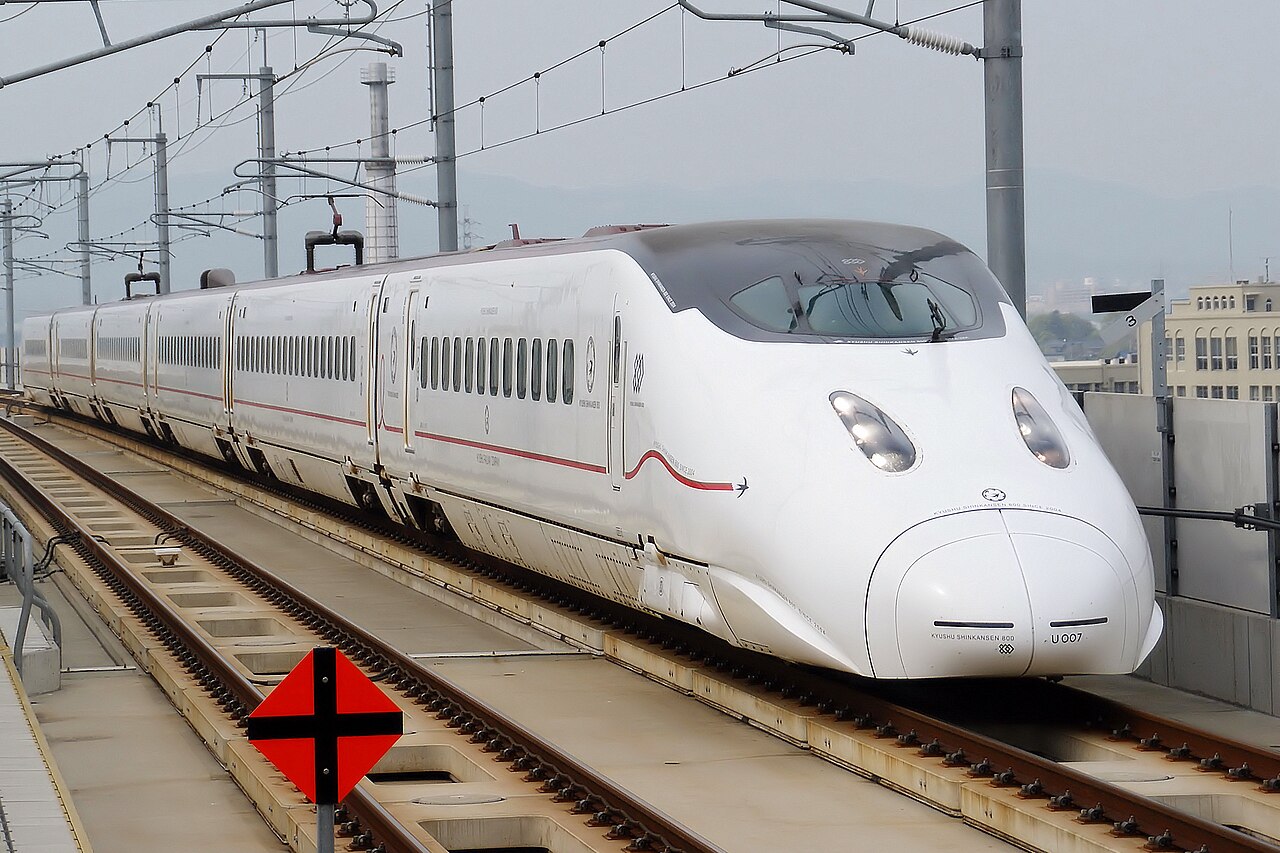
Services are formed of eight-car N700 series sets (JR West N700-7000 and JR Kyushu N700-8000) or six-car JR Kyushu 800 series sets, with the 800 series having been used since the service began. All cars became non-smoking with the Shinkansen smoking ban of March 2024. After the Tōhoku-style limited-stop pattern passed to Sakura and Mizuho in 2011, a handful of Tsubame again ran through onto the San'yō Shinkansen in Honshu: a timetable revision on 17 March 2012 added Tsubame workings from Kumamoto to Shin-Shimonoseki and from Kagoshima-Chūō to Kokura — the first time a regular Tsubame had reached a Honshu line in the 37 years since the Okayama–Nishi-Kagoshima limited express was withdrawn in 1975. That through-running ended on 16 March 2013, but the 4 March 2017 revision restored a Kumamoto-to-Kokura working onto the San'yō Shinkansen. The service's growth and disruptions are also on record: cumulative ridership passed 10 million passengers on 18 March 2007, 1,101 days after the line opened, and reached 20 million by March 2010, while the April 2016 Kumamoto earthquake suspended the whole line before service was progressively restored that month.
Timeline
- 1930The Tsubame name (originally written 燕) is first used from 1 October 1930 for limited express services between Tokyo and Kobe, the start of a lineage that makes it one of the oldest names in Japanese railways.
- 1992JR Kyushu revives the Tsubame name from 15 July 1992 for a Kagoshima Main Line limited express (using new 787 series trains), having first obtained advance agreement from the other JR Group companies.
- 2004With the partial opening of the Kyushu Shinkansen between Shin-Yatsushiro and Kagoshima-Chūō on 13 March 2004, the Tsubame name moves to the Shinkansen and new Relay Tsubame services begin on the parallel Kagoshima Main Line, connecting at Shin-Yatsushiro — the only Japanese station where conventional trains stopped at platforms adjacent to the Shinkansen platforms.
- 2007Cumulative Tsubame ridership passes 10 million passengers on 18 March 2007, 1,101 days after the line opened on 13 March 2004.
- 2010Cumulative Tsubame ridership reaches 20 million passengers in March 2010.
- 2011When the remaining section of the Kyushu Shinkansen opens on 12 March 2011, the faster services pass to the new Mizuho and Sakura, and Tsubame becomes an all-stations service across the line (similar to the Kodama), running mainly as a Hakata–Kumamoto shuttle; the Relay Tsubame ends operation.
- 2012The 17 March 2012 timetable revision adds two northbound Tsubame running onto the San'yō Shinkansen (Kumamoto–Shin-Shimonoseki and Kagoshima-Chūō–Kokura) — the first regular Tsubame to reach a Honshu line in the 37 years since the Okayama–Nishi-Kagoshima limited express was withdrawn in 1975.
- 2017After San'yō Shinkansen through-running ended on 16 March 2013, the 4 March 2017 revision restores a Kumamoto-to-Kokura Tsubame (now numbered 302), reopening through service onto the San'yō Shinkansen.
Gallery 4 photos
Every photo for this page — tap any image to view it full-size. All from Wikimedia Commons (credit under each).