History
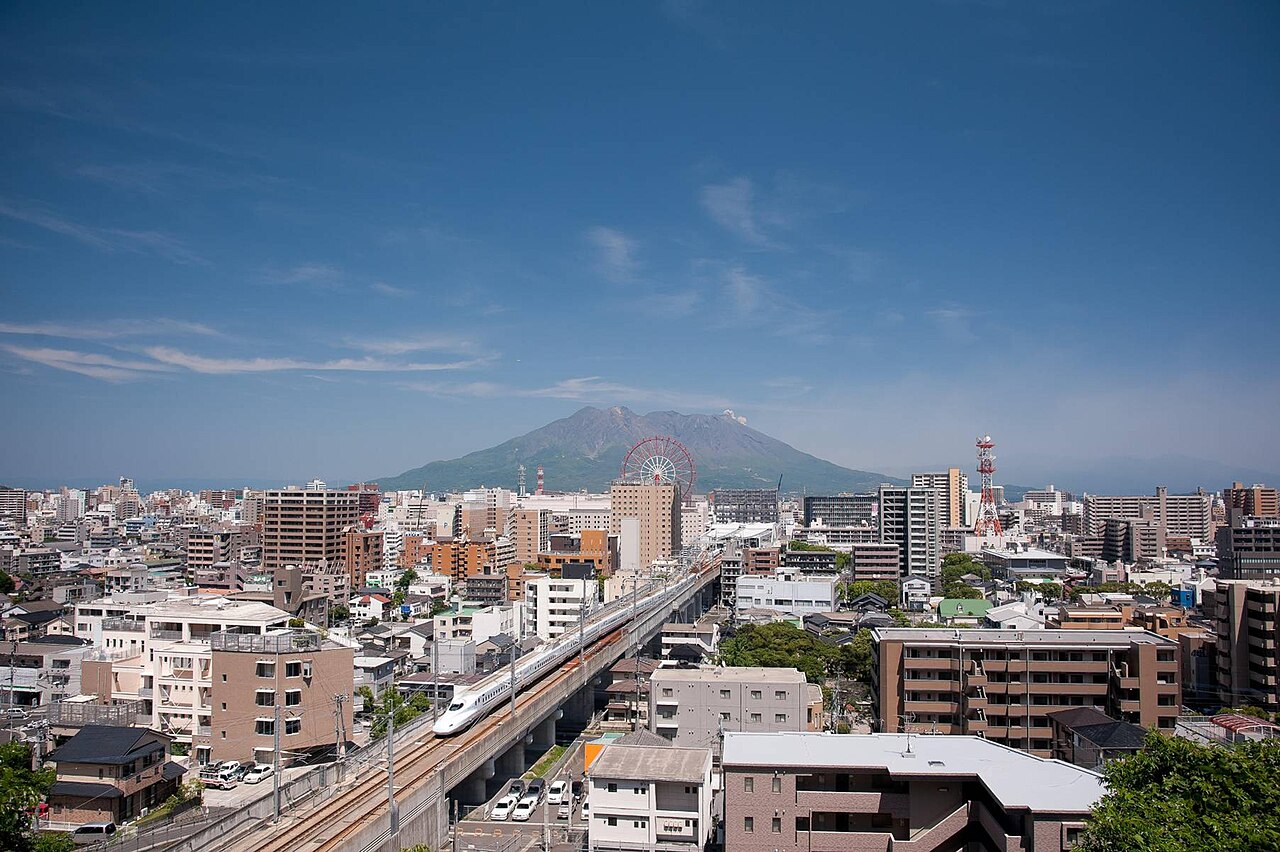
The route threads down the western side of Kyūshū through four prefectures — Fukuoka, Saga, Kumamoto and Kagoshima — and serves twelve stations, from Hakata in the north through Kumamoto and Shin-Yatsushiro to Kagoshima-Chūō at the southern terminus. Four of those stations were newly built for the Shinkansen alone. Like the San'yō Shinkansen to which it connects, it is a heavily tunnelled railway: tunnels account for about half of its total length, and the proportion is far higher on the mountainous southern half, where roughly seven-tenths of the alignment is underground. The line is electrified at 25 kV, 60 Hz, and its physical length of 256.8 km is distinct from the 288.9 km "operating" distance used for fares, which is reckoned along the parallel conventional route. A distance marker near Kagoshima-Chūō, measured from Tokyo Station, records the largest distance figure shown by any railway milepost in Japan.
The line's origins reach back to the high-speed planning of the early 1970s, itself prefigured by a 1969 national development plan that already spoke of a Kyūshū high-speed railway linking Fukuoka and Kumamoto and reaching into the south of the island. Unlike the Tōkaidō and San'yō Shinkansen, which were built to relieve overloaded trunk lines, the planned-network lines were conceived as instruments of regional development. The Kyūshū Shinkansen between Fukuoka and Kagoshima was named in the basic plan promulgated under the Nationwide Shinkansen Railway Development Act and publicly announced in 1972, and in November 1973 it was among the five so-called seibi (planned) Shinkansen lines whose development plans were formally decided, the route specified to pass through the Kumamoto and Sendai areas with the national railway (JNR) designated as the builder.
Worsening JNR finances then stalled the project: a 1982 cabinet decision shelved the planned-network lines for the time being. The way reopened in January 1987, when that suspension was reversed against a background of national-railway reform and strong local pressure. The break-up and privatisation of JNR that April briefly made the newly created JR Kyushu the nominal builder, but later in 1987 responsibility for constructing the line was handed to the public Japan Railway Construction Public Corporation. To hold down construction cost, planners initially favoured a "Transport Ministry plan" that would have built the Yatsushiro–Nishi-Kagoshima segment to Shinkansen dimensions but laid narrow-gauge track at first — the Super Express, or super-tokkyū, method — running a 200 km/h limited express through to Hakata rather than a full Shinkansen, a scheme estimated to cut the Hakata–Nishi-Kagoshima journey from about four hours to a little over two.
Construction of the Kagoshima Route began in 1991, when a provisional plan for the Yatsushiro–Kagoshima segment was settled and a groundbreaking ceremony was held that September. The starting point was later shifted to Shin-Yatsushiro. Through the late 1990s the intermediate Funagoya–Shin-Yatsushiro segment was authorised under the same Super Express method, but national policy then changed course decisively: in December 2000 the government resolved to build the whole Hakata–Kagoshima corridor to full Shinkansen standard, and in April 2001 the entire route was authorised as a standard-gauge, full-spec line. The earlier narrow-gauge compromise was abandoned in favour of a true Shinkansen end to end.
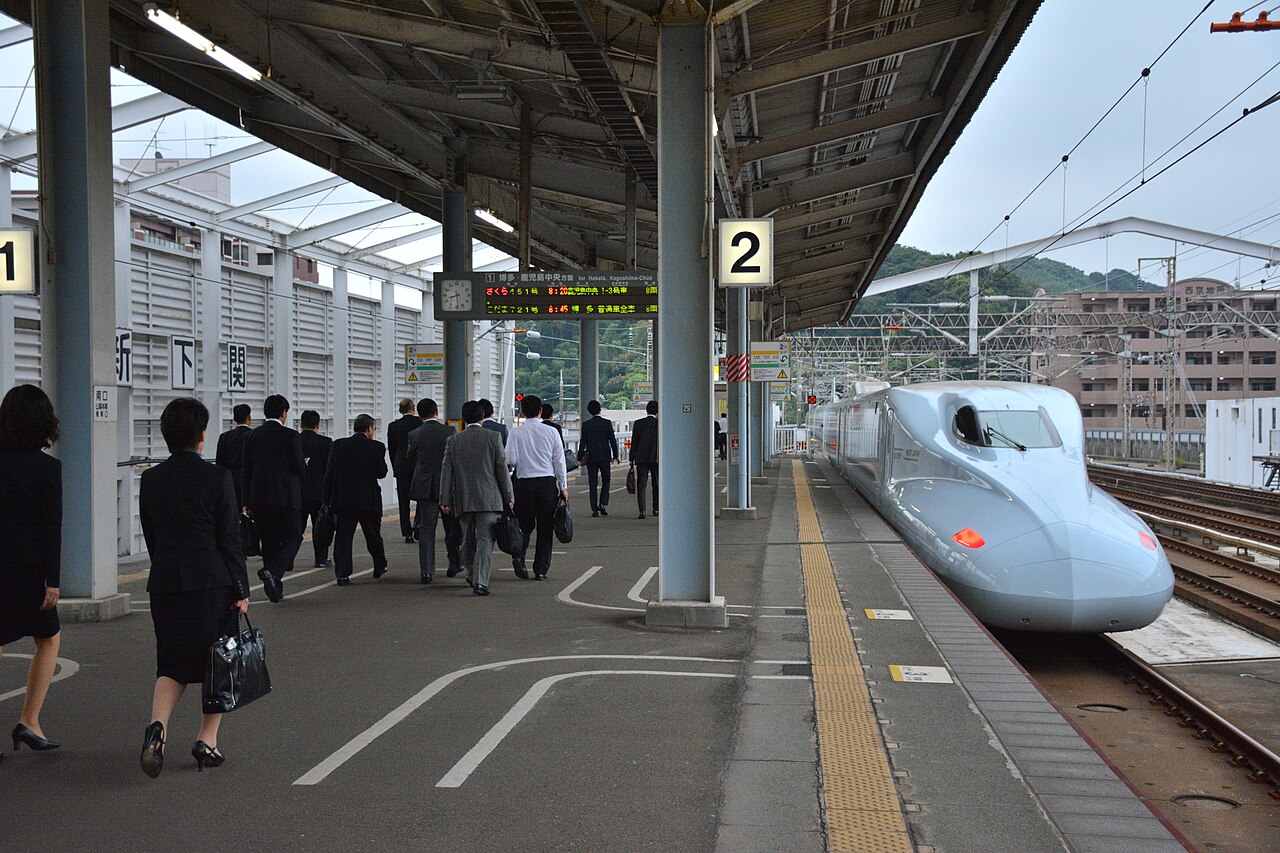
The line opened in two stages, southern half first. On 13 March 2004 the southernmost segment, Shin-Yatsushiro to Kagoshima-Chūō (126.8 km), entered service as a full-spec Shinkansen. The terminal Nishi-Kagoshima was renamed Kagoshima-Chūō to mark the occasion. Because the northern half was still years from completion, JR Kyushu adopted an unusual cross-platform arrangement at Shin-Yatsushiro: Shinkansen Tsubame trains terminated there and passengers stepped directly across the same platform to a conventional limited express, the Relay Tsubame, which ran the remaining Shin-Yatsushiro–Hakata leg on the existing network. The two services shared train numbers and could be booked on a single ticket, and at the southern end the new Shinkansen cut the Shin-Yatsushiro–Kagoshima-Chūō run from about two hours to little over half an hour. On the same day the parallel conventional Kagoshima Main Line between Yatsushiro and Sendai was separated from JR Kyushu and transferred to the new third-sector operator, Hisatsu Orange Railway, where fares subsequently rose by roughly thirty percent.
Seven years later the northern half completed the route. On 12 March 2011 the Hakata–Shin-Yatsushiro segment (130.0 km) opened, finishing the Kagoshima Route some thirty-eight years after its development plan had been decided and removing the Shin-Yatsushiro interchange. The Relay Tsubame was withdrawn the same day, and Tsubame was redefined as the line's all-stations service. The full-opening date was, however, overshadowed by catastrophe elsewhere: ceremonies had been arranged at communities up and down the line for 12 March, but the great Tōhoku earthquake had struck the day before, on 11 March 2011, and the opening celebrations were called off across the route. A makeshift "hundred-day" send-off was held at Hakata and other stations on 19 June 2011, framed both as a belated launch and as a wish for recovery from the disaster.
Full opening also unlocked the line's defining operational feature: direct running onto the San'yō Shinkansen and through to Shin-Ōsaka. From 12 March 2011 two new through services began. The premier Mizuho makes the fastest runs between Shin-Ōsaka and Kagoshima-Chūō, while the Sakura provides the regular hourly through service with additional stops; both cross onto JR West's San'yō Shinkansen, and with a further interchange at Shin-Ōsaka the line is connected all the way to Tokyo. The all-stations Tsubame, by contrast, stays on the Kyūshū Shinkansen, shuttling chiefly between Hakata and Kumamoto; its name revives that of the former Hakata–Kagoshima limited express, and the three service tiers descend in speed from Mizuho to Sakura to Tsubame. Through running began at fifteen round trips a day; after additional trainsets were delivered, the 2012 timetable raised this to twenty-three round trips and trimmed journey times further once slow-running restrictions near Shin-Yatsushiro were lifted, bringing the fastest Shin-Ōsaka–Kagoshima-Chūō trip to 3 hours 43 minutes (JA rev 109283577; EN gives the current Mizuho time as 3h45m). End to end, full opening had cut Hakata–Kagoshima-Chūō to about one hour and nineteen minutes and Hakata–Kumamoto to about thirty-three minutes.
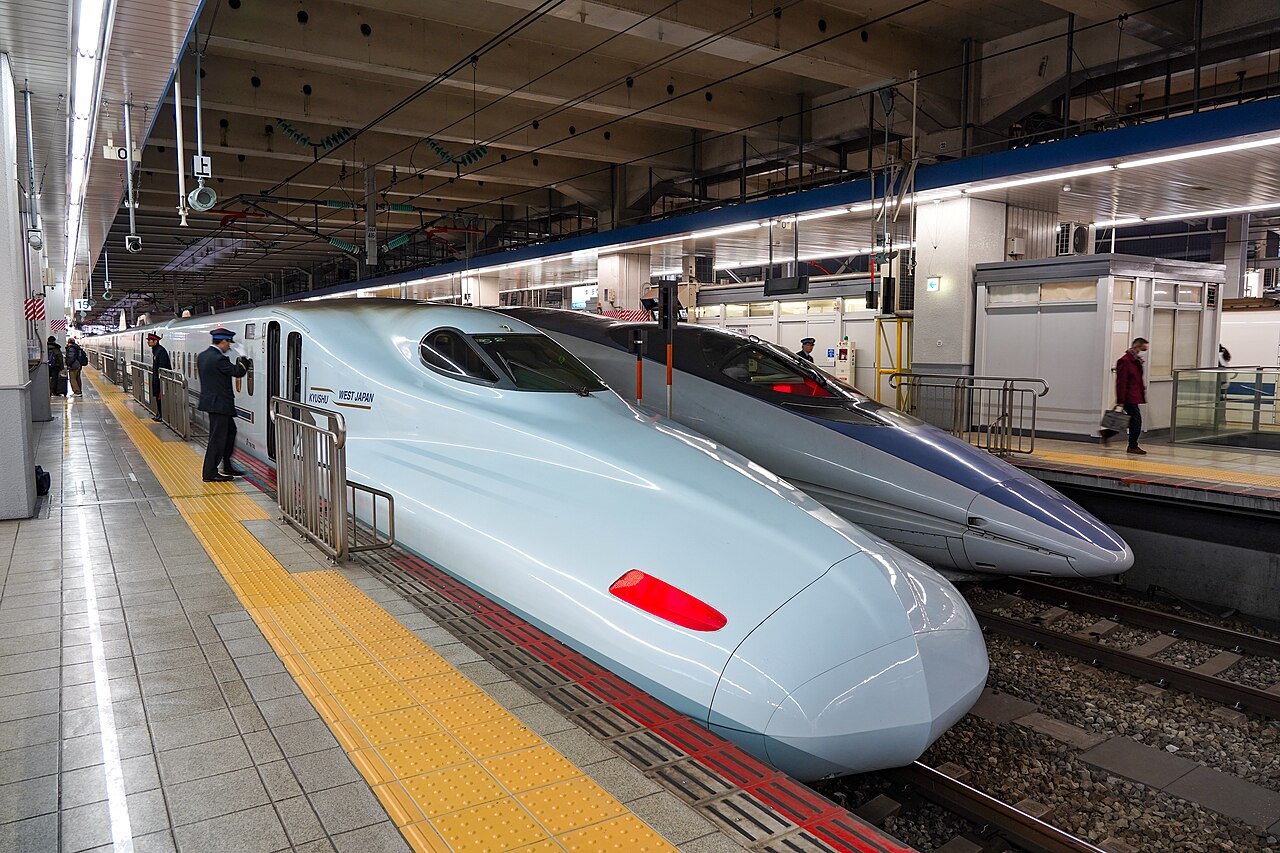
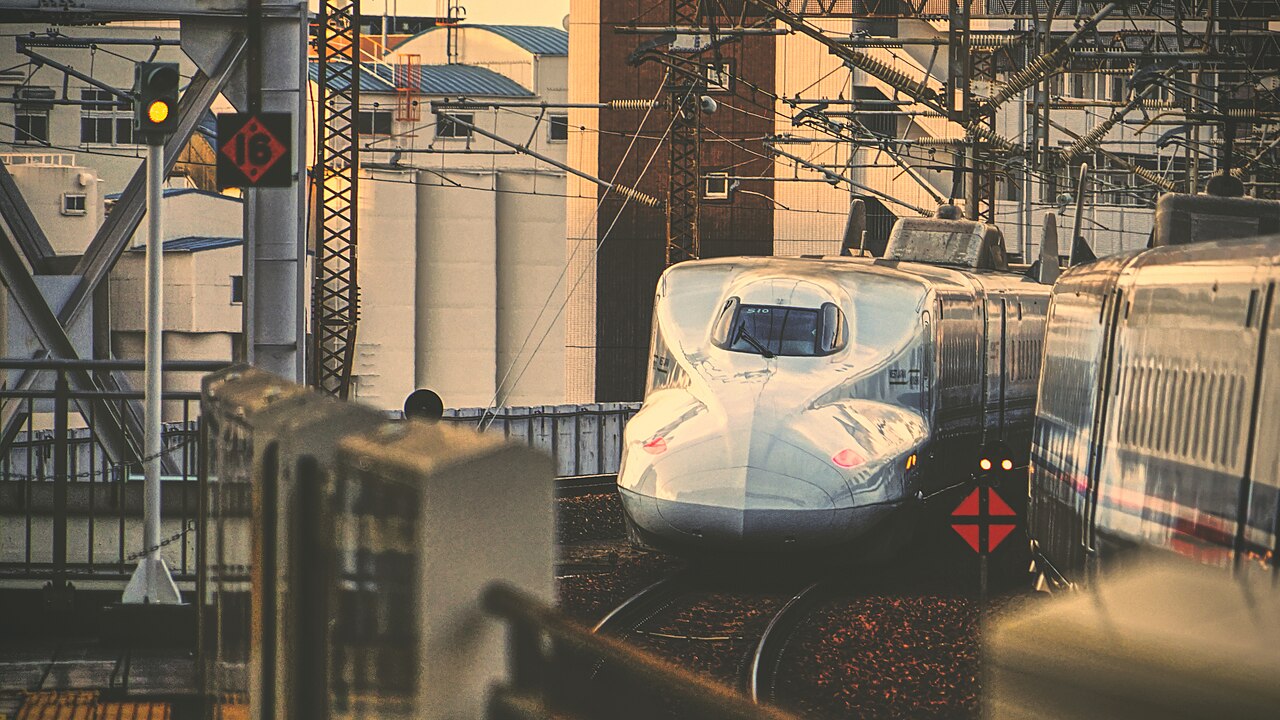
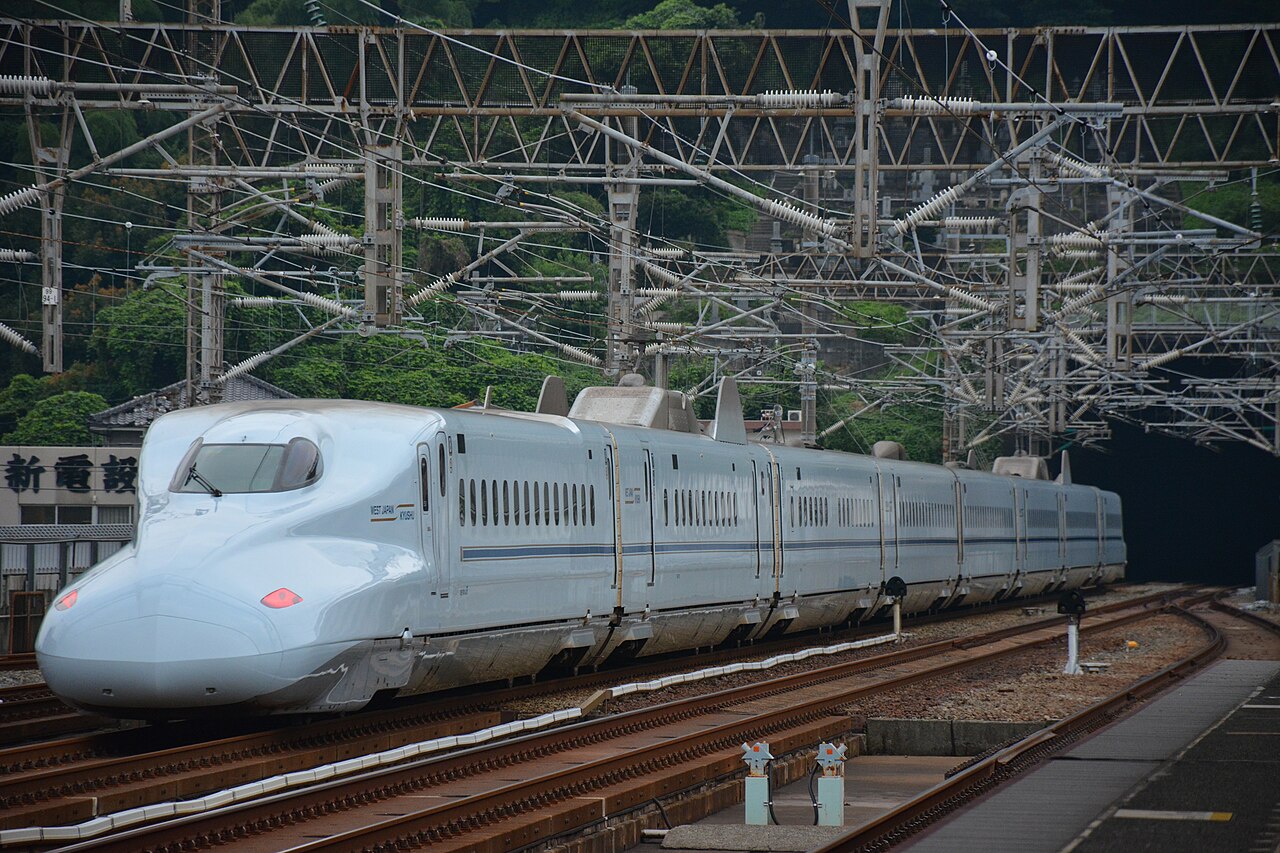
The line is worked by two classes of standard-gauge, double-track Shinkansen stock, both designed for a route with long tunnels and unusually steep gradients — about half the line is in tunnel, and short sections reach a 35-per-mil grade, the steepest on any Shinkansen. Those gradients are partly a consequence of economy: to save money the route was built to a somewhat simpler specification than older Shinkansen in places, including slab track that was deliberately hollowed out in part, and the steep grades on the southern half and at the Hakata end of the longest tunnel are among the visible results. The rolling stock had to be designed around them. The 800 series, developed by Hitachi from the existing 700 series and introduced with the 2004 partial opening, is a six-car, all-powered design with a deliberately Japanese-styled interior; every car is motored to handle the climbs, and the type is held to the line's 260 km/h ceiling. Nine 800-series sets are in service, the later examples receiving cosmetic revisions. For through services to Shin-Ōsaka, JR Kyushu and JR West jointly developed an eight-car version of the N700 series (the 7000 and 8000 sub-series), fitted with speed-holding braking on every bogie for the long downgrades; although the trains are capable of 300 km/h, they are operated at the line's design speed of 260 km/h while on the Kyūshū Shinkansen. The combined N700 fleet for the through services reached twenty-nine sets — nineteen JR West sets and ten JR Kyushu sets, totalling 232 cars — by spring 2012, with a further set added that summer. The maximum speed across the line is 260 km/h, its design speed, on the long southern stretch between the Hakata depot junction and Kagoshima-Chūō.
The Kyūshū Shinkansen reshaped travel within the island and toward the Kansai region. Six months after full opening, in September 2011, JR Kyushu reported that ridership on the southern part of the island, between Kumamoto and Kagoshima, had risen about sixty-four percent year on year, comfortably beating the company's own forty-percent forecast; in the more contested northern corridor, where the Shinkansen faces conventional rapid trains, a private railway and expressway buses, the increase was a more modest thirty-eight percent. Over the longer term the modal shift was striking. On the Fukuoka–Kagoshima corridor rail's share of public-transport trips climbed from around half in the early 1990s to roughly two-thirds after the 2004 partial opening and to about eighty-four percent after full opening, while air travel's share collapsed to a few percent; rail patronage on that corridor, which had stood at under a million a year before construction, more than doubled to over two million a year after full opening. On the longer Kansai routes the change was sharper still: between the Kansai region and Kumamoto, where air had carried more than three-quarters of travellers, rail and air shares reversed and rail rose to a clear majority, and between Kansai and Kagoshima air fell from over ninety percent toward roughly a third. The line's arrival also remade competing modes — long-distance buses and short-haul flights were cut back on the corridors it served — and, on the conventional side, the separation of the Yatsushiro–Sendai section to the Hisatsu Orange Railway left that third-sector operator carrying steadily thinning local traffic at higher fares. Measured by average daily traffic across the whole line, ridership grew from roughly 8,000 passengers a day on the isolated southern segment in the mid-2000s to about 16,800 once the full line opened, and to around 19,000 in the years just before the pandemic. The COVID-19 collapse cut daily ridership and revenue by more than half in fiscal 2020, after which traffic recovered steadily, with the most recent reported years again approaching pre-pandemic levels.
The line's most serious operational test came with the 2016 Kumamoto earthquakes. A magnitude-6.5 foreshock on the evening of 14 April 2016, followed by a magnitude-7.3 mainshock in the early hours of 16 April, both of maximum seismic intensity, inflicted heavy damage along the Kagoshima Route. Nine trains were running when the foreshock hit; an out-of-service 800-series set deadheading from Kumamoto derailed on a river bridge about 1.3 km from Kumamoto Station and was shifted further by the mainshock, while every other train was brought to a controlled stop by the seismic-detection system without derailing. Because the structures had been engineered to withstand a quake of the 1995 Kobe class, the fixed infrastructure escaped catastrophic structural failure, though there was cracking to viaduct supports and many sound-barrier walls came down. Service was restored in stages over the following days, and the full line reopened thirteen days after the quake, with through running to the San'yō Shinkansen resuming the next day; some sections ran under speed restrictions for a considerable time afterward.
More than two decades after its first trains and over a decade as a complete route, the Kyūshū Shinkansen functions as the high-speed spine of western Kyūshū and the island's fast link to Honshū, carrying Mizuho, Sakura and Tsubame services over a 256.8 km line at up to 260 km/h. Its staged construction, its narrow-gauge-to-full-spec change of plan, the cross-platform Relay Tsubame era, and the through services to Shin-Ōsaka together make it one of the more distinctive chapters in the build-out of the national Shinkansen network.
Timeline
- 1972The Kyūshū Shinkansen (Fukuoka–Kagoshima) is named in the basic plan publicly announced under the Nationwide Shinkansen Railway Development Act.
- 197313 November: development plans are decided for five planned-network (seibi) Shinkansen lines, including the Kyūshū Shinkansen, with JNR named as builder.
- 1982September: a cabinet decision shelves the planned-network Shinkansen lines amid JNR's financial difficulties.
- 1987January: the suspension is reversed, reopening the path to construction; a cost-saving 'Transport Ministry plan' envisages an initial narrow-gauge Super Express to Hakata.
- 1991Construction of the Kagoshima Route begins; a provisional plan for the Yatsushiro–Kagoshima segment is settled and a groundbreaking ceremony is held in September. (EN: construction of the Kagoshima route began in 1991.)
- 2000December: the government resolves to build the whole Hakata–Kagoshima corridor to full Shinkansen (full-spec) standard, abandoning the narrow-gauge plan.
- 2001April: the entire Hakata–Kagoshima route is authorised as a standard-gauge, full-spec line.
- 200413 March: the southern Shin-Yatsushiro–Kagoshima-Chūō section (126.8 km; EN rounds to 127 km) opens; the 800 series enters service; Nishi-Kagoshima is renamed Kagoshima-Chūō; passengers change cross-platform at Shin-Yatsushiro to the Relay Tsubame; the parallel Kagoshima Main Line (Yatsushiro–Sendai) passes to Hisatsu Orange Railway.
- 201112 March: the northern Hakata–Shin-Yatsushiro section (130.0 km) opens, completing the Kagoshima Route ~38 years after its plan; Mizuho and Sakura through services to Shin-Ōsaka via the San'yō Shinkansen begin, Tsubame becomes the all-stations service, and the Relay Tsubame is withdrawn. Opening ceremonies along the line are cancelled after the Tōhoku earthquake of 11 March; a 'hundred-day' send-off follows on 19 June 2011.
- 2011September: six months after full opening, JR Kyushu reports ridership up about 64% year-on-year in southern Kyūshū (Kumamoto–Kagoshima), beating its 40% forecast; the northern corridor rises about 38%.
- 2012Spring timetable: through services to Shin-Ōsaka increase to 23 round trips a day and journey times shorten after slow-running near Shin-Yatsushiro is lifted; fastest Shin-Ōsaka–Kagoshima-Chūō reaches 3 hours 43 minutes (JA rev 109283577; EN rev 1349210458 gives current Mizuho end-to-end as 3h45m).
- 2016April: the Kumamoto earthquakes (M6.5 foreshock 14 April; M7.3 mainshock 16 April, both max intensity 7) damage the route; a deadheading 800-series set derails near Kumamoto. The full line reopens 13 days later, with San'yō through running resuming the next day.
Sources
Facts last verified 3 June 2026.
Gallery 2 photos
Every photo for this page — tap any image to view it full-size. All from Wikimedia Commons (credit under each).