
History
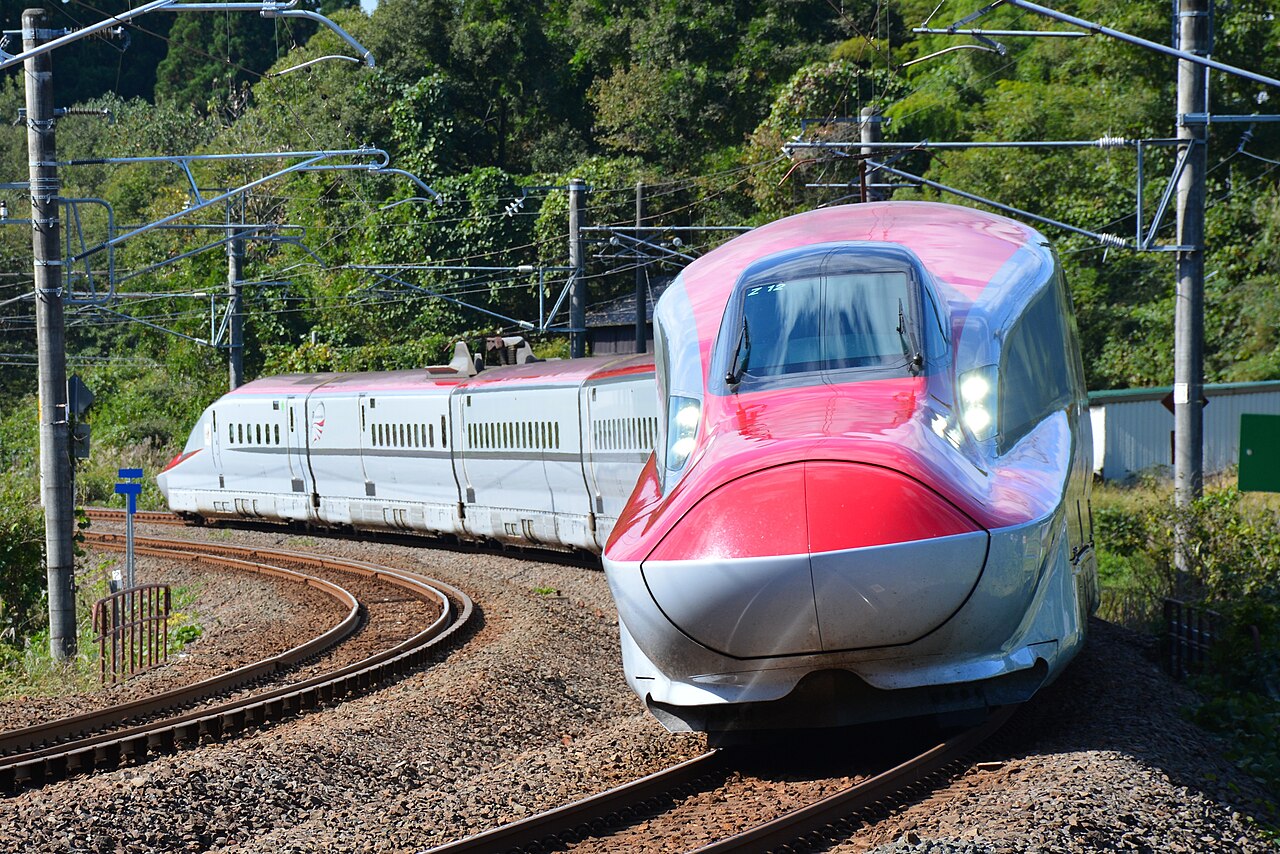
The idea grew out of Akita Prefecture's position on the rail map. After the Tōhoku Shinkansen opened, the Tazawako Line became more important as a feeder toward the Tokyo area, and in October 1984 the prefecture, jointly with the Tōhoku regional economic federation, commissioned a study into speeding up the Tazawako Line. By March 1986 a mini-Shinkansen was written into the prefecture's development plan as a priority. The politics then turned competitive. In July 1987 a Ministry of Transport committee formally selected the Fukushima–Yamagata section of the Ōu Main Line as the model route for the mini-Shinkansen concept; many in Akita felt they had been outmaneuvered by Yamagata, and a local promotion alliance was formed days later to press Akita's own case. Momentum returned in 1990: in August the ministry folded the Tazawako and Ōu Main Line works into its budget request, JR East set up a team that September to study Tōhoku Shinkansen–Tazawako Line through-running, and at the end of December a revived interest-free loan scheme from the national Railway Development Fund finally made construction financially feasible.
The project was budgeted at roughly ¥96.6 billion (96.6 oku yen, written 966億円). Of that, about ¥31.0 billion (310億円) was for rolling stock and about ¥65.6 billion (656億円) for ground facilities — itself split into about ¥59.8 billion (598億円) of construction work and about ¥5.8 billion (58億円) of renewing worn-out infrastructure. The funding model used interest-free loans from the Railway Development Fund covering half of the eligible cost for each prefecture, Akita and Iwate; the Japan Railway Construction Public Corporation acted as the building authority and entrusted the work to JR East, with the completed facilities to be transferred to JR East afterward. The rolling stock was held by a third-sector company, Akita Shinkansen Rolling Stock Holding Co., jointly funded by Akita Prefecture and JR East and leased to JR East. That company was dissolved on 31 March 2010; Akita Prefecture's investment of about ¥11.525 billion (115.25億円) was repaid in full, and the trains were sold to JR East for about ¥2.354 billion (23.54億円). In the end Akita Prefecture's net share came to about ¥9.8 billion (98億円) of construction cost, or roughly a tenth of the total.
Construction was approved quickly — JR East applied to the Ministry of Transport on 28 January 1992 and authorization followed on 30 January — and a groundbreaking ceremony was held in front of Akita Station on 13 March 1992. Track work began that same month with double-tracking on the Ōu Main Line. The job was done in stages rather than as one continuous build. A parallel single standard-gauge track was laid along the 51.7 km Ōmagari–Akita stretch of the Ōu Main Line; on a 13 km section between Jingūji and Mineyoshikawa a third rail was added to one of the narrow-gauge tracks so that mini-Shinkansen trains could use either alignment; and the final stage converted the 75 km narrow-gauge Tazawako Line between Morioka and Ōmagari to standard gauge and built a connecting ramp at Morioka onto the Tōhoku Shinkansen, completed in December 1996. To shorten the work, JR East imported a continuous track-renewal machine from the United States — nicknamed Big Wonder, and the first use of such equipment in Japan — which substantially cut labor and construction time. Learning from a wave of level-crossing problems that had followed the Yamagata Shinkansen's opening, the prefecture, JR East's Akita branch and the prefectural police agreed before opening to grade-separate 24 of the prefecture's roughly seventy crossings and abolish nine others (33 crossings addressed in total); every station building on the route was rebuilt for the opening except Kakunodate, which had only recently been renovated. The service name was chosen by public competition from some 63,000 entries; Komachi finished first with 3,832 nominations.
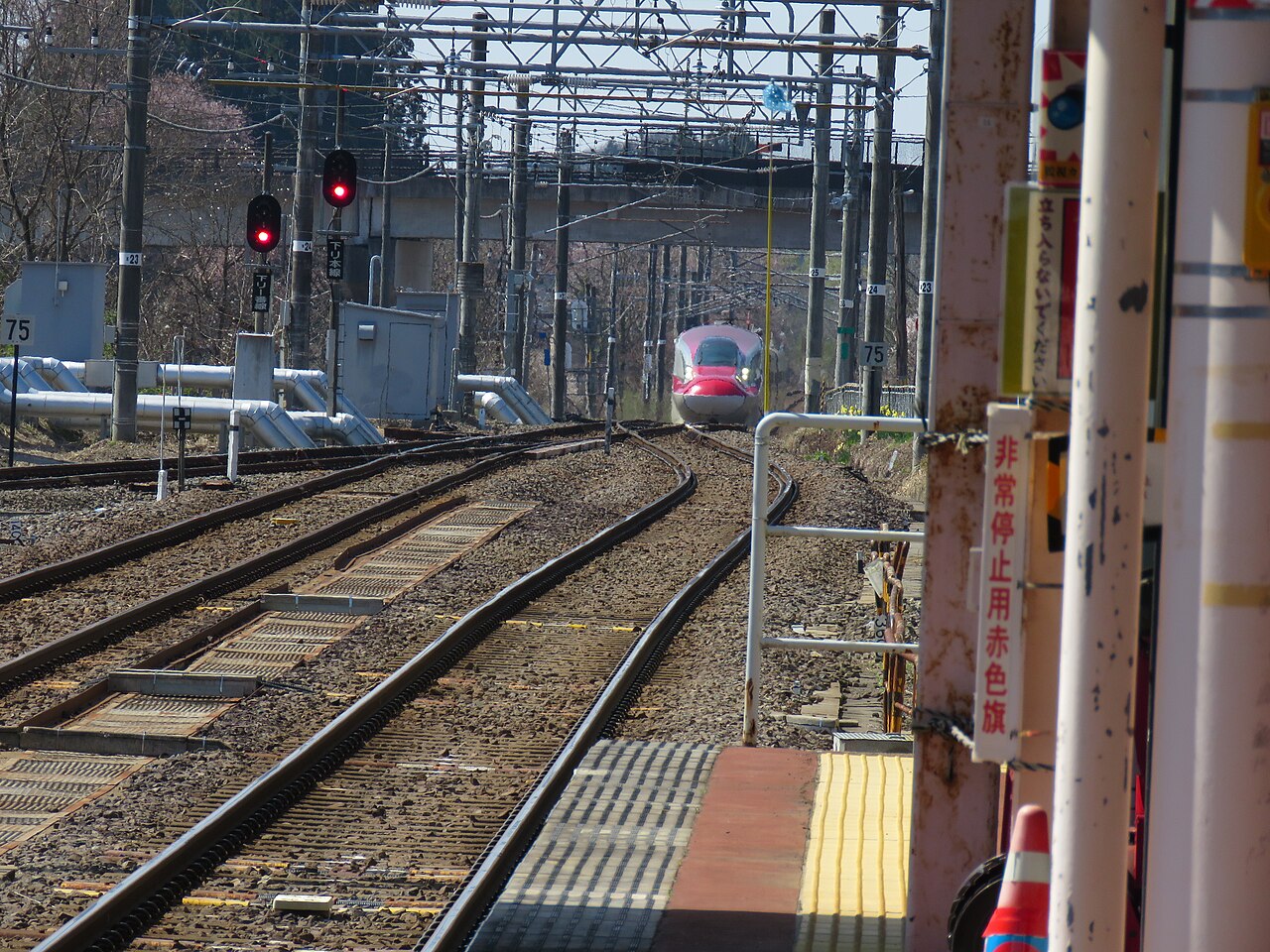
The Akita Shinkansen opened on 22 March 1997, after a five-year build, with Komachi trains running through between Tokyo and Akita using five-car E3 series sets, lengthened to six cars in 1998. The immediate effect was dramatic for a route that had required a change of trains at Morioka: the fastest Tokyo–Akita journey fell from 4 hours 37 minutes to 3 hours 49 minutes, with the average around 4 hours 21 minutes. About ten minutes of the saving came simply from eliminating the Morioka interchange, about 22 minutes from raising the Tōhoku Shinkansen ceiling from 240 to 275 km/h, and about 16 minutes from lifting the Tazawako and Ōu Main Line limit from 95 to 130 km/h.
In its early years the line was held back by its coupling partner. The E3 sets were built for 275 km/h, but most were coupled on the Tōhoku Shinkansen to 200 series trains capped at 240 km/h, so many Komachi services ran well off the headline time — some taking 4 hours 20 minutes to 4 hours 39 minutes, as much as fifty minutes slower than the fastest. JR East closed the gap by deploying more 275 km/h E2 series stock and adding non-stop Sendai–Morioka runs: a December 1998 revision raised the number of E2-coupled services, and from December 1999 all the Tokyo services were E2-coupled and ran at 275 km/h, bringing the average down to about 4 hours 3 minutes.
The next leap came with new rolling stock at both ends of the coupling. For the Akita Shinkansen, JR East introduced the 320 km/h-capable E6 series, paired on the trunk with the new E5 series. E6 sets entered service as Super Komachi on 16 March 2013, initially running at up to 300 km/h on the Tōhoku Shinkansen; the fastest Tokyo–Akita time fell to 3 hours 45 minutes. The 300 km/h operation was extended that September, and on 15 March 2014 every Komachi was switched to the E6 and the Tōhoku Shinkansen ceiling raised to 320 km/h. With that, the fastest Tokyo–Akita time reached 3 hours 37 minutes and the average 3 hours 50 minutes, finally bringing every scheduled service under four hours — seventeen years after opening. The E3 sets were retired from Akita service and the Super Komachi name dropped, with all trains simply called Komachi again. The speed distinction that defines a mini-Shinkansen remained intact: up to 320 km/h while coupled to a Hayabusa on the Tōhoku trunk between Tokyo and Morioka, but no more than 130 km/h once the Komachi separates and runs alone over the conventional Morioka–Akita section. On that section 110 km/h is more typical through the hills, and trains slow to around 90 km/h on the sharpest curves; the E6's body-tilting cannot be used there because the car is already at the limit of the conventional loading gauge.
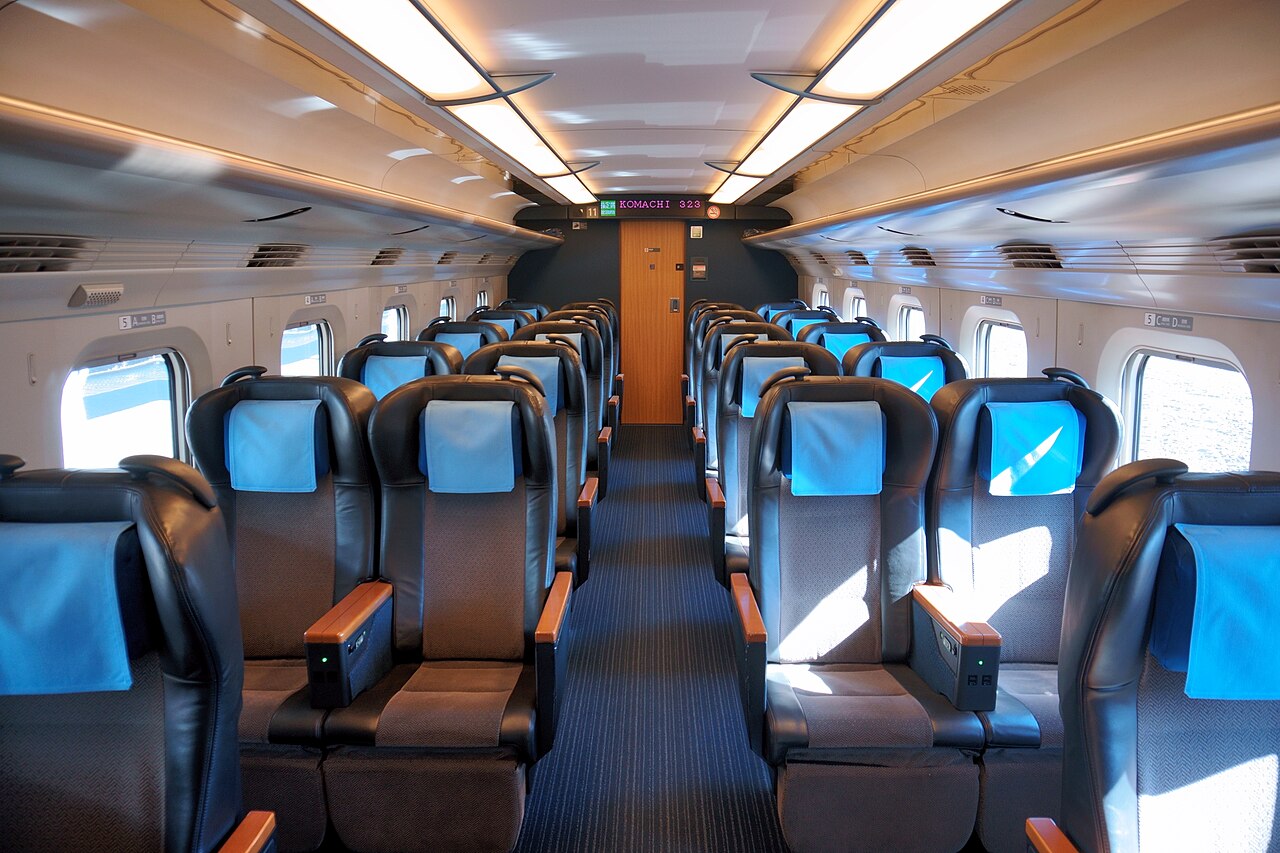
The conventional half of the route shapes the operation in other ways too. Much of the Tazawako Line and Ōu Main Line is single track, so trains make passing stops to let opposing services through. At Ōmagari, where the route changes from the Tazawako Line to the Ōu Main Line, the track layout forces a switchback: the train reverses direction, and seats set facing forward for the Tokyo–Ōmagari leg face backward from Ōmagari to Akita. The Shizukuishi–Tazawako area is heavy-snow country, and deep snow regularly delays trains; collisions with wildlife such as deer also disrupt running. Because the Komachi couples to a Hayabusa at Morioka, a late Komachi can hold its partner there, and on the congested Tokyo–Ōmiya trunk shared with the Jōetsu and Hokuriku Shinkansen those delays can ripple outward.
Weather and seismic events have repeatedly suspended the line. Heavy snow on the Sea of Japan side forced the first full-day suspension since opening on 5 January 2006, and a second came on 11 February 2006 after a Komachi was caught by an avalanche the previous day and snow-clearing was required; during the same severe winter a train was stranded with passengers aboard. The line was suspended after the Tōhoku earthquake and tsunami of 11 March 2011, with partial Morioka–Akita running resuming from 18 March and through service to Tokyo restored on 29 April 2011 as the Tōhoku Shinkansen fully reopened. Torrential rain closed the whole line in August 2013, July 2017 and again in July 2023, when record rainfall kept services suspended for several days. Earthquakes off Fukushima in 2021 and 2022 each disrupted operations as well.
A distinct hazard emerged from the coupling mechanism itself. On 19 September 2024 a Hayabusa–Komachi pairing uncoupled while running between Furukawa and Sendai on the Tōhoku Shinkansen and made an emergency stop; the roughly 320 passengers were unhurt, but the line was blocked for about five hours. JR East later attributed the fault to a metal fragment, apparently left from manufacturing, lodged behind the uncoupling switch in an E6 cab, which short-circuited and triggered the mechanism; similar fragments were found across ten Komachi sets. A second in-service separation occurred on 6 March 2025 between Ueno and Ōmiya, stopping near Nishi-Nippori; the Japan Transport Safety Board classed it a serious incident, and coupled through-running was suspended, with passengers told to change at Morioka. After an emergency measure to secure the uncoupling equipment, coupled operation with the Hayabusa and direct running to Tokyo were restored in stages from 14 March 2025. In April 2025 JR East began drawing part of the traction power for the Akita–Morioka section from solar-generated renewable energy, its first such trial on the line.
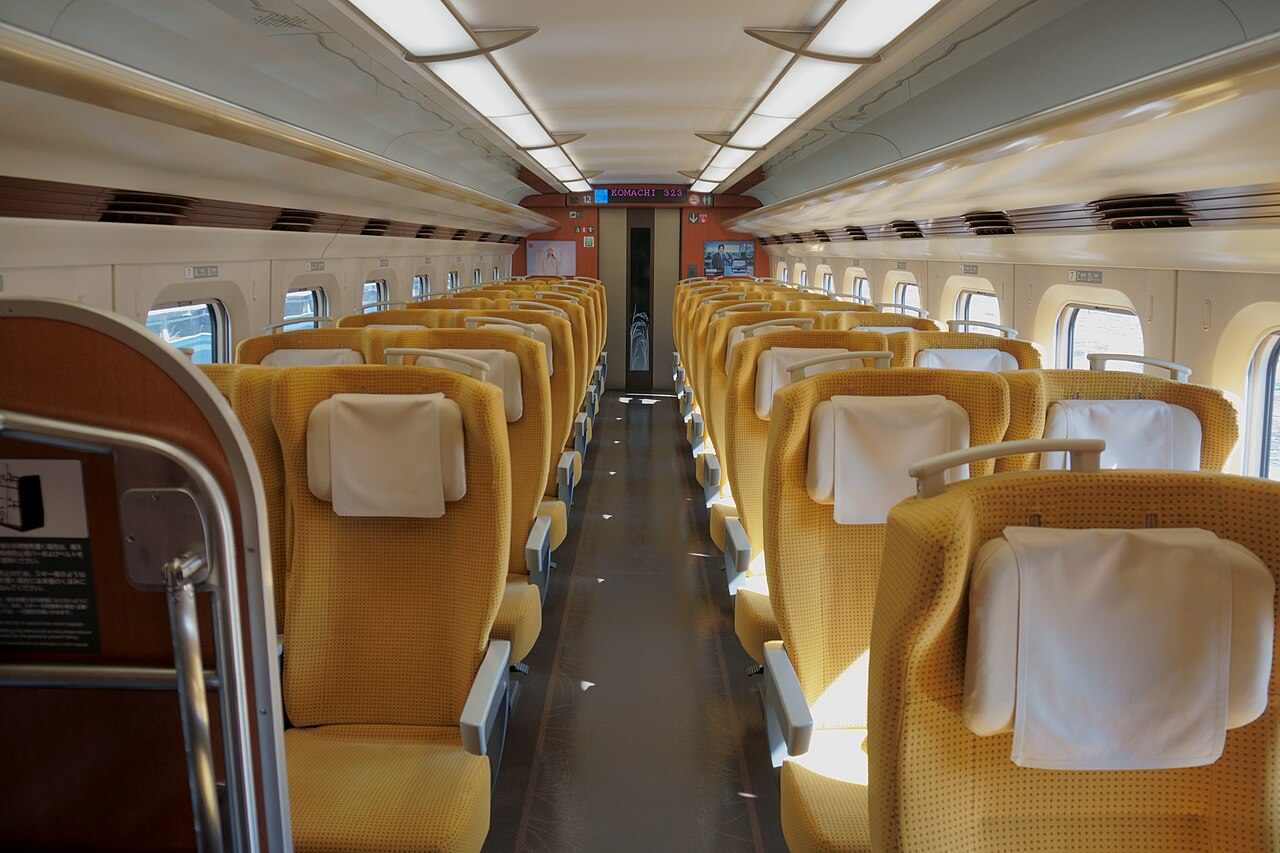
The Akita Shinkansen carries a substantial share of the travel between Akita and the capital region. Ministry data for 2000 put annual rail travel into Akita from the Tōhoku Shinkansen-line prefectures at about 690,000 passengers — the largest flows from Miyagi at about 281,000, then Tokyo at about 233,000 and Iwate at about 88,000 — with a comparable volume travelling the other way. Cumulative ridership passed one million within months of opening in August 1997 and reached fifty million by October 2019, a steady climb that the prefecture has treated as a vindication of the project. Regauging the conventional lines did have a cost beyond money: it severed the through connection that had once let trains run from Morioka via Akita toward Aomori, so the former Tazawa limited express that ran that corridor was cut back, and the city of Noshiro has periodically asked JR East to extend the Akita Shinkansen northward to Higashi-Noshiro Station (東能代駅) specifically — a request seen as difficult given the through-freight role of the Ōu Main Line north of Akita. Looking ahead, Akita Prefecture and JR East signed a memorandum on 26 July 2021 to advance a New Sengan Tunnel across the steep, weather-prone Iwate–Akita border between Tazawako and Akabuchi, with JR East proposing to bear sixty percent of the cost and a hoped-for saving of about seven minutes; by December 2024 the estimated cost had risen by ¥30 billion to about ¥100 billion (700億 to 1,000億円) and the projected build extended from roughly eleven to fifteen years.
Timeline
- 1984October: Akita Prefecture, with the Tōhoku regional economic federation, commissions a study into speeding up the Tazawako Line, which had grown in importance as a feeder toward Tokyo after the Tōhoku Shinkansen opened.
- 1987July: a Ministry of Transport committee selects Fukushima–Yamagata on the Ōu Main Line as the model mini-Shinkansen route; Akita forms a promotion alliance days later to advance its own line.
- 1990December: a revived interest-free loan scheme from the national Railway Development Fund makes construction of the Akita mini-Shinkansen financially feasible.
- 1992JR East applies to the Ministry of Transport on 28 January and is authorized on 30 January; a groundbreaking ceremony is held at Akita Station on 13 March and track work begins that month. Project cost budgeted at about ¥96.6 billion (966億円).
- 1996December: the final construction stage is completed — the 75 km Tazawako Line (Morioka–Ōmagari) regauged to standard gauge plus a connecting ramp at Morioka onto the Tōhoku Shinkansen. The service name Komachi had been chosen in July from about 63,000 public entries.
- 199722 March: the line opens after a five-year build; Komachi runs through Tokyo–Akita in five-car E3 series sets (coupled to 200 series / E2 on the Tōhoku Shinkansen). Fastest Tokyo–Akita time falls from 4h37m to 3h49m. Cumulative ridership passes 1 million on 15 August.
- 1998December: all sets lengthened from five to six cars; the share of 275 km/h E2-coupled Tōhoku services is increased to reduce journey times.
- 1999December: all Tokyo Komachi services become E2-coupled and run at 275 km/h on the Tōhoku Shinkansen, cutting the average Tokyo–Akita time to about 4h03m.
- 20065 January: first full-day suspension since opening, due to heavy snow on the Sea of Japan side. 11 February: a second full-day suspension after a Komachi is caught in an avalanche the previous day; a train is also stranded with passengers aboard during the severe winter.
- 201031 March: the third-sector Akita Shinkansen Rolling Stock Holding Co. is dissolved; Akita Prefecture's ~¥11.525 billion (115.25億円) is repaid in full and the trains are sold to JR East for ~¥2.354 billion (23.54億円). The first pre-production E6 set begins test running in July.
- 201111 March: all services suspended after the Tōhoku earthquake and tsunami; partial Morioka–Akita running resumes from 18 March and through service to Tokyo is restored on 29 April with the Tōhoku Shinkansen's full reopening.
- 201316 March: E6 series enters service as Super Komachi, running at up to 300 km/h on the Tōhoku Shinkansen; the fastest Tokyo–Akita time falls to 3h45m. (A Komachi lead car had derailed near Jingūji on 2 March with no injuries.)
- 201415 March: all Komachi services switch to the E6 series and the Tōhoku Shinkansen ceiling is raised to 320 km/h; fastest Tokyo–Akita time reaches 3h37m (average 3h50m), bringing every scheduled service under four hours. The Super Komachi name is dropped.
- 201722–29 July: services between Ōmagari and Akita are suspended following ground collapse after heavy rain.
- 201911 October: cumulative ridership reaches 50 million.
- 202126 July: Akita Prefecture and JR East sign a memorandum to advance a New Sengan Tunnel across the Iwate–Akita border, with JR East proposing to bear 60% of the cost. (Services north of Nasushiobara were suspended on 13 February after an off-Fukushima earthquake.)
- 202419 September: a Hayabusa–Komachi pairing uncouples in service between Furukawa and Sendai and stops; ~320 passengers unhurt, line blocked ~5 hours. JR East later attributes it to a manufacturing metal fragment behind the E6 uncoupling switch, found in ten sets. 5 December: the New Sengan Tunnel cost estimate rises by ¥30 billion to about ¥100 billion (700億→1,000億円).
- 20256 March: a second in-service separation occurs between Ueno and Ōmiya near Nishi-Nippori; classed a serious incident, coupled through-running is suspended. After an emergency fix securing the uncoupling equipment, coupled operation and Tokyo through-running resume in stages from 14 March. In April, JR East begins using some solar renewable power on the Akita–Morioka section.
Sources
Facts last verified 3 June 2026.