History
The idea is usually traced to Yamanouchi Shūichirō, then the operations bureau chief of Japanese National Railways and later a vice-president of JR East. He was struck by how France's TGV left its purpose-built tracks at the end of the high-speed section and continued onto ordinary lines to reach provincial cities, and he wanted to bring the Shinkansen to Yamagata — home of the Zaō ski country — in the same spirit. The political opening came from sport: when Yamagata was provisionally chosen in January 1981 to host the 47th National Sports Festival in 1992, the prefecture set up a transport-planning council that June, and by 1983 it was formally proposing a "prefectural-capital Shinkansen." In October 1986 a JNR project team selected the Fukushima–Yamagata corridor. An early alternative had the line branch much further north, at Sendai, and reach Yamagata over the Senzan Line; instead the planners chose to diverge from the Tōhoku Shinkansen at Fukushima and follow the Ōu Main Line through Yonezawa, keeping the route within Yamagata Prefecture so that its towns would share in the benefit.
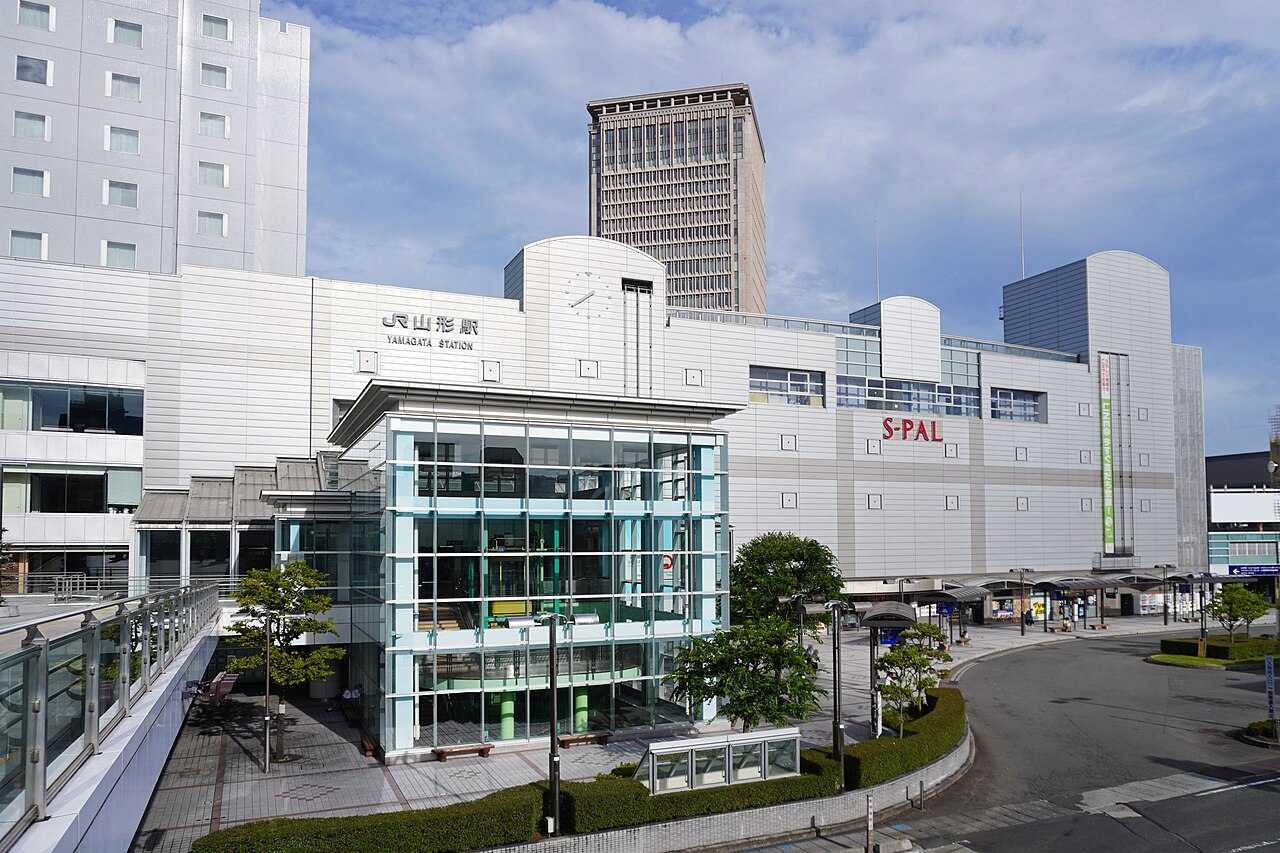
A crucial framing decision made the project affordable. After the 1987 privatization of JNR, the scheme was deliberately positioned not as a "Shinkansen project" but as a "conventional-line revitalization" project, which is what unlocked national subsidy — a ¥170 million government grant was secured for the fiscal 1988 budget after year-end negotiations. To carry out and own the works, a third-sector company, Yamagata JR Direct Express Holding (Yamagata Jeiāru Chokkō Tokkyū Hoyū), was established in April 1988 with capital of ¥9 billion, its shareholders led by Yamagata Prefecture and JR East. Crucially, this company was not a railway operator in the ordinary legal sense; it owned the upgraded facilities and the trains and leased them back to JR East. Groundbreaking followed at Yamagata Station in August 1988.
The physical conversion was substantial. The Ōu Main Line between Fukushima and Shinjō had been built to Japan's narrow 1,067 mm gauge, and it had to be re-laid to the international standard gauge of 1,435 mm — the same gauge as the Shinkansen — with regauging work on the Ōu line getting under way around the summer of 1990 and test running of the new trains beginning that November near the Itaya pass. Because the line stayed open to traffic during much of the work, with buses substituting on some stretches, it was an awkward, staged operation; but reusing the existing right-of-way, structures, and stations cut both cost and time dramatically compared with building anew. The project cost roughly ¥63 billion, split between about ¥35.7 billion of ground works and about ¥27.3 billion of rolling stock.
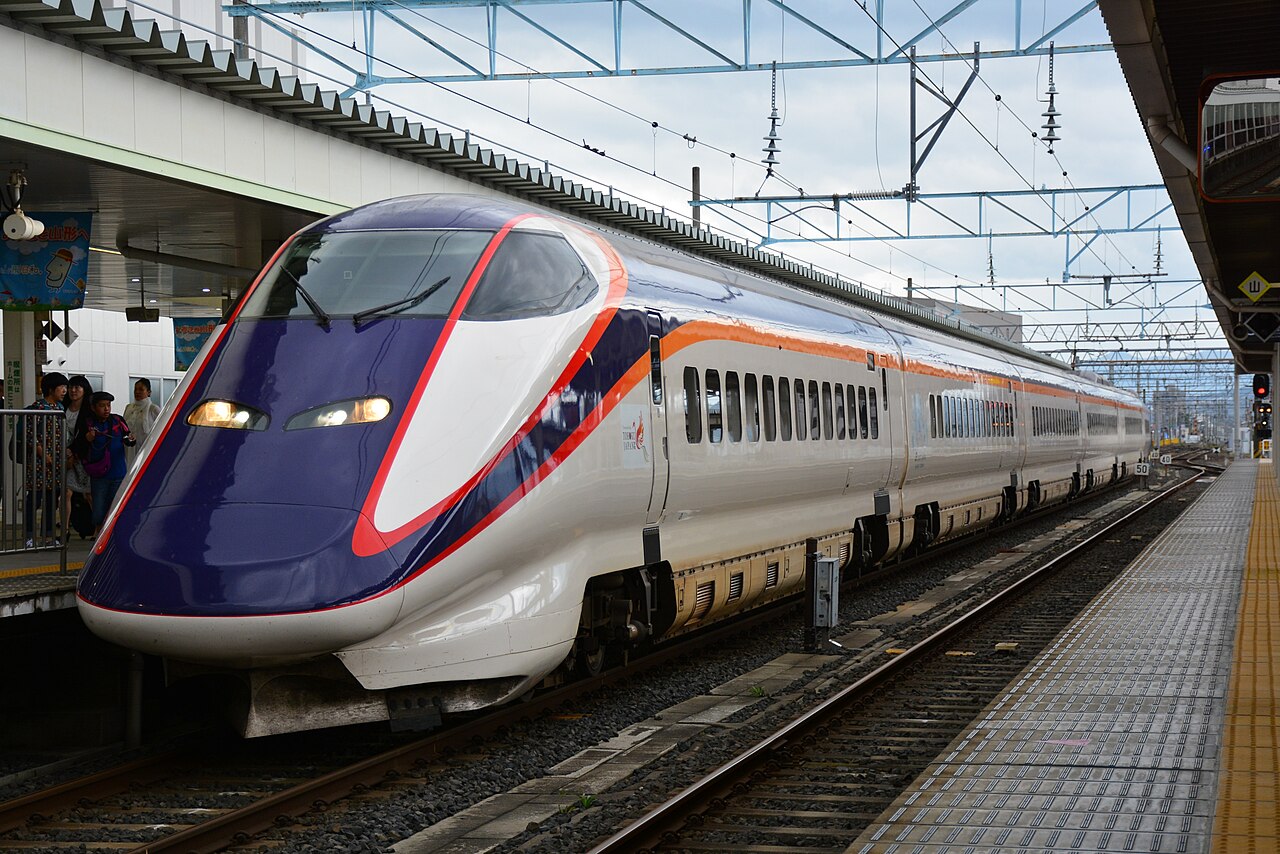
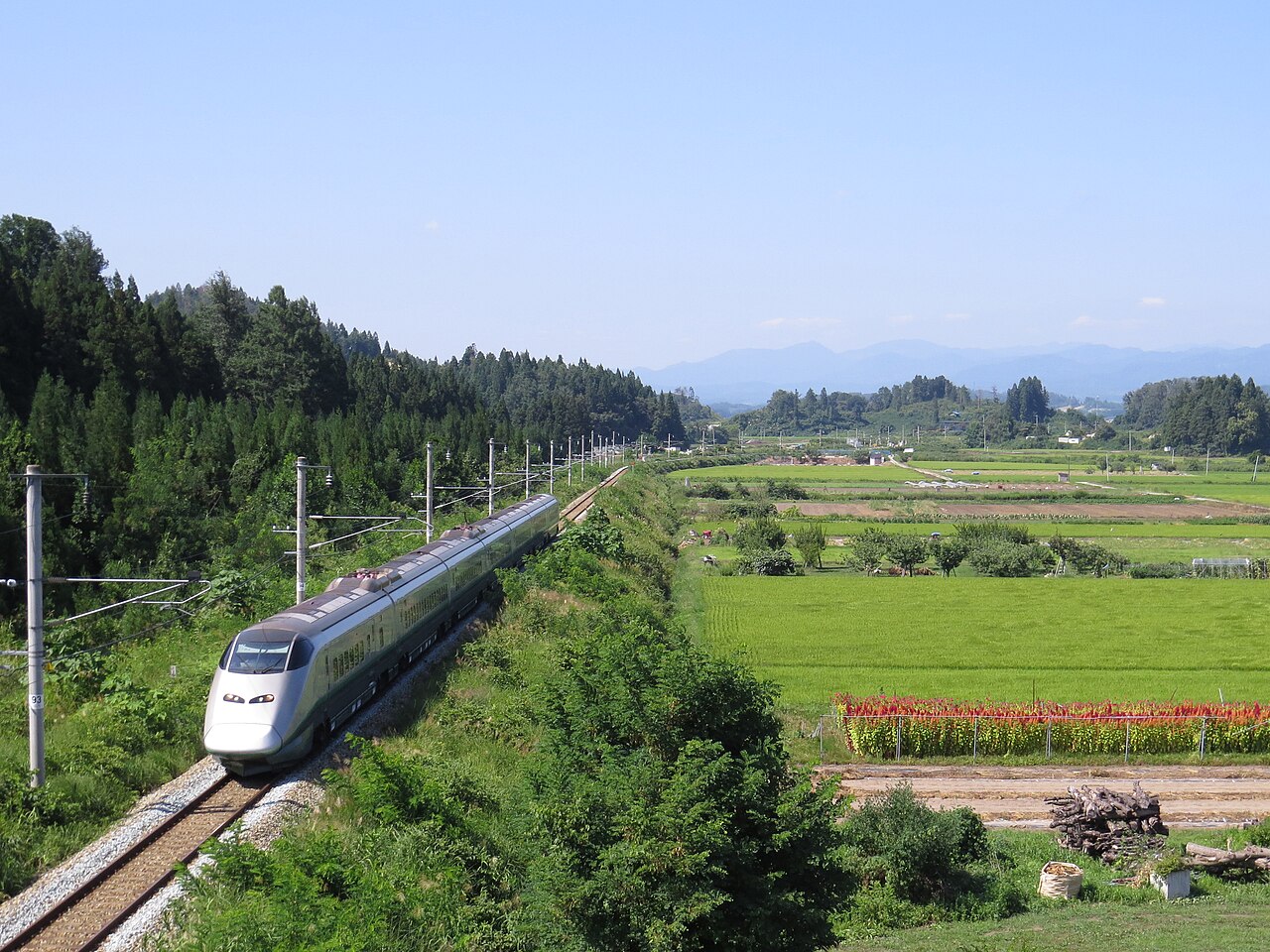
On 1 July 1992, after about four years of work, the Yamagata Shinkansen opened between Tokyo and Yamagata, just ahead of that summer's National Sports Festival. The new Tsubasa services used purpose-built 400 series trains, then running as six-car sets, which on the Tōhoku Shinkansen between Tokyo and Fukushima were typically coupled to 200 series Yamabiko trains and uncoupled at Fukushima to continue alone down the regauged Ōu line. This coupling-and-splitting at Fukushima — letting a Yamagata-bound train share the trunk Shinkansen's high-capacity slots as far as Fukushima, then peel off — is the operational signature of the line, and it persists today, with E3 and E8 series Tsubasa sets coupling to Yamabiko services. The trains were lengthened from six cars to seven on 1 December 1995.
The speed story is where the mini-Shinkansen character is sharpest. Under Japan's Nationwide Shinkansen Railway Development Act, a Shinkansen is defined as a trunk line on which trains can run at 200 km/h or more over the main section; the Fukushima–Shinjō stretch does not meet that test and remains, in law, a conventional line. On it the trains are limited to 130 km/h and share the rails with ordinary Ōu Main Line locals, which carry the nickname "Yamagata Line." Those local services needed their own dedicated rolling stock built to the standard gauge — the first standard-gauge local trains ever built for a JR line — and because long stretches of the regauged route are single-tracked, an unusual sight emerged of a Shinkansen-type train waiting in a passing loop for a local to clear, the same trade-off later seen on the Akita Shinkansen. Only on the Tōhoku Shinkansen north of Tokyo do the trains reach true high speed. Even so, the gains were real: opening the through service cut the fastest Tokyo–Yamagata time from about 3 hours 9 minutes to about 2 hours 27 minutes. Tellingly, of the roughly 42 minutes saved, only around 10 came from removing the change of trains at Fukushima; the larger part, about 32 minutes, came from raising the maximum speed on the Ōu section itself from 95 km/h to 130 km/h. Service frequency also doubled, from seven daily round trips under the old conventional Tsubasa limited express to fourteen.
Attention soon turned north, to extending the line from Yamagata to Shinjō. JR East was wary: the Yamagata–Shinjō segment of roughly 61 km carried only about 2,000 limited-express passengers a day and looked like a loss-maker. The impasse was broken in February 1997 by an unusual financing scheme in which a Yamagata prefectural tourism-development corporation lent the construction money — about ¥35.1 billion — to JR East interest-free, with repayment deferred for ten years and then spread over a further ten; a syndicate of local banks supplied about 60% of the extension funds (¥20.85 billion). Extension work began in May 1997. Alongside the regauging, JR East and trackside municipalities roughly halved the number of level crossings on the Yamagata–Shinjō section, from seventy-nine to around forty-one, by building overpasses and similar structures, and added park-and-ride parking. On 4 December 1999, after about two and a half years of work, the extension to Shinjō opened. It brought the fastest Tokyo–Shinjō time down from about 3 hours 32 minutes to about 3 hours 5 minutes, and lifted the number of Shinkansen-served stations within Yamagata Prefecture to ten — more than in any other prefecture, albeit all of them conventional-line stations served by through trains.
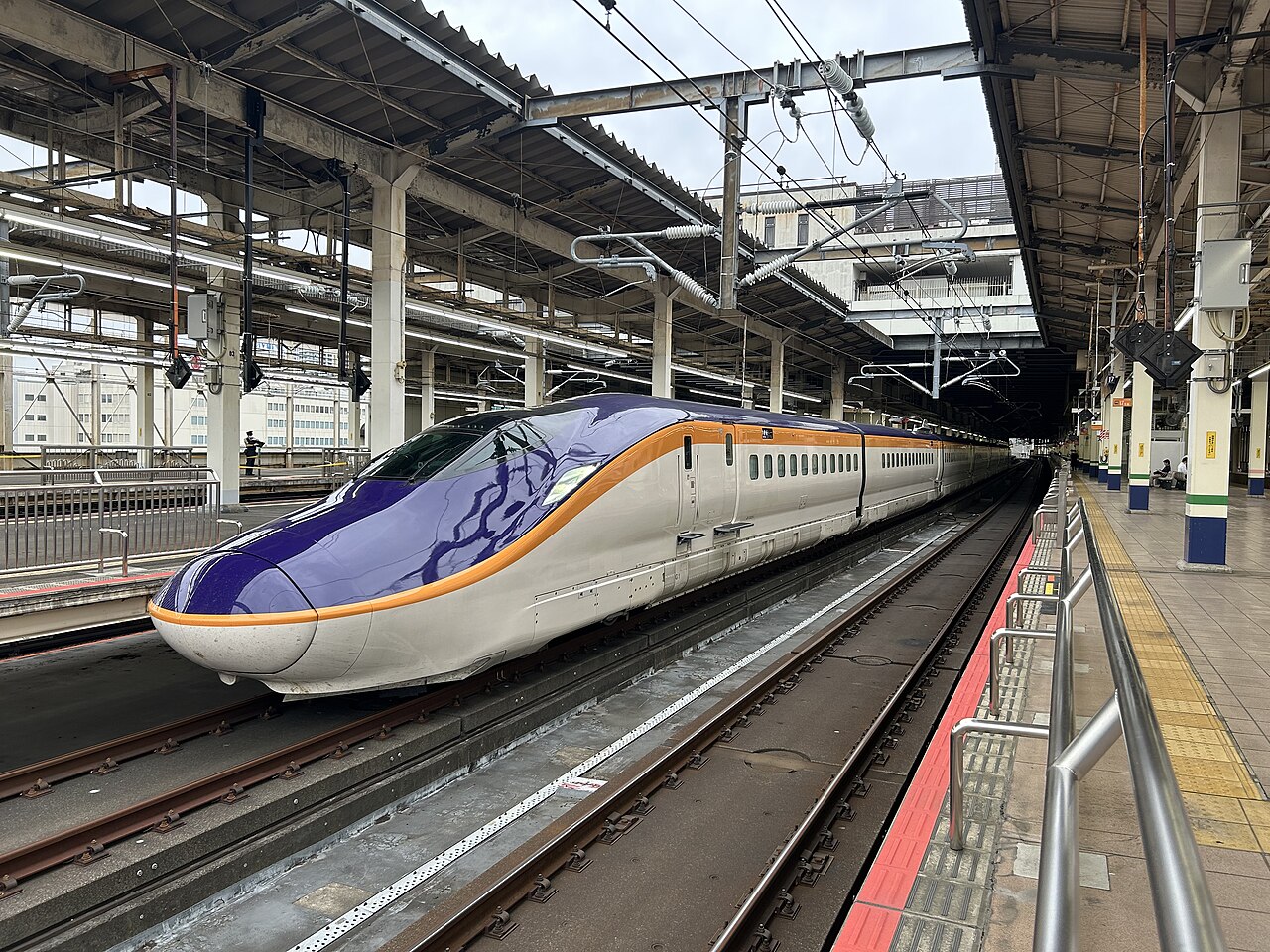
The rolling stock evolved in step. The holding company had owned the original 400 series fleet — eighty-four cars in twelve sets, leased to JR East — but the trains for the 1999 Shinjō extension and all later stock were owned by JR East directly, which is why the prefectural company gradually became a pure facility-leasing entity; it transferred its assets to JR East and was wound up by the end of March 2018, its liquidation completed that September. The pioneering 400 series itself, in its distinctive silver livery, gave way from 20 December 2008 to E3 series (E3-2000) sets and was withdrawn from service by 18 April 2010; an earlier E3 variant, the E3-1000, had been introduced with the 1999 Shinjō extension and stayed in service until 2024. The newest generation is the E8 series, which entered revenue service on 16 March 2024 — the first new train type on the line in about twenty-five years. The E8, delivered from 2023 and intended to replace the remaining E3 sets through to around 2026, is built to run at up to 300 km/h on the Tōhoku Shinkansen while reflecting the landscape and identity of Yamagata; E3-hauled Tsubasa trains, by contrast, run at up to 275 km/h on that trunk section. The trains' speed thus depends entirely on where they are: high on the Tōhoku trunk, capped at 130 km/h on the conventional Ōu segment.
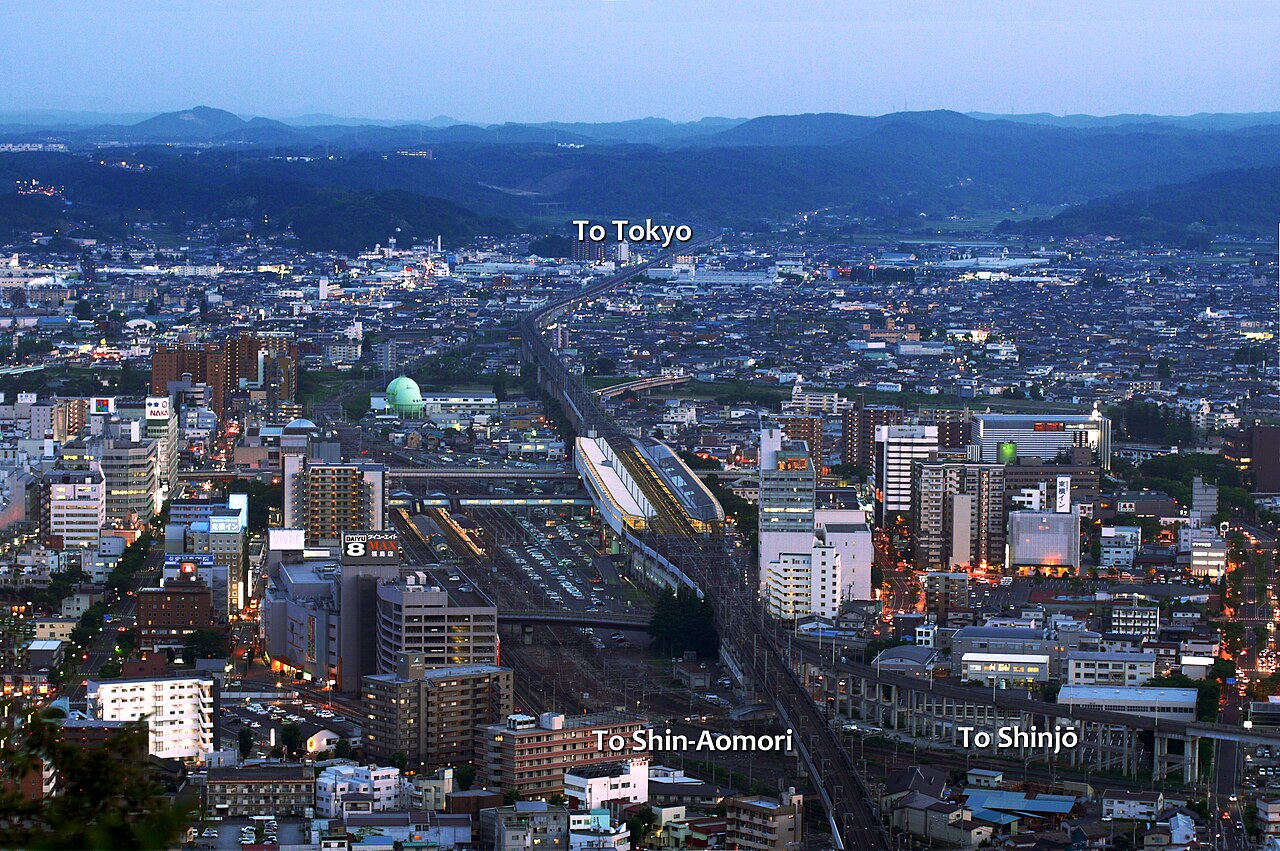
Fukushima Station, the junction where the two worlds meet, has long been the line's structural weak point. The connecting track between the Tōhoku Shinkansen and the Ōu Main Line is single, branching from a down-side siding, so the area around Fukushima is effectively single-tracked, and a northbound Yamabiko coupling with a Tsubasa has had to cross the down main line twice within the station to reach the platform used for joining and splitting. In winter especially, a snow-induced delay there can ripple across the whole line. To fix this, JR East announced in March 2020 a new up-direction approach line: a fresh track branching from the Ōu Main Line, passing beneath the elevated Shinkansen and connecting directly to the up Shinkansen platform, eliminating the at-grade crossings and allowing arrivals and departures to be handled simultaneously. Construction began in April 2021, with completion scheduled for the end of fiscal 2026. The same March 2020 announcement paired the approach line with the E8 series introduction as the two halves of a single improvement programme.
Weather and terrain remain the line's chronic adversaries, concentrated on the Itaya pass between Fukushima and Yonezawa, where steep gradients, altitude, and exposure to heavy rain, snow, and wind force low speeds and cause frequent disruption. Heavy snow produced the line's first all-day suspension since opening on 4 January 2001, and record rainfall in July 2024 triggered a slope collapse that closed the Yamagata–Shinjō section for weeks. The 2011 Tōhoku earthquake halted all services on 11 March 2011, with the Fukushima–Shinjō section resuming on 31 March and full through-running to Tokyo restored on 12 April, initially at reduced capacity. To address the Itaya bottleneck for good, JR East has studied a long base tunnel through the Ōu Mountains west of Fukushima; by late 2017 it had estimated the cost of a cross-border tunnel on the existing mini-Shinkansen premises at about ¥150 billion, with an option to widen it to the full Shinkansen loading gauge for roughly ¥12 billion more — leaving open, in principle, an eventual upgrade to full high-speed standard.
The line reshaped travel in its corridor. By the year 2000, official inter-prefectural data recorded on the order of a million rail passengers a year travelling between Yamagata and the Tōhoku-Shinkansen prefectures to its south, with Tokyo by far the largest single market; Yamagata Airport, which had peaked at around 700,000 passengers a year in 1991, saw its traffic fall by 1992 as the new through service competed with the Tokyo–Yamagata air route, dropping to under a quarter of that peak by 2009. More than three decades on, the Yamagata Shinkansen stands both as a practical fast link for a relatively small prefecture and as the proof-of-concept for the whole mini-Shinkansen idea — a model later repeated for the Akita Shinkansen — that a region can gain a one-seat ride to Tokyo without the cost of a brand-new high-speed railway, accepting in exchange the slower running and shared, weather-exposed tracks that the compromise entails.
Timeline
- 1981January: Yamagata is provisionally selected to host the 47th National Sports Festival in 1992; the prefecture sets up a transport-planning council that June, the spark for the project.
- 1986October: a JNR project team selects the Fukushima–Yamagata corridor for the mini-Shinkansen, choosing a Fukushima branch via Yonezawa over an alternative Sendai/Senzan Line route.
- 1988April: the third-sector Yamagata JR Direct Express Holding company is set up (capital ¥9 billion) to build and own the works and lease them to JR East. Groundbreaking at Yamagata Station follows on 25 August.
- 1990Regauging work on the Ōu Main Line gets under way around the summer; test running of the new 400 series begins near the Itaya pass on 14 November.
- 19921 July: the Yamagata Shinkansen opens between Tokyo and Yamagata after about four years' work (project cost ~¥63 billion). Tsubasa runs with six-car 400 series sets, coupled to 200 series Yamabiko on the Tōhoku Shinkansen. Fastest Tokyo–Yamagata time falls from ~3h09m to ~2h27m.
- 19951 December: Tsubasa sets are lengthened from six cars to seven.
- 1997February: an interest-free loan of ~¥35.1 billion from a Yamagata prefectural tourism corporation breaks the financing impasse for the Shinjō extension; construction begins in May.
- 19994 December: the line is extended from Yamagata to Shinjō after ~2.5 years' work; E3-1000 series sets are introduced. Fastest Tokyo–Shinjō time falls from ~3h32m to ~3h05m; Yamagata Prefecture now has ten Shinkansen-served stations.
- 20014 January: heavy snow causes the line's first all-day suspension since opening.
- 200718 March: all cars are made non-smoking.
- 200820 December: E3-2000 series sets enter service, beginning the replacement of the 400 series.
- 201018 April: the pioneering 400 series is withdrawn from service.
- 201111 March: the Tōhoku earthquake suspends all services. Fukushima–Shinjō resumes on 31 March; full through-running to Tokyo is restored on 12 April, initially at reduced capacity.
- 201729 November: JR East estimates a Fukushima–Yonezawa cross-border base tunnel at ~¥150 billion, with widening to the full Shinkansen loading gauge adding ~¥12 billion.
- 20203 March: JR East announces a two-part improvement programme — the new E8 series and a new up-direction approach line at Fukushima to remove a long-standing bottleneck.
- 2021April: construction of the Fukushima up-approach line begins, with completion scheduled for the end of fiscal 2026.
- 202416 March: the E8 series enters revenue service — the first new train type on the line in about 25 years, built for up to 300 km/h on the Tōhoku Shinkansen. 25 July: record rainfall causes a slope collapse, closing Yamagata–Shinjō for weeks.
Sources
Facts last verified 3 June 2026.
Gallery 2 photos
Every photo for this page — tap any image to view it full-size. All from Wikimedia Commons (credit under each).