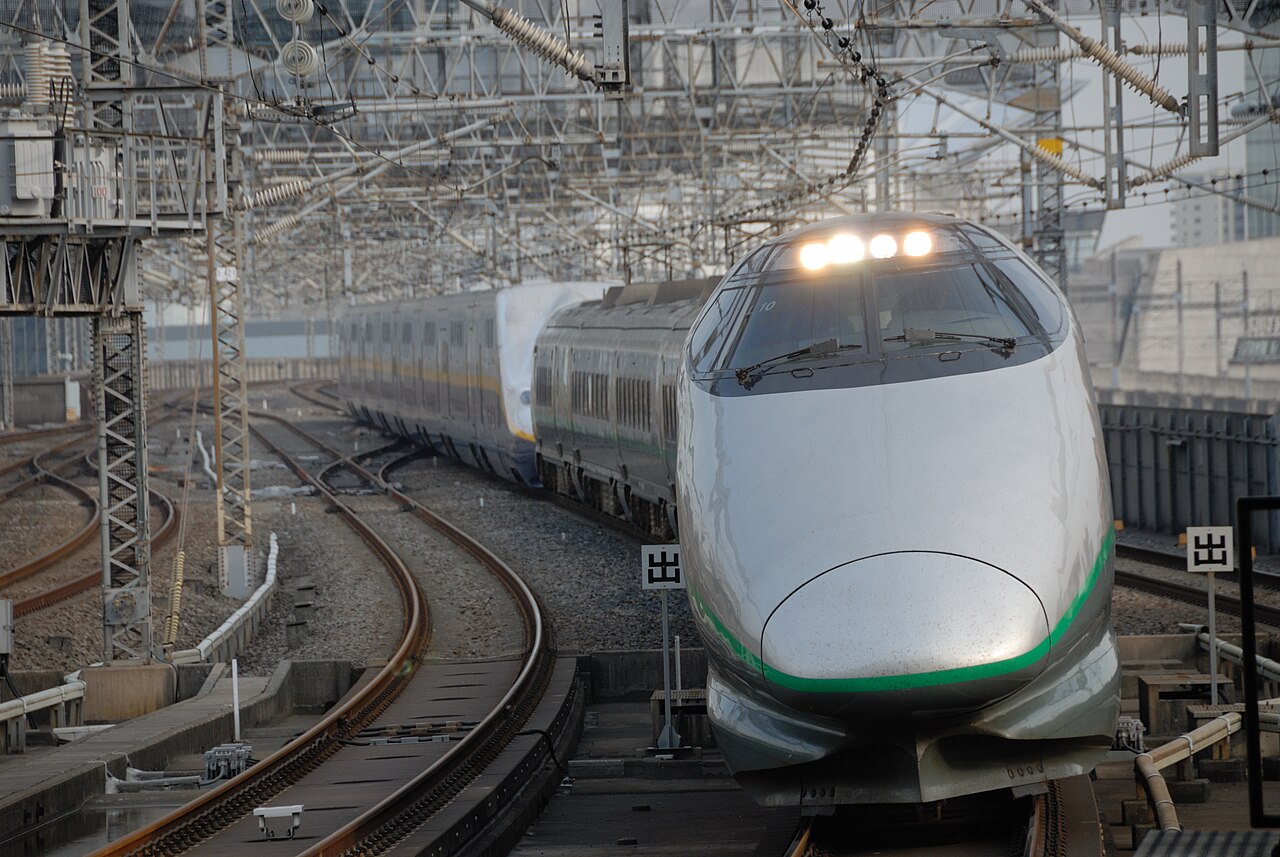
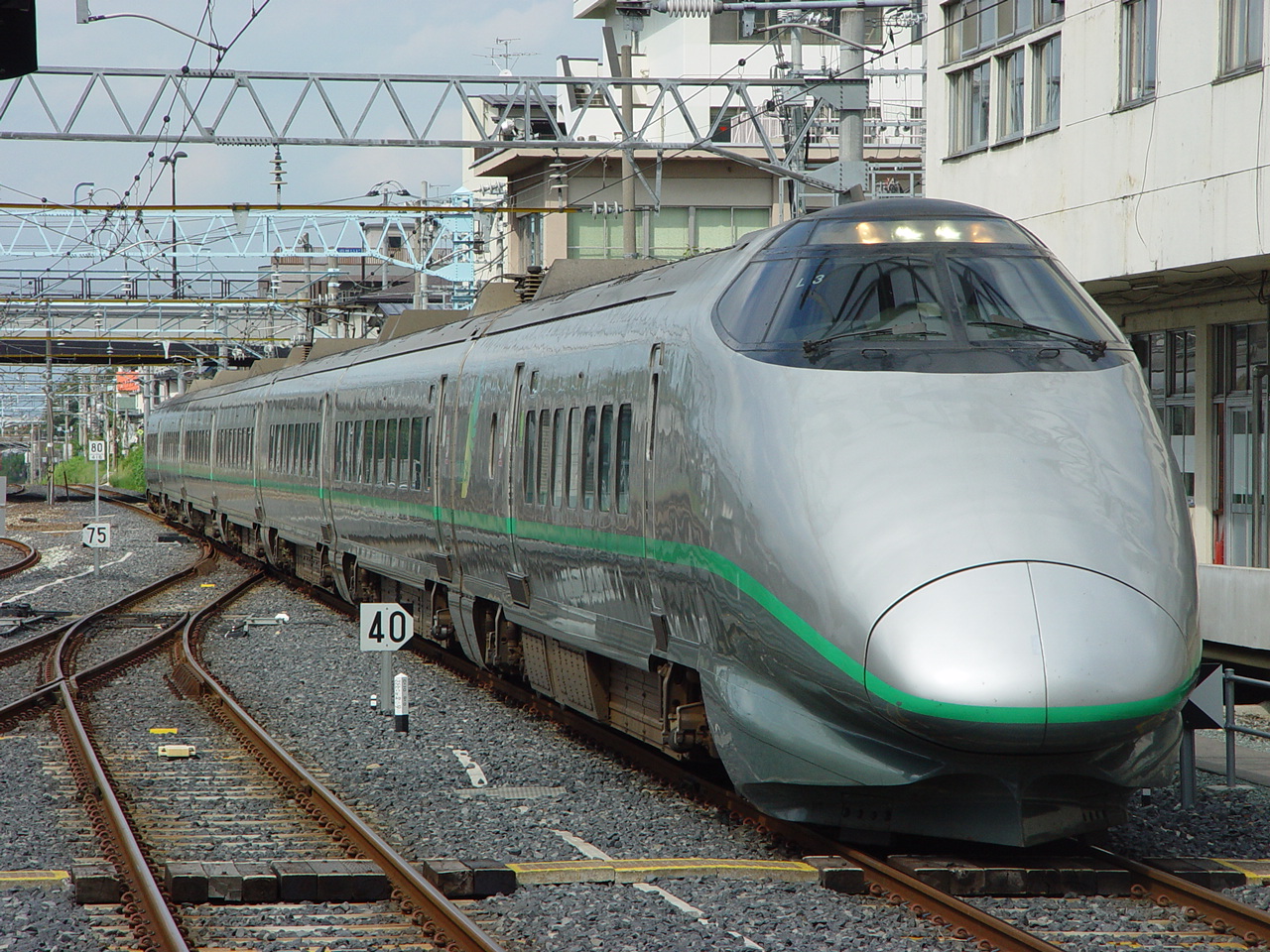
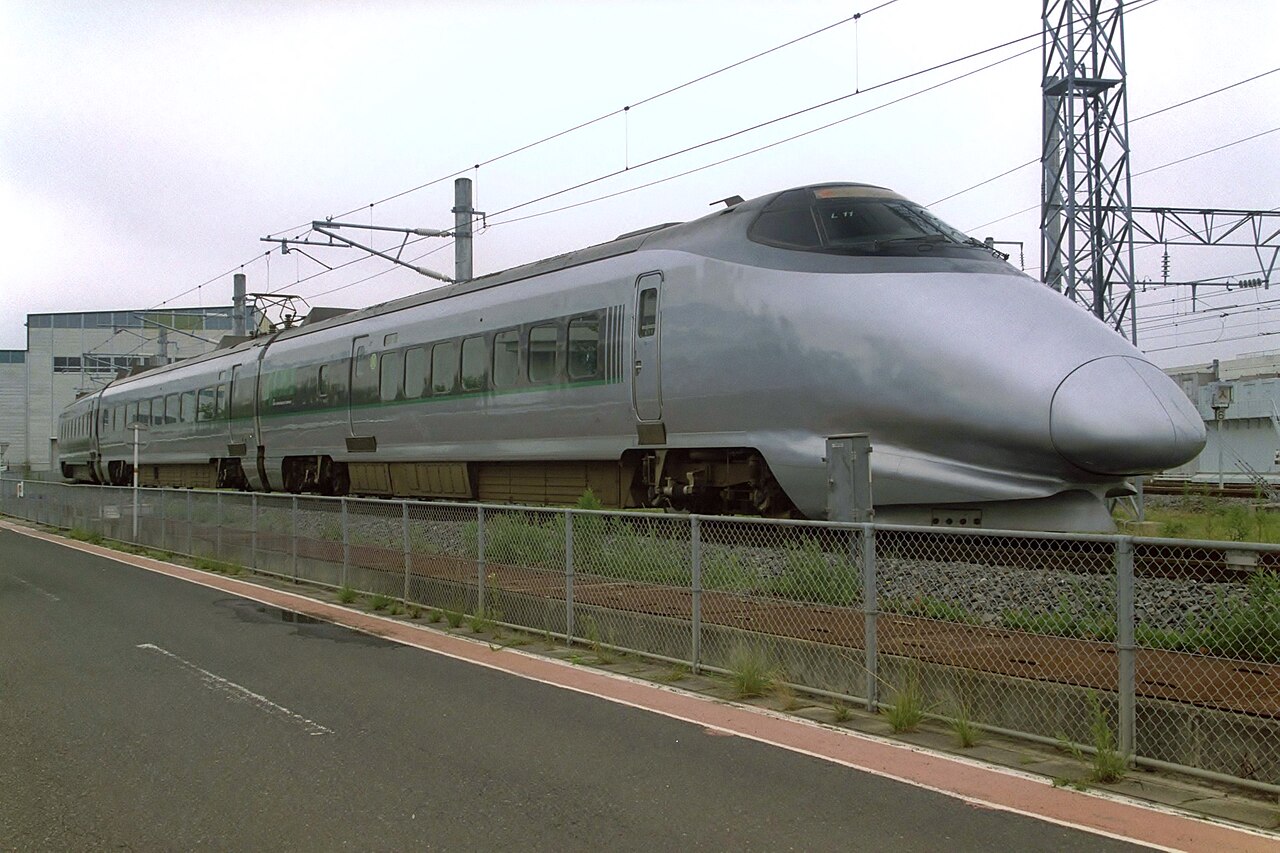
History
Because the route kept its original loading gauge even after the track gauge was widened, the 400 series had to be built with a narrower cross-section than full-size Shinkansen stock — the origin of the "mini-Shinkansen" designation — so ordinary cars used 2+2 seating rather than the usual 3+2 and Green cars used 2+1; at full-size Shinkansen platforms a retractable step flips out from beneath the doors to bridge the wider gap. On the Tōhoku Shinkansen trunk between Tokyo and Fukushima the 400 series most often ran coupled to a 200 series set, with the coupling and splitting equipment carried in the Tokyo-end leading car. Originally formed as six-car sets, the trains were lengthened to seven cars between November and December 1995 owing to the popularity of the Tsubasa services.
Operating speed reflected the two very different lines the type served: 240 km/h on the Shinkansen section, but only 130 km/h on the regauged conventional section. Withdrawals began in December 2008 as E3-2000 series trains took over, and although most of the fleet was gone during 2009, one set (L3) remained until 18 April 2010 — a date chosen to mark eighteen years of service — when it worked the commemorative "Tsubasa 18" farewell run from Shinjō to Tokyo. L3 was formally withdrawn on 30 April 2010. One car, Green car 411-3 from set L3, is preserved at the Railway Museum in Saitama.
Timeline
- 1992Revenue service begins on 1 July, the day the Yamagata Shinkansen (Fukushima–Yamagata) opens; twelve six-car sets enter Tsubasa service. The pre-series set S4 had been converted to production set L1 on 29 June.
- 1995All sets lengthened from six to seven cars between November and December (from 1 December per the JA source) by inserting a type 429 trailer (car 15), owing to the popularity of the Tsubasa services.
- 1999From 4 December the Yamagata Shinkansen is extended from Yamagata to Shinjō, and the 400 series operating range is extended to Shinjō; coupling with E4 series sets had also been introduced from 29 April that year.
- 2001Coupled operation with 200 series sets ends (from 21 September); thereafter the 400 series coupled only with E4 series sets in revenue service.
- 2008Replacement by E3-2000 series trains begins in December, starting with the withdrawal of set L1.
- 2010Final 400 series run takes place 18 April with set L3 (the date marks 18 years of service), the commemorative "Tsubasa 18" farewell working from Shinjō to Tokyo; the type is retired and L3 formally withdrawn on 30 April. Car 411-3 is preserved at the Railway Museum.
Sources
Facts last verified 3 June 2026.
Gallery 3 photos
Every photo for this page — tap any image to view it full-size. All from Wikimedia Commons (credit under each).