
History
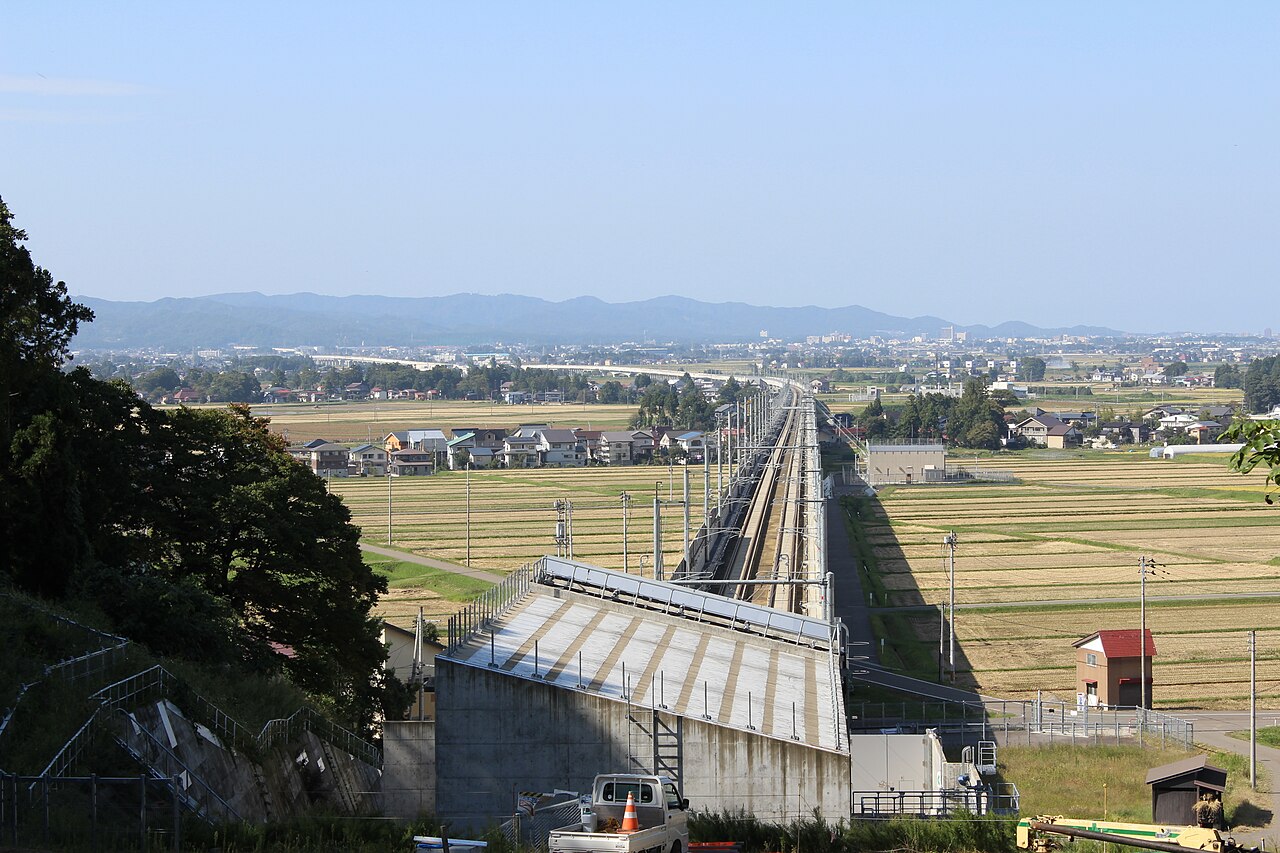
The Hokuriku Shinkansen has deep roots in Japan's national high-speed-rail planning. It was one of the five so-called "seibi shinkansen" (nationally planned Shinkansen) lines: the route was publicly designated in 1972 under the Nationwide Shinkansen Railway Development Act, and its development plan was fixed on 13 November 1973. Construction was then frozen for years amid Japanese National Railways' deteriorating finances, and work did not begin until 1989, on the Takasaki–Karuizawa section. The Nagano–Kanazawa portion was started partly to a "super-tokkyū" (narrow-gauge new-line) standard before the whole route was upgraded to full Shinkansen specification — one of several economies adopted because, as a seibi shinkansen, the project was under standing pressure to hold down construction costs while crossing mountainous, heavy-snow country and a power-frequency divide.
The line began life as the Nagano Shinkansen. Its first section, the 117.4 km between Takasaki (in Gunma Prefecture) and Nagano (in Nagano Prefecture), opened on 1 October 1997, timed to serve the 1998 Nagano Winter Olympics, and was the first of the seibi shinkansen lines to enter service. The line's legal designation had always been "Hokuriku Shinkansen" under Japan's nationwide Shinkansen-development legislation, but in the run-up to the Nagano opening JR East judged that using that name in passenger service would mislead travellers, since the Hokuriku region proper still lay far beyond the railhead — for customers bound for Hokuriku the practical route at that time was the Jōetsu Shinkansen to Echigo-Yuzawa and a transfer onward. JR East therefore sought an operational name; Hokuriku local governments, worried that construction westward might stall, pressed to keep "Hokuriku" in use. The compromise JR East announced on 25 July 1997 was to use "Nagano Shinkansen" in voice announcements and to mark Tokyo-area stations with a "Nagano-bound Shinkansen" style of wording; the "Nagano-bound" variant soon fell away and timetables simply read "Nagano Shinkansen." The new services were branded Asama, replacing the conventional Shin'etsu Main Line limited expresses of the same name, which had taken about two hours fifty minutes from Tokyo (Ueno) to Nagano. With the opening, part of the conventional line — including the steeply graded Usui Pass between Yokokawa and Karuizawa, which had required dedicated bank engines — was abandoned, and the parallel Shin'etsu Main Line between Karuizawa and Shinonoi was transferred to a new third-sector operator, the Shinano Railway.
The second stage carried the line into the Hokuriku region. The extension from Nagano to Kanazawa — a section of 228.0 km running through Niigata, Toyama and Ishikawa prefectures — opened on 14 March 2015. Construction onward from Nagano had been authorised in stages through the 2000s, and the Nagano–Kanazawa civil works were completed in May 2014. With the opening, travel time from Tokyo to Toyama fell to about two hours, with Kanazawa roughly thirty minutes further. It was at this stage that the line formally took the name Hokuriku Shinkansen for passenger purposes — JR East had announced in October 2013 that the formal line name would be Hokuriku Shinkansen, presented with a "via Nagano" qualifier to reflect its reach into the region. The 2015 extension also triggered the largest transfer of parallel conventional track in the project: roughly 252 km of route between Nagano and Kanazawa passed from the JR companies to four newly created third-sector operators, among them the Shinano Railway's Kita-Shinano Line, the Echigo Tokimeki Railway, the Ainokaze Toyama Railway, and the IR Ishikawa Railway.
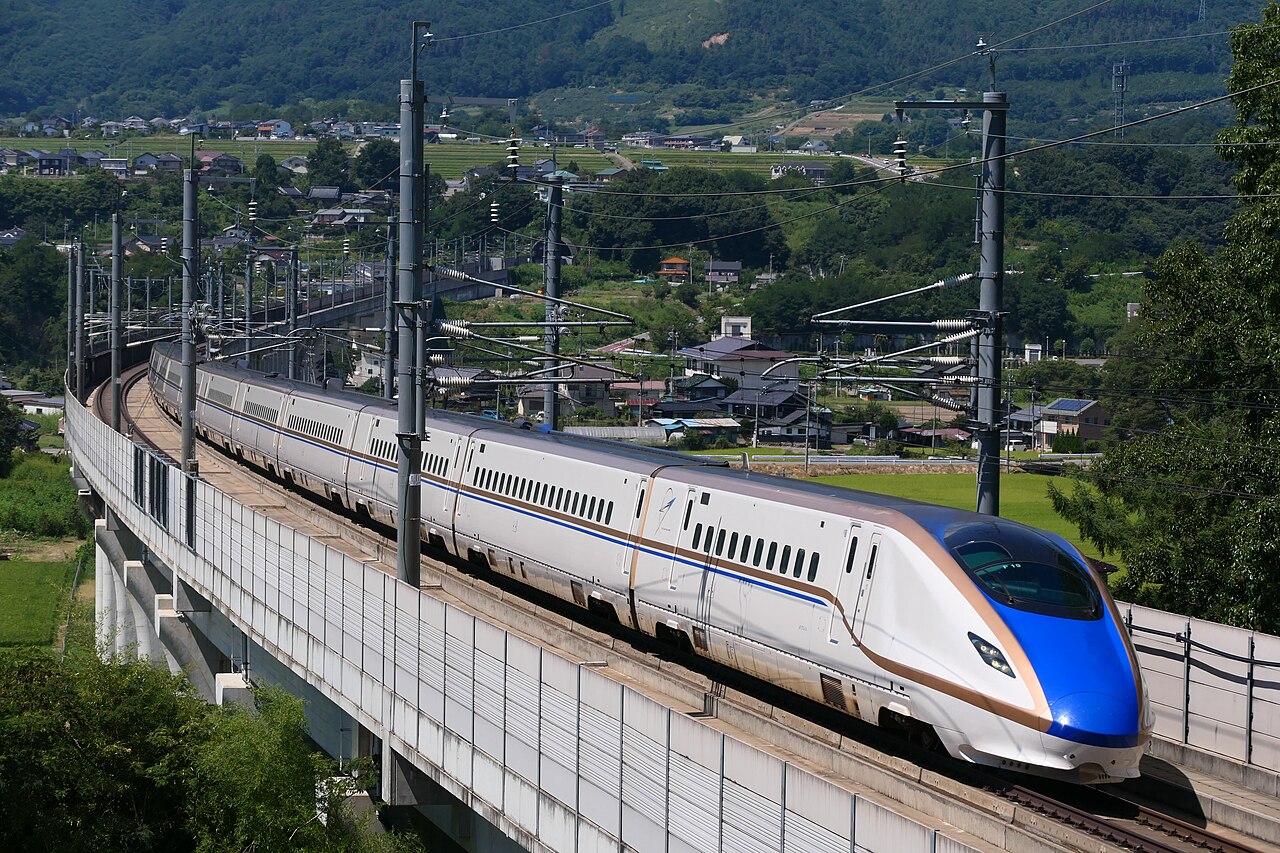
The third stage, opened on 16 March 2024, extended the line about 125 km from Kanazawa through Fukui Prefecture to Tsuruga, adding six stations (Komatsu, Kagaonsen, Awaraonsen, Fukui, Echizen-Takefu and Tsuruga). Construction of this section had been approved in 2012 and commenced that year. Opening-day ceremonies were held at both Tsuruga and Tokyo, led by the presidents of JR West and JR East respectively. With the extension in service, the journey from Tokyo to Tsuruga takes 3 hours 8 minutes — about fifty minutes shorter than the previous arrangement of riding the Shinkansen to Kanazawa and changing to a conventional limited express. In step with the opening, the Thunderbird limited express ended its Kanazawa–Tsuruga running on 15 March 2024, and a further 84.3 km stretch of the Hokuriku Main Line (Daishōji–Tsuruga) was handed to a new third-sector operator, Hapi-Line Fukui.
The two-operator arrangement is built into the line's geography. JR East runs the eastern portion from Takasaki to Jōetsumyōkō, and JR West runs onward from Jōetsumyōkō to Tsuruga; the facility-management boundary between the two companies sits on the Kanazawa side of Jōetsumyōkō Station, at 177 km 950 m measured from the Takasaki origin — immediately north of the station. This was the first time a single Shinkansen line, sharing one name, came to be run by more than one railway company. (Where company boundaries fall on the older Shinkansen network, the line name itself changes — for instance Tōhoku becomes Hokkaidō — so a single named line split between operators was genuinely new with the Hokuriku Shinkansen.) Trains reach Tokyo by running through over the Jōetsu and Tōhoku Shinkansen tracks between Takasaki and Tokyo — the Hokuriku Shinkansen's own dedicated infrastructure begins at Takasaki. Since the 2015 extension, services have been organised into four train types: the limited-stop Kagayaki and the mostly all-stations Hakutaka, both running Tokyo–Tsuruga; the Tsurugi shuttle between Toyama and Tsuruga; and the Asama between Tokyo and Nagano, the direct descendant of the original Nagano Shinkansen service. The line's status as the first of Japan's "seibi shinkansen" (nationally planned Shinkansen) to begin construction, and the fact that it threads mountainous, heavy-snow country while crossing a power-frequency divide, drove the adoption of a range of cost-saving and purpose-built technologies.
The frequency split is the line's signature engineering challenge. The route is electrified throughout at 25 kV AC, but it crosses Japan's 50 Hz / 60 Hz commercial-power boundary, which runs through this part of the country, and it does so more than once: broadly, the section from the Tokyo end to Karuizawa is supplied at 50 Hz, the section from Karuizawa westward at 60 Hz, with a further 50 Hz stretch in the Niigata area around Itoigawa before the supply returns to 60 Hz onward to Tsuruga. The underlying pattern follows the commercial supply along the route: 50 Hz through Gunma, 60 Hz through Nagano, back to 50 Hz through Niigata, and 60 Hz again through Toyama, Ishikawa and Fukui. Because directly connecting currents of different frequency would risk a large fault current, the transitions are handled at dedicated sectioning posts (SPs) — at Shin-Karuizawa, Shin-Takada and Shin-Itoigawa — where the feeding supply is switched between substations across an electrically isolated gap. The changeover is triggered automatically by the passing train, so a Shinkansen can run through the boundary under power without coasting. To run across these transitions, the E7 and W7 trainsets carry onboard equipment able to operate under both frequencies and to switch automatically between them. The frequency split also reached into the signalling: at the 1997 Nagano opening a dual-frequency automatic train control system compatible with the then-analogue Tōhoku/Jōetsu ATC had to be developed to cope with the interference where the two supplies meet, and ahead of the Kanazawa extension a 60 Hz-capable version of the network's later digital ATC (DS-ATC) was developed for the line. The line also climbs hard at its eastern end — the ruling gradient between Takasaki and Karuizawa reaches 30 per mil (3.0 percent) — which has historically constrained which trains could work the route. The maximum line speed is 260 km/h over the Hokuriku line proper between Takasaki and Tsuruga; on the shared approach the ceiling is lower, with the Omiya–Takasaki stretch raised to 275 km/h. Snow was the other dominant constraint: the Shin'etsu and Hokuriku country the line crosses is among the snowiest in Japan, and because the seibi-shinkansen budget ruled out simply copying the costliest existing defences, the route required purpose-developed cold-weather countermeasures suited to each stretch's climate rather than a single uniform anti-snow method.
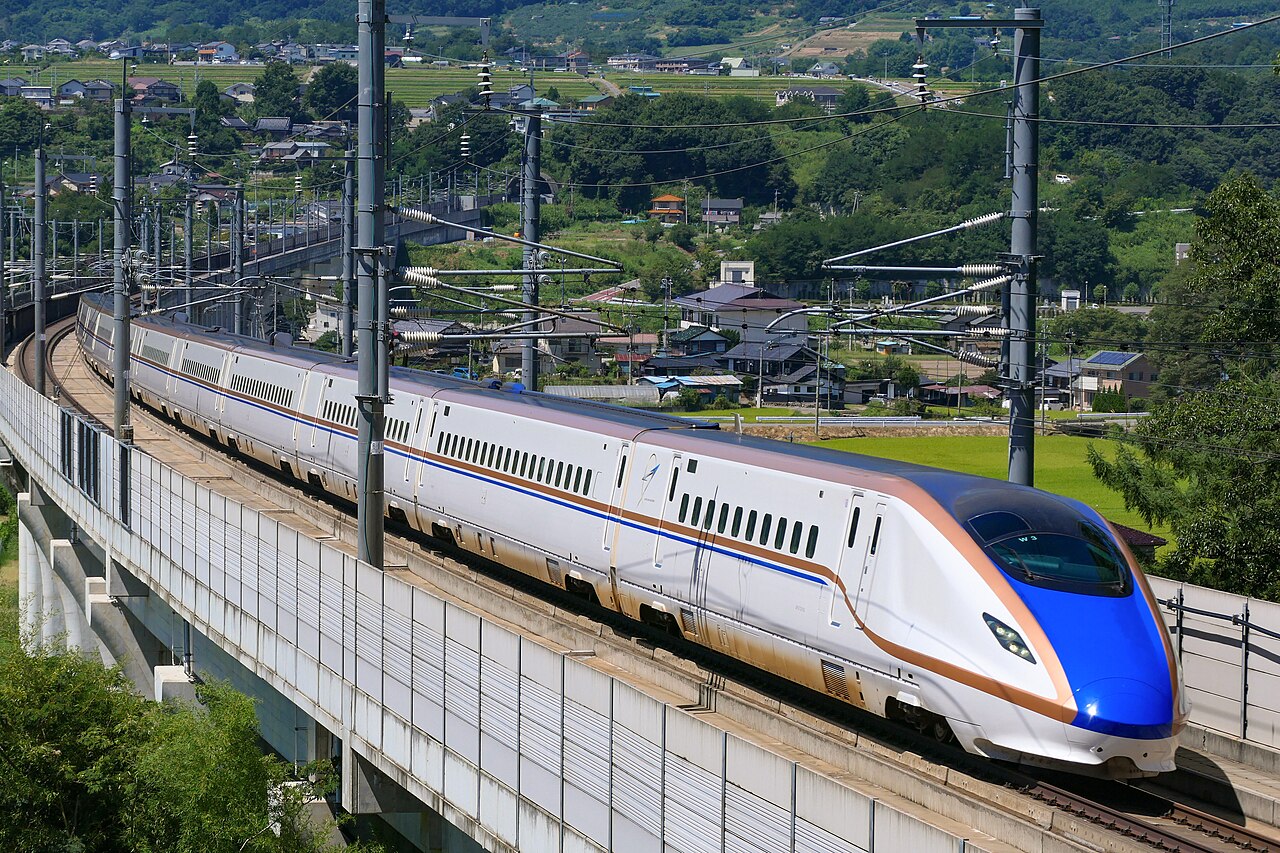
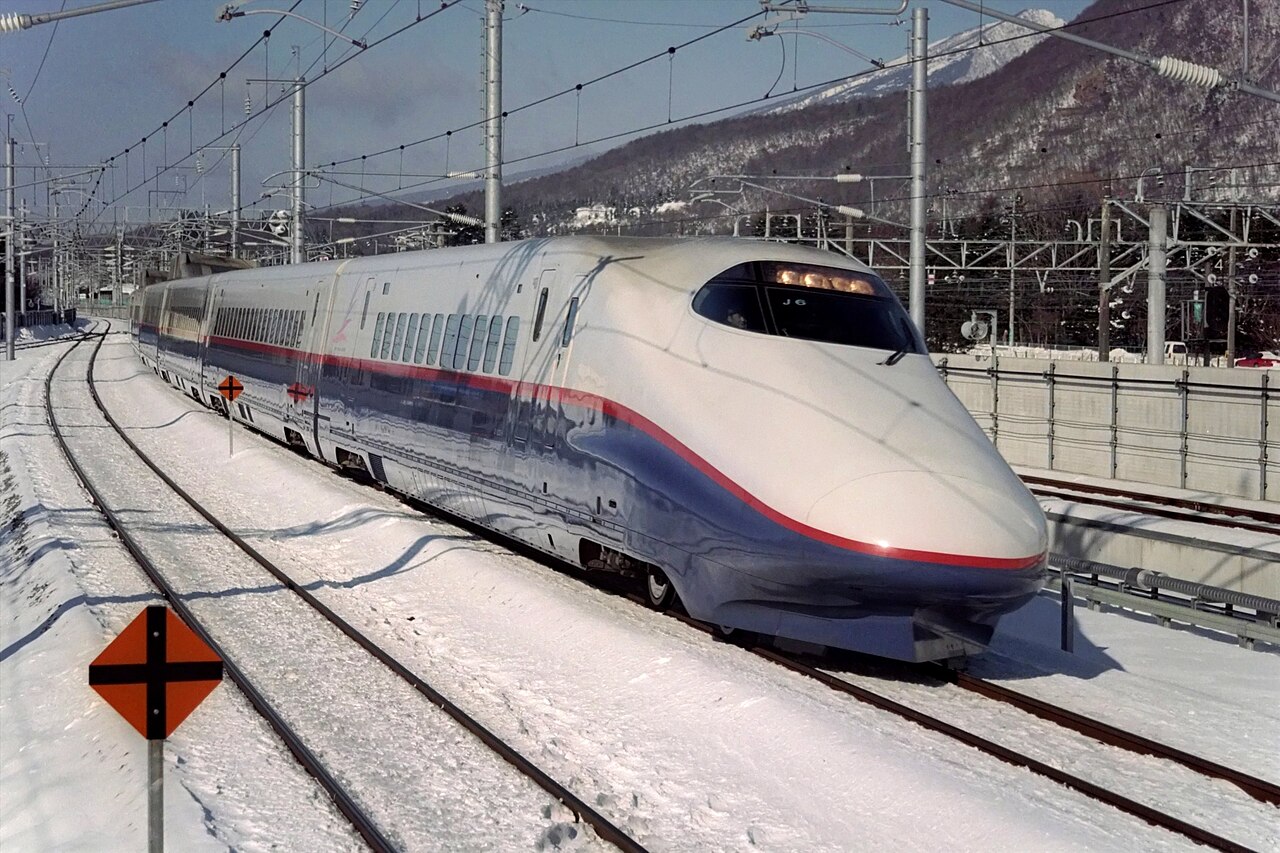
Rolling stock has turned over once across the line's history. The Nagano Shinkansen opened with a new fleet of JR East E2 series eight-car sets, the dual-frequency, gradient-capable workhorses of the early years. During the 1998 Winter Olympics one specially modified 200 series set, numbered F80, was pressed into additional Asama service in February 1998; it had been adapted to run under both 50 Hz and 60 Hz supplies, lightened to meet the line's 16-tonne axle-load limit, and fitted with extra equipment for the 30-per-mil grade, with its top speed held to 210 km/h. The current generation arrived for the Kanazawa extension: JR East introduced a fleet of E7 series twelve-car sets, phased in from March 2014 (initially on a handful of Asama return workings from the 15 March 2014 timetable revision), and JR West added W7 series twelve-car sets — mechanically equivalent and operated in a common pool with the E7s — from the 14 March 2015 opening; the W7 fleet was reported to have cost ¥32.8 billion. The remaining E2 series sets were withdrawn from Hokuriku services on 31 March 2017, after which all Asama workings were formed of E7 and W7 stock.
The line's most serious incident came on the night of 12–13 October 2019, when Typhoon Hagibis (the 2019 East Japan Typhoon) brought record rainfall across eastern Japan and the Chikuma River breached its levee at Nagano. The Nagano Shinkansen Rolling Stock Center, sited about a kilometre from the river, was inundated to an estimated depth of around 4.3 metres, flooding stabled trains up to armrest height. Ten twelve-car sets were caught — eight E7 sets belonging to JR East and two W7 sets belonging to JR West, amounting to about a third of the line's fleet; two of the sets, comprising 78 axles, were derailed by the floodwaters. No manual existed governing where or when to evacuate trains from the depot, and none had been moved. On 6 November 2019 JR East and JR West announced that all ten flooded sets would be scrapped, salvaging some parts, with a book loss of up to ¥14.8 billion. (JR East separately put the book value of its eight sets at ¥11.8 billion; reporting cited a loss to JR West of approximately ¥3 billion (about US$28 million at 2019 exchange rates) — figures stated on differing bases and attributed to differing sources.) Service was suspended on part of the line for thirteen days; through running between Tokyo and Kanazawa resumed under a provisional timetable on 25 October 2019, and the regular timetable was fully restored on 14 March 2020. JR East announced it would divert newly built E7 sets intended for the Jōetsu Shinkansen to make up the Hokuriku shortfall, and afterward moved to raise the depot's key facilities by roughly ten metres and to evacuate trains elsewhere when flooding is forecast.
In its role the Hokuriku Shinkansen knits the Sea-of-Japan-side cities of Toyama, Kanazawa and Fukui into the Tokyo network with same-day-return journey times, supplanting the slower conventional limited expresses that preceded each stage. The line carried steady patronage through the late 2010s before the COVID-19 pandemic sharply depressed traffic in fiscal 2020. It has also served as a relief valve for the national network: when the Tōkaidō Shinkansen has been suspended, supplementary Hokuriku Shinkansen and Thunderbird services have been laid on as an alternative axis between the Kantō and Kansai regions. The line's resilience was tested again on 1 January 2024, when the Noto Peninsula earthquake briefly halted the whole line; the Tokyo–Nagano section restarted about an hour and twenty minutes later, and the remaining sections were back in service the following day, with stranded trains on the Toyama–Kanazawa stretch opened up as overnight "train hotels" for waiting passengers.
The line is not finished. The route of the final section, from Tsuruga onward to Shin-Osaka, was decided on 20 December 2016 as the "Obama–Kyoto" alignment, running west to Obama and then south to join the Tōkaidō Shinkansen at Kyoto, with a further station proposed at Matsuiyamate on the way to Shin-Osaka; including Kyoto on the route was seen as important for tourism. Earlier proposals — a shorter Maibara route feeding onto the congested Tōkaidō Shinkansen, an upgrade of the existing Kosei Line, a Kyoto-bypassing Obama route, and a wider Maizuru variant — were set aside in its favour. The extension has been estimated to cost up to about ¥5.3 trillion and to take up to 28 years to build. The plan has since been unsettled: as of 16 December 2025 the route is being reconsidered at the request of Kyoto Prefecture and the Kyoto City Council, citing economic and environmental concerns, and the national transport ministry has suspended plans to begin construction in fiscal 2026. An earlier interim idea — a gauge-changing train to extend Hokuriku-network benefits west of Tsuruga before the Osaka link was built — was abandoned by JR West in August 2018.
Timeline
- 197313 November: the line's development plan is fixed; it is one of the five nationally planned 'seibi shinkansen' lines (route publicly designated in 1972). Construction is later frozen amid JNR's financial troubles, then begins in 1989 on the Takasaki–Karuizawa section.
- 19971 October: the first section, Takasaki–Nagano (117.4 km), opens as the 'Nagano Shinkansen', timed for the 1998 Nagano Winter Olympics; Asama services begin with JR East E2 series sets, replacing the conventional Shin'etsu Main Line Asama limited express. The legal line name was always 'Hokuriku Shinkansen'; the operational-naming compromise was announced 25 July 1997.
- 1998February: during the Nagano Winter Olympics, a specially modified 200 series set (F80), adapted for dual 50/60 Hz operation, lightened to the 16-tonne axle limit and equipped for the 30-per-mil grade, runs additional Asama services at up to 210 km/h.
- 20132 October (per EN): JR East announces the formal passenger line name will be 'Hokuriku Shinkansen', presented as 'Hokuriku Shinkansen (via Nagano)'.
- 201415 March: E7 series twelve-car sets enter service on a small number of Asama return workings ahead of the Kanazawa extension. Nagano–Kanazawa civil works completed 24 May 2014.
- 201514 March: the Nagano–Kanazawa extension (228.0 km) opens; W7 series sets enter service; ~252 km of parallel conventional lines transfer to four new third-sector operators. Tokyo–Toyama falls to about two hours.
- 201731 March: the remaining E2 series eight-car sets are withdrawn from Hokuriku services; all Asama workings thereafter use E7 and W7 stock.
- 2018August: JR West abandons the planned gauge-changing train (GCT) that was to extend Hokuriku benefits west of Tsuruga before the Osaka link.
- 201912–13 October: Typhoon Hagibis floods the Nagano Shinkansen Rolling Stock Center (~4.3 m deep) after the Chikuma River levee breaches; ten 12-car sets (eight JR East E7, two JR West W7), ~1/3 of the fleet, are damaged, two sets (78 axles) derailed. All ten are scrapped (announced 6 November); book loss up to ¥14.8 billion. Through service resumes under a provisional timetable on 25 October.
- 202014 March: the regular timetable is fully restored after the 2019 typhoon damage.
- 20241 January: the Noto Peninsula earthquake briefly halts the whole line; the Tokyo–Nagano section restarts about 1h20m later and the rest the next day, with stranded Toyama–Kanazawa trains used as overnight 'train hotels'.
- 202416 March: the Kanazawa–Tsuruga extension (~125 km, six stations: Komatsu, Kagaonsen, Awaraonsen, Fukui, Echizen-Takefu, Tsuruga) opens; Tokyo–Tsuruga journey time 3h08m. The Thunderbird limited express ends Kanazawa–Tsuruga service (15 March); the Daishōji–Tsuruga Hokuriku Main Line (84.3 km) transfers to Hapi-Line Fukui.
- 202516 December: the Tsuruga–Shin-Osaka 'Obama–Kyoto' route (selected 20 December 2016) is placed under reconsideration at the request of Kyoto Prefecture and the Kyoto City Council; the transport ministry suspends plans to start construction in fiscal 2026.
Sources
Facts last verified 3 June 2026.