
History
The line's roots reach back to the prewar "dangan ressha" (bullet train) scheme of the late 1930s, an aborted plan for a standard-gauge high-speed trunk line. The Japanese-language article notes that land bought for that earlier project along the San'yō corridor had since been returned to its original owners, so when construction finally came the right-of-way had to be acquired all over again — one of the reasons the route leans so heavily on tunnelling rather than surface alignment through built-up plains.
Formal authorization came in stages. The Shin-Ōsaka–Okayama segment was approved by the Minister of Transport on 9 September 1965, treated administratively as a track-addition to the San'yō Main Line; its route and stations were fixed in 1966, and a groundbreaking ceremony was held at Akō in Hyōgo Prefecture on 16 March 1967. Work on the Okayama–Hakata segment was authorized on 18 June 1969, with groundbreaking ceremonies held on 10 February 1970 at sites in Kurashiki, Hiroshima, Shimonoseki, and Kitakyūshū. Like the Tōkaidō Shinkansen before it, the San'yō line was built by Japanese National Railways (JNR), the state operator that ran it for the first decade and a half of its life.
The line opened in two stages. The Shin-Ōsaka–Okayama section entered service on 15 March 1972; at the opening the fastest Hikari covered Tokyo–Okayama in 4 hours 10 minutes and Shin-Ōsaka–Okayama in 58 minutes, under the slogan "Hikari heads west." The remaining Okayama–Hakata section opened on 10 March 1975, completing the through line; the fastest scheduled time was then 6 hours 56 minutes Tokyo–Hakata and 3 hours 44 minutes Shin-Ōsaka–Hakata. The Japanese-language article records that full-line opening slipped roughly three months past an original target of December 1974, owing to difficult land acquisition and local opposition movements concerned about noise.
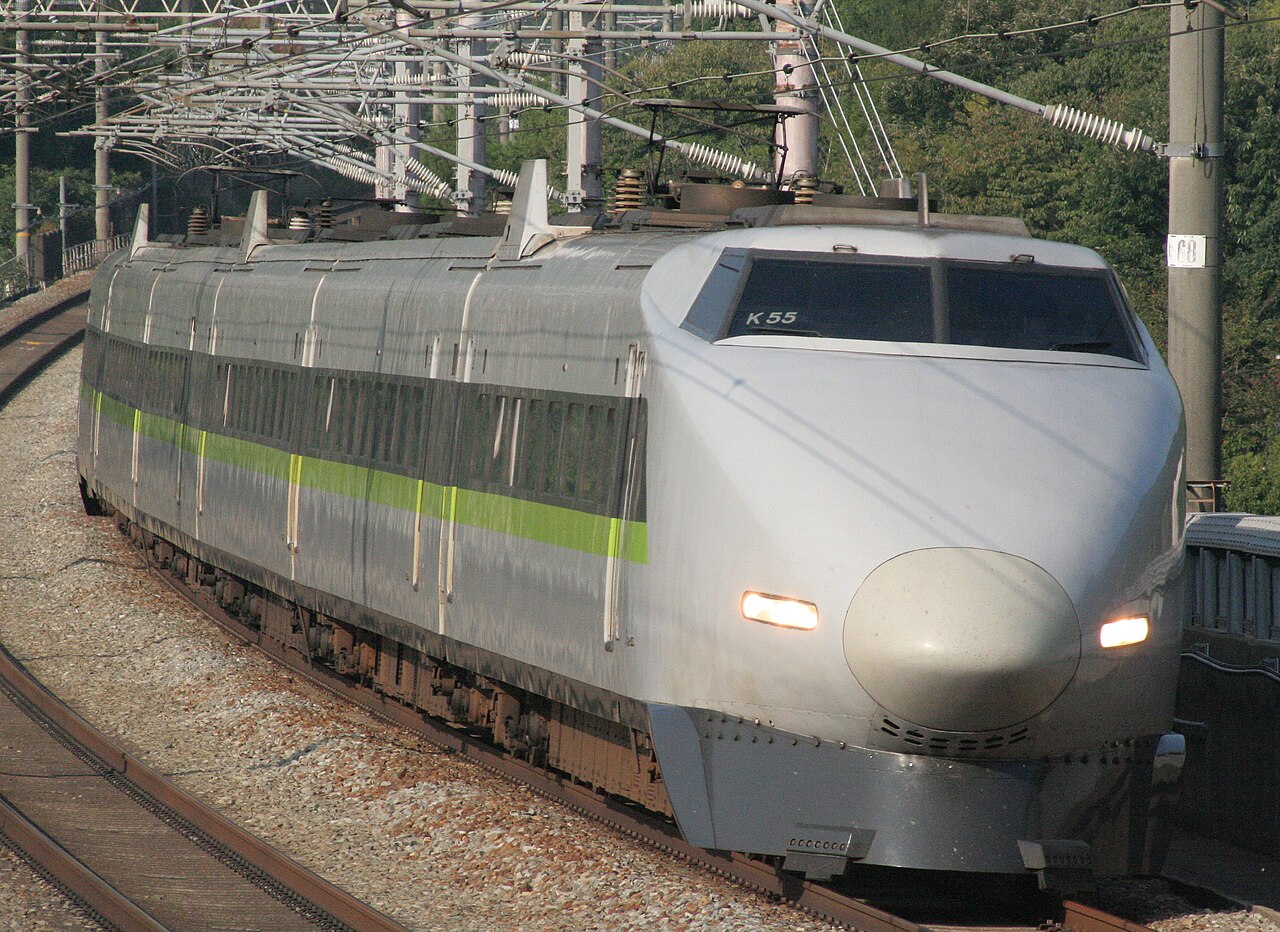
The earliest services used the original 0 series trains inherited from the Tōkaidō, the type JNR had introduced when the Tōkaidō Shinkansen opened in 1964 and which was eventually built in 3,216 cars through 1986. An all-motored design that could be lengthened or shortened in two-car units and carried buffet and dining cars in its 12- and 16-car formations, the 0 series first ran the Shin-Ōsaka–Hakata route in 3 hours 44 minutes at a 210 km/h top speed. The heavy tunnelling west of Okayama had a direct effect on the fleet: because cars had to seal their ventilation far more often to manage the pressure changes of repeated tunnel entries, the Okayama–Hakata extension required a continuous-ventilation system, and 0-series cars built before 1973 that lacked it were barred from running west of Okayama. From the 1 October 1980 timetable, the lifting of a 160 km/h restriction between Mihara and Hakata cut the Shin-Ōsaka–Hakata time to 3 hours 28 minutes.
The pace of improvement quickened in the mid-1980s. The 100 series — the first redesigned Shinkansen type, introduced from 1 October 1985 and ultimately built in 1,056 cars — brought the first double-deck Shinkansen cars, used for green-class and dining accommodation, along with reclining three-abreast seats and private compartments. Its regular top speed was held to 220 km/h, and a timetable revision on 1 November 1986 raised the line's maximum to that figure (the 0 series' ceiling was lifted to 220 km/h at the same time), bringing Shin-Ōsaka–Hakata down to 2 hours 59 minutes.
The line passed out of state hands at the 1987 privatization. On 1 April 1987 JNR was broken up; the entire San'yō Shinkansen was transferred to the newly created JR West, while the physical Shinkansen infrastructure was vested in the Shinkansen Holding Corporation. JR West bought those facilities outright on 1 October 1991. Competition with airlines sharpened after privatization, and JR West responded by upgrading the passenger experience on San'yō services — among them the "West Hikari," introduced on 13 March 1988 alongside the opening of the petition-funded Shin-Onomichi and Higashi-Hiroshima stations. A further step came on 11 March 1989, when the 100N-series "Grand Hikari" entered service; running at 230 km/h, it trimmed Shin-Ōsaka–Hakata to 2 hours 49 minutes.
The 1990s were the line's speed-record decade. On 8 August 1992 the experimental WIN350 test train (a 500-900 series set) reached 350.4 km/h, then a Japanese domestic record. Regular Nozomi service reached the San'yō on 18 March 1993, hauled by the new 300 series — a train JR Central had developed to raise Tōkaidō speeds, with an aluminium-alloy body in place of steel and VVVF-controlled AC induction motors that were smaller and more powerful than the old DC motors, and no dining or double-deck cars. The 300 series ran Tokyo–Hakata once an hour and covered Shin-Ōsaka–Hakata in 2 hours 32 minutes at 270 km/h. The decade's defining train arrived on 22 March 1997, when the 500 series entered Nozomi service between Shin-Ōsaka and Hakata. Developed by JR West expressly to push San'yō speeds higher, it was the first Shinkansen to run at 300 km/h in revenue service; to manage air resistance, noise, and the tunnel-exit pressure boom, it adopted a near-circular body cross-section of reduced area and a 15-metre-long nose with a canopy-style cab, giving it an appearance unlike any other Shinkansen. Just nine 16-car sets — 144 cars in all — were built, and they cut Shin-Ōsaka–Hakata to 2 hours 17 minutes, a timing the line has hovered around ever since. The San'yō route's favourable alignment, built to a 250 km/h design standard with gentler curves than the older Tōkaidō, is what permitted these higher speeds.
The service was not without disruption: on 17 January 1995 the Great Hanshin earthquake closed the line; because it struck before the first trains, passengers were spared direct harm, and service was restored in stages, with full operation resuming on 8 April 1995. Toward the end of the decade, on 27 June 1999, a slab of concrete fell from the roof of the Fukuoka Tunnel between Kokura and Hakata onto a passing train, prompting a wider safety inspection campaign across the line's tunnels and viaducts.
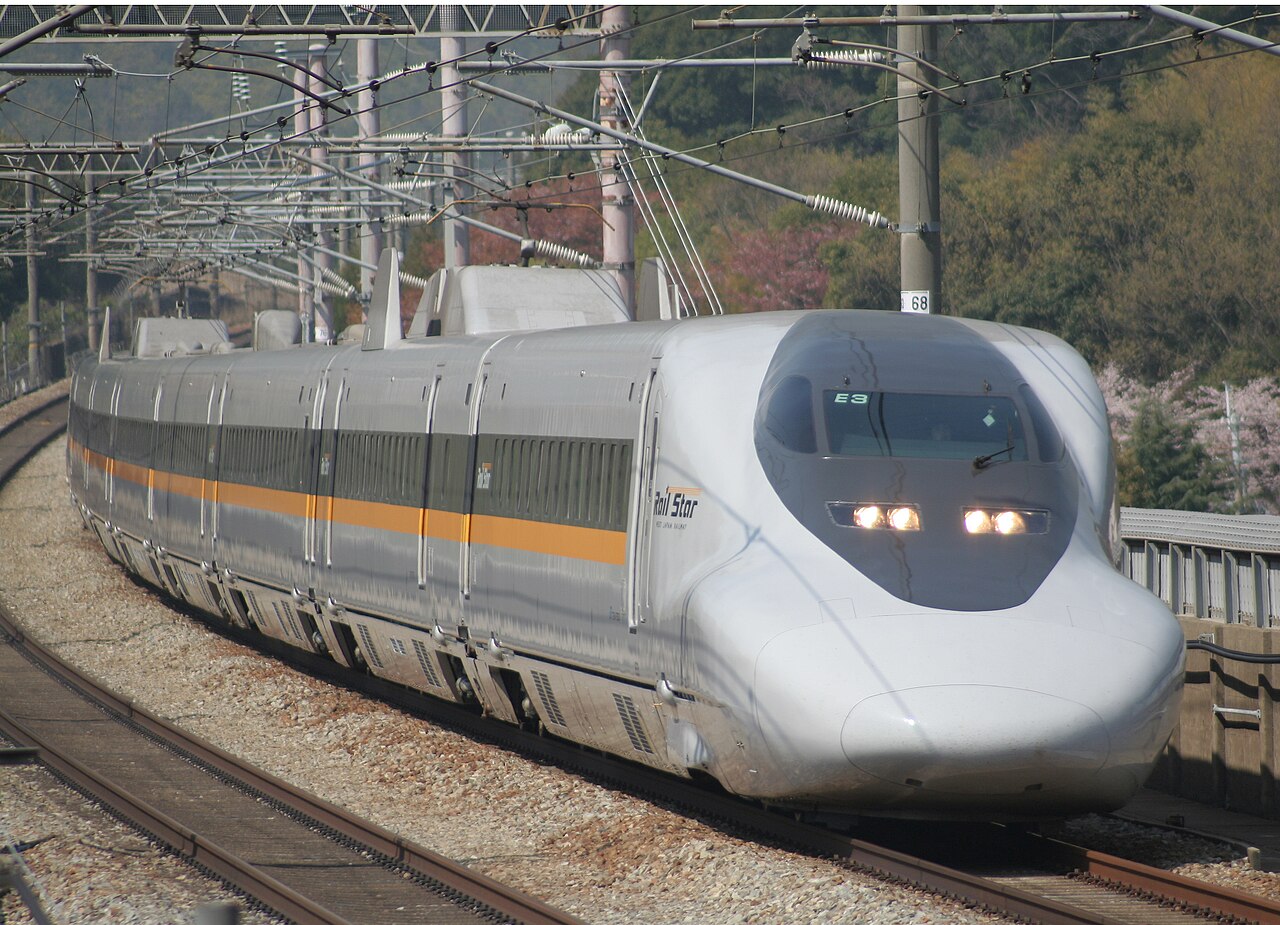
The new century brought a steady cadence of rolling-stock and service change. The 700 series, co-developed by JR Central and JR West, entered Tokyo–Hakata Nozomi service on 13 March 1999, coinciding with the opening of Asa Station. Where the 500 series had been costly and cramped in pursuit of pure speed — and managed only 270 km/h on the less favourable Tōkaidō — the 700 series emphasised value and ride comfort, settling for a slightly lower 285 km/h top speed and adopting a distinctive "duck-bill" nose shape that suppressed the tunnel pressure wave while preserving interior space. 1,200 cars were built as 16-car Nozomi sets, and a further 128 cars as 8-car 700-7000 "Hikari Rail Star" sets, which began running as a premium San'yō-only service on 11 March 2000. Ogori Station was renamed Shin-Yamaguchi on 1 October 2003, the same large-scale revision that shifted the corridor decisively toward a Nozomi-centred timetable and added Nozomi stops at Himeji, Fukuyama, Tokuyama, and Shin-Yamaguchi. The N700 series launched on Nozomi services on 1 July 2007; built on the 700 series but lighter, more powerful, and fitted with the first body-tilting system on these lines to reduce slowing through curves, it restored 300 km/h running on the San'yō (its top speed remained 270 km/h on the Tōkaidō), with a 300 km/h ceiling against the 700 series' 285 km/h. The original 0 series finished regular service on 30 November 2008, after which 8-car 500-series sets — cut down from 16 cars, their green cars converted to ordinary reserved seating and their top speed reduced to 285 km/h — took over scheduled Kodama duties.
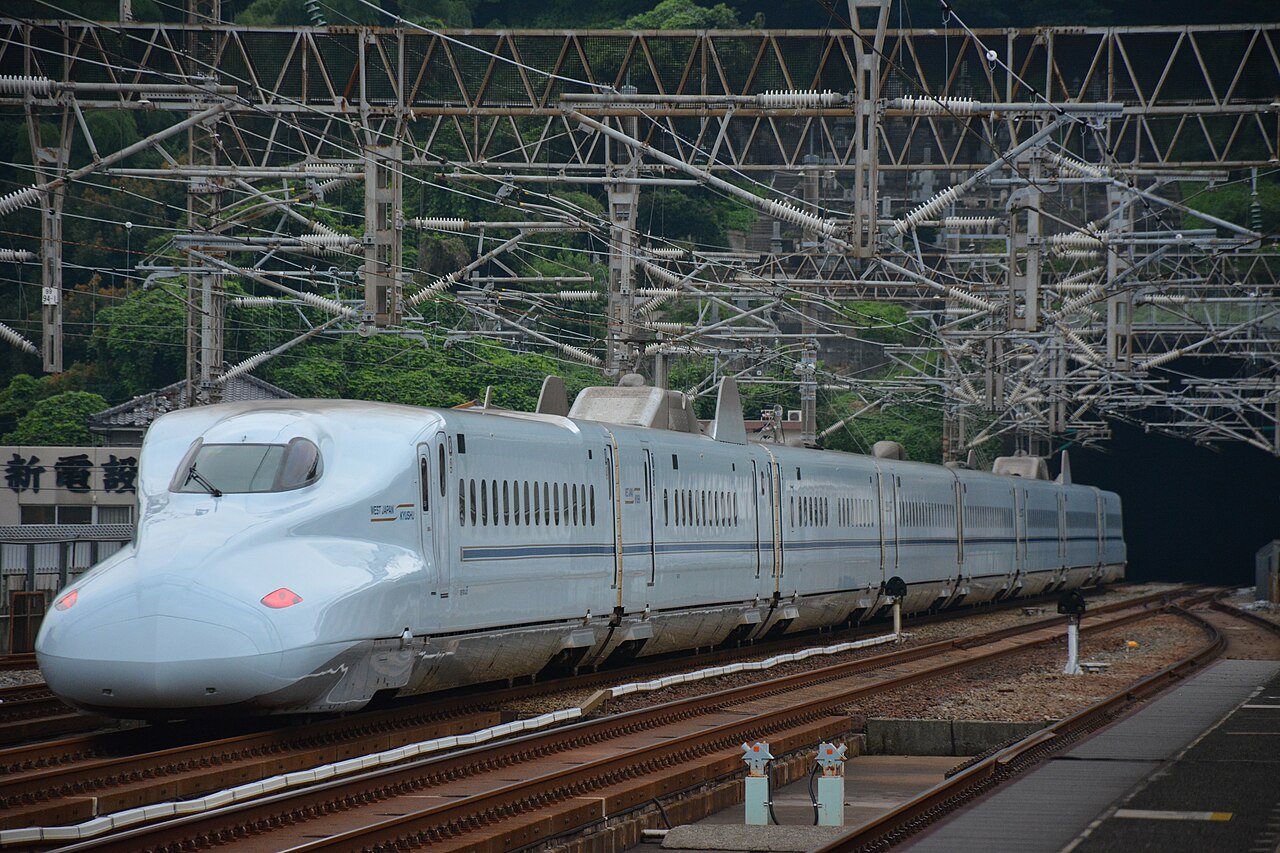
The single largest change to how the San'yō line is used came with the full opening of the Kyūshū Shinkansen. From the revised timetable of 12 March 2011, new Mizuho and Sakura services began through-running between Shin-Ōsaka and Kagoshima-Chūō using 8-car N700-7000 and N700-8000 series trainsets. The effect on the market was dramatic: JR West's share of Osaka–Kagoshima passenger traffic rose from 13 percent in March 2011 to 35 percent in March 2012, and in July 2013 the company began offering discounted advance-purchase fares to compete with new low-cost carriers such as Peach. With Mizuho and Sakura absorbing the role, most of the San'yō-only Hikari Rail Star services — by then largely redundant — were wound down. The 100 and 300 series both finished service by the 17 March 2012 revision, after which every train on the line could manage at least 285 km/h. Further refinement of the N700 fleet followed. JR Central announced the improved "N700A" (the "A" for Advanced) in May 2011, and from 2013 these G- and F-series 16-car sets — with upgraded brakes and body-tilting, a constant-speed control system, and other reliability and ride improvements — entered service on the San'yō; JR West completed an N700A-feature retrofit of its entire 16-set N700-3000 fleet by 8 March 2016. New digital ATC-NS signalling, switched in on 19 February 2017, let the railway shave running times from the 4 March 2017 revision. The current frontier is the N700S (the "S" for Supreme), announced by JR Central on 24 June 2016 and in service from 1 July 2020: it provides a power outlet at all 1,323 seats, shortens stopping distance in an earthquake by about five percent, and — in a Shinkansen first — carries a battery self-propulsion system that lets a stranded train move under its own power to a safer location during a prolonged outage. A reshaped nose and other refinements make the N700S roughly 15 tonnes lighter per set than the N700A and cut energy use by about seven percent. JR West's July 2024 plan to retire the 500 series rests on converting surplus 16-car N700 sets into 8-car formations to replace them.
In its mature form the San'yō Shinkansen is a heavily engineered line. Its physical length is 553.7 km, though its fare-calculation (operating) distance is 644.0 km, and its distance posts are numbered from Tokyo Station. It has 19 stations across one metropolis and five prefectures (JR West's own figures count 18, excluding JR-Central-managed Shin-Ōsaka), an average station spacing of about 30 km, double track throughout, standard 1,435 mm gauge, and 25 kV/60 Hz overhead electrification. By structure type, roughly 12 percent of the route is on roadbed, 9 percent on bridges, 28 percent on viaduct, and 50 percent in tunnel. There are 142 tunnels in all, occupying 50.8 percent of the line and as much as 56.4 percent west of Okayama; the only tunnel-free stretch is between Nishi-Akashi and Himeji. Among the bores are the 16,250 m Rokkō Tunnel near Shin-Kobe and the 18,713 m Shin-Kanmon Tunnel, which carries the line under the Kanmon Strait between Honshū and Kyūshū. As of 2012 the maximum line speed varied by segment — 300 km/h over most of the route, but capped at 285 km/h between Shin-Ōsaka and Shin-Kobe and 275 km/h between Shin-Kobe and Nishi-Akashi.
The role the line plays is correspondingly heavy. Annual ridership grew from about 58 million in FY2005 to 62 million (FY2009), 65 million (FY2013), and 83 million (FY2017). By the line's 50th anniversary in 2025, the San'yō Shinkansen had carried some three billion passengers since opening; a send-off ceremony for a Hakata–Tokyo Nozomi marked the full-line milestone on 10 March 2025. Recent developments have leaned toward standardization and amenity rationalization: on 16 March 2024 the onboard smoking rooms on the Tōkaidō, San'yō, and Kyūshū Shinkansen were all abolished, ending smoking on every Shinkansen in Japan, and in July 2024 JR West announced it would retire the distinctive 500 series and standardize San'yō rolling stock, with four of the remaining 500-series sets to go by 2026 and the last two by 2027.
Timeline
- 19659 September: the Shin-Ōsaka–Okayama section is authorized by the Minister of Transport, administratively as a track-addition to the San'yō Main Line.
- 196716 March: groundbreaking ceremony for the Shin-Ōsaka–Okayama section, held at Akō, Hyōgo Prefecture.
- 197010 February: groundbreaking for the Okayama–Hakata section (ceremonies at Kurashiki, Hiroshima, Shimonoseki, and Kitakyūshū).
- 197215 March: the Shin-Ōsaka–Okayama section opens. Fastest Hikari: Tokyo–Okayama 4h10m, Shin-Ōsaka–Okayama 58m. 0 series in service.
- 197510 March: the Okayama–Hakata section opens, completing the through line. Fastest Shin-Ōsaka–Hakata 3h44m; Tokyo–Hakata 6h56m. Opening was ~3 months later than the original Dec-1974 target due to land-acquisition and noise opposition.
- 19801 October: lifting of the 160 km/h restriction between Mihara and Hakata cuts Shin-Ōsaka–Hakata to 3h28m.
- 19861 November: maximum speed raised to 220 km/h; Shin-Ōsaka–Hakata 2h59m.
- 19871 April: JNR is privatized; the entire San'yō Shinkansen transfers to JR West; the infrastructure is held by the Shinkansen Holding Corporation.
- 198911 March: the 100N-series 'Grand Hikari' enters service at 230 km/h, cutting Shin-Ōsaka–Hakata to 2h49m.
- 19911 October: JR West buys the Shinkansen facilities outright from the Shinkansen Holding Corporation.
- 19928 August: the experimental WIN350 (500-900 series) test train records 350.4 km/h, then a Japanese domestic record.
- 199318 March: Nozomi service begins on the San'yō (300 series), Tokyo–Hakata hourly; Shin-Ōsaka–Hakata 2h32m at 270 km/h.
- 199517 January: the Great Hanshin earthquake closes the line (struck before first trains; no passenger casualties). Full service resumes 8 April 1995.
- 199722 March: the 500 series enters Nozomi service Shin-Ōsaka–Hakata, the first 300 km/h running on the line; Shin-Ōsaka–Hakata 2h17m.
- 199913 March: 700 series enters Tokyo–Hakata Nozomi service, coinciding with the opening of Asa Station. 27 June: concrete falls from the Fukuoka Tunnel onto a passing train, prompting a tunnel-safety inspection campaign.
- 200011 March: 700-7000 'Hikari Rail Star' premium San'yō service begins.
- 20031 October: Ogori Station renamed Shin-Yamaguchi; large revision shifts the corridor to a Nozomi-centred timetable, adding Nozomi stops at Himeji, Fukuyama, Tokuyama and Shin-Yamaguchi.
- 20071 July: N700 series launches on Nozomi services, top speed 300 km/h (vs 285 km/h for the 700 series).
- 200830 November: the original 0 series ends regular service; 8-car 500-series sets take over scheduled Kodama duties.
- 201112 March: Mizuho and Sakura through-services to the Kyūshū Shinkansen begin (Shin-Ōsaka–Kagoshima-Chūō, 8-car N700-7000/8000). JR West's Osaka–Kagoshima market share rises from 13% (Mar 2011) to 35% (Mar 2012).
- 201217 March: the 100 and 300 series finish service; afterward every train on the line can manage at least 285 km/h.
- 202416 March: onboard smoking rooms abolished across the Tōkaidō, San'yō and Kyūshū Shinkansen, ending smoking on all Japanese Shinkansen. July: JR West announces retirement of the 500 series (four sets by 2026, last two by 2027) and standardization of San'yō rolling stock.
- 202510 March: the line marks its 50th anniversary of full opening; a send-off ceremony is held for a Hakata–Tokyo Nozomi. Cumulative ridership has reached about 3 billion.
Sources
Facts last verified 3 June 2026.