History
The postwar recovery turned the Tōkaidō corridor — the Pacific coastal strip linking Tokyo, Nagoya, Kyoto and Osaka — into the industrial spine of Japan. By 1955 the existing Tōkaidō Main Line was carrying roughly double its practical capacity; electrification in 1956 offered only partial relief, and the question of a dedicated new line moved from vision to urgent engineering problem.
Japanese National Railways (JNR) committed to a dedicated high-speed line, and the National Diet approved the plan in December 1958, allocating ¥194.8 billion of the ¥300 billion estimated cost for a five-year construction programme. Two figures were central. Shinji Sogō, the JNR president, lobbied political leaders aggressively, accepting a funding allocation he knew to be insufficient because the project would otherwise not have been approved at all. Hideo Shima, the chief engineer, made the defining technical choices. The most consequential was track gauge: against Japan's narrow 1,067 mm network standard, Shima's team built to the international standard gauge of 1,435 mm, isolating the Shinkansen from the rest of the network but enabling wider, more stable cars and far higher speeds. To bridge a financing gap, Sogō and Shima secured a World Bank loan in 1959 — they had requested US$200 million and obtained $80 million, about 15 percent of the project cost, on condition it not fund experimental technology; that loan was fully repaid by 1981. Construction began formally on 20 April 1959. Severe cost overruns during the compressed five-year build ultimately forced both Sogō and Shima to resign before the line opened.
On 1 October 1964 — nine days before the opening of the Tokyo Summer Olympics — the Tōkaidō Shinkansen entered passenger service. The timing was deliberate: Japan wanted the world's visitors to witness a country that had leapt to the forefront of transportation technology. Hikari 1 departed Tokyo and Hikari 2 set off in the opposite direction simultaneously, inaugurating two tiers of service: the limited-stop Hikari (Tokyo–Osaka in four hours) and the all-stops Kodama (five hours). Those times masked the line's true capability: track settlement and unresolved concerns from the rushed schedule led JNR to cap regular operation at 160 km/h, below the 210 km/h the infrastructure was built for. Ridership stood at about 61,000 passengers per day in 1964 and grew with extraordinary speed. In November 1965, once track conditions were verified, timetables were revised: Hikari to three hours ten minutes, Kodama to four hours, with sustained 210 km/h operation. As the first purpose-built high-speed railway operating at commercial speeds no other passenger railway matched, the line was recognised in 2000 as a joint Historic Mechanical Engineering Landmark and IEEE Milestone.
Cumulative ridership reached one billion passengers by 1976. On 1 April 1987 JNR was dissolved and the Tōkaidō Shinkansen passed to the Central Japan Railway Company (JR Central), which inherited a share of JNR's long-term debt; the line's revenues were nonetheless sufficient to service those obligations while funding continued investment. The next threshold came in March 1992, when JR Central introduced the 300 series and, with it, the Nozomi — a new fastest service. With a lighter aluminium-alloy body and VVVF inverter traction, the 300 series ran at 270 km/h and cut the Tokyo–Osaka time to two hours thirty minutes, forty minutes faster than the quickest Hikari, stopping only at Shinagawa, Shin-Yokohama, Nagoya, Kyoto and Shin-Osaka.
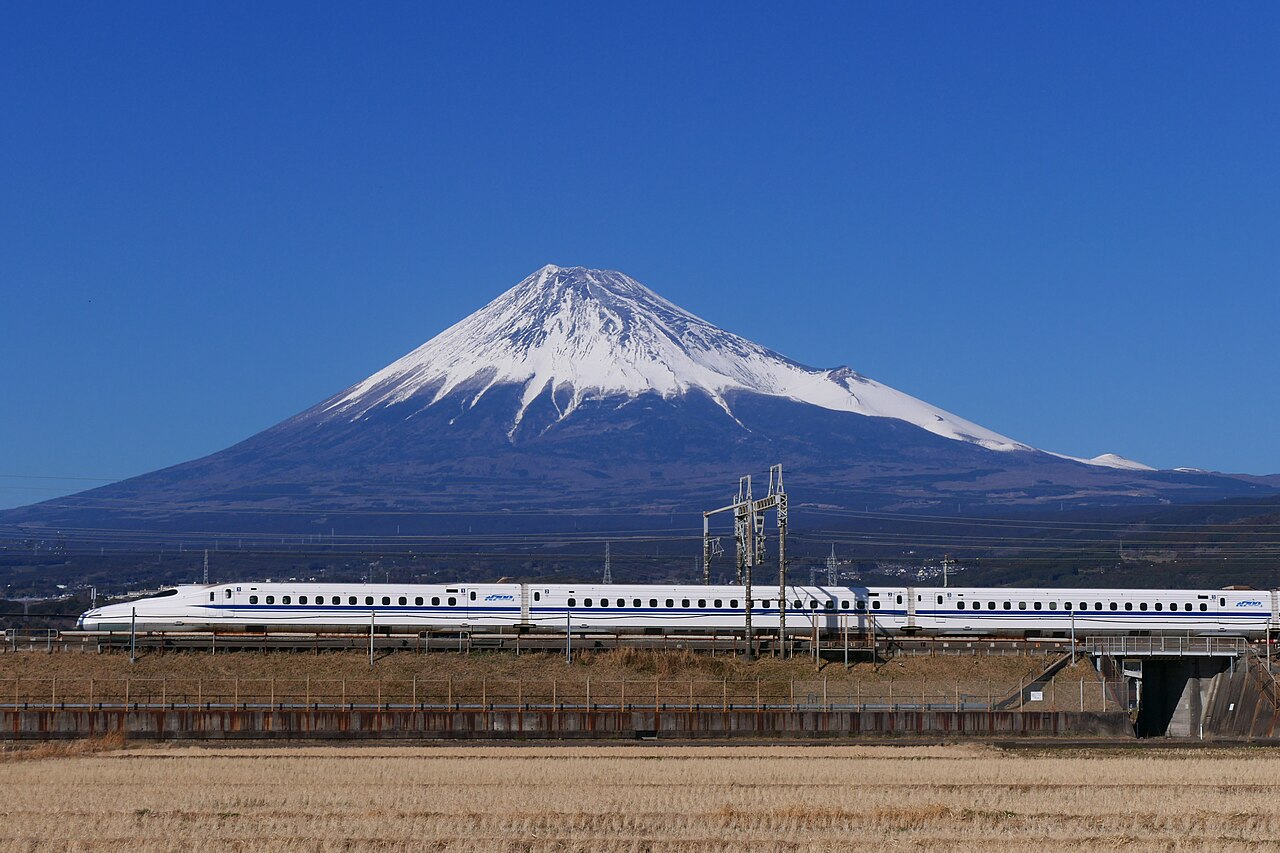
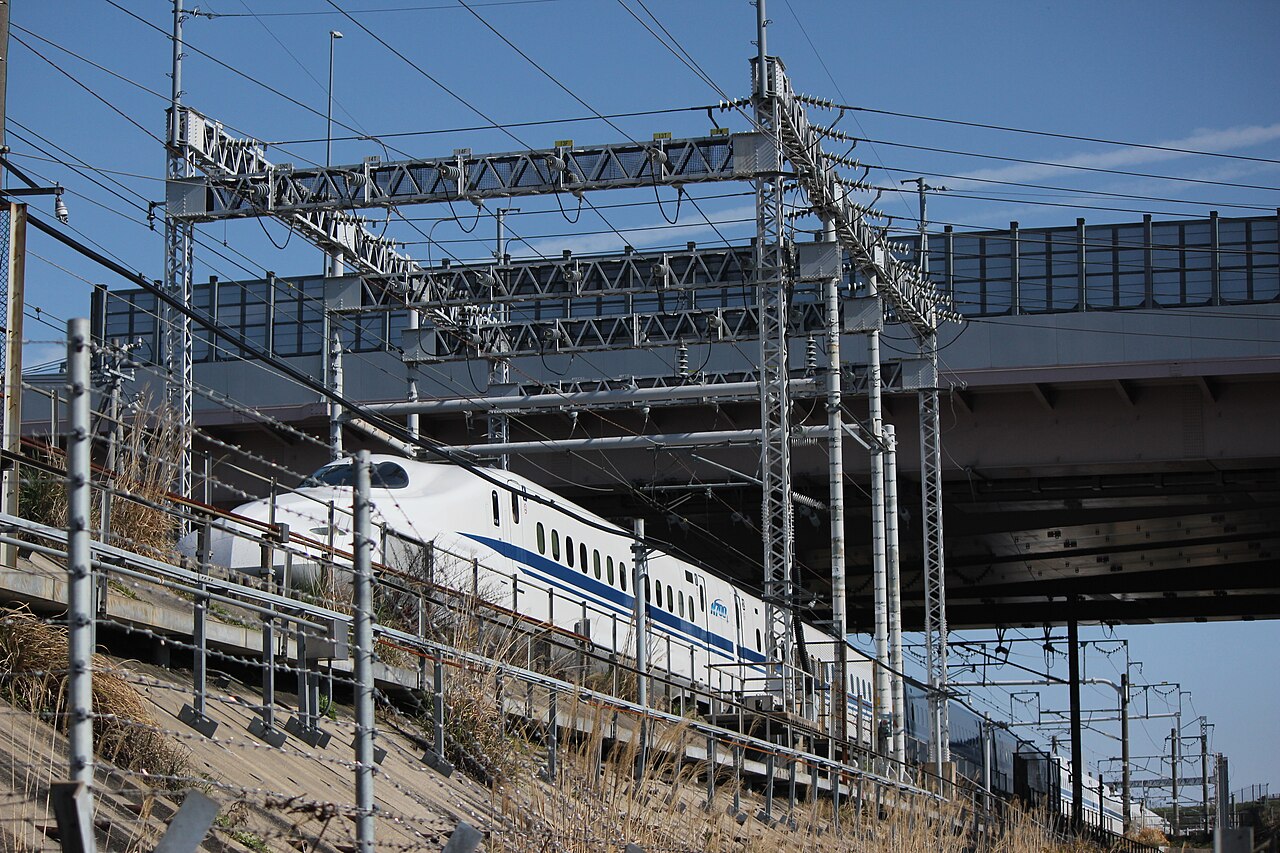
The rolling stock evolved across six decades. The 0 series that opened the line ran for 35 years, the last withdrawn from Tōkaidō service on 18 September 1999. The 100 series (from 1 October 1985) brought the first Shinkansen double-deck cars and served until September 2003. The 300 series inaugurated the Nozomi and ran until March 2012. The 500 series — operated by JR West — arrived in November 1997 and reached 300 km/h on the connecting San'yō Shinkansen (though limited to 270 km/h on the Tōkaidō); its long aerodynamic nose made it visually unlike any other Shinkansen. It was withdrawn from Tōkaidō service by February 2010, though it continues in service on the San'yō Shinkansen. The 700 series (from July 1999) introduced a "duck-bill" nose to tame the tunnel-exit pressure wave and full smoke-free service, running until its ceremonial final Tōkaidō run on 1 March 2020. The N700 series (from 1 July 2007) added active body-tilting, allowing higher speeds through curves; from 2013 sets were progressively upgraded to N700A specification, with dedicated N700A new-builds from 8 February 2013. A timetable revision on 14 March 2015 raised the maximum operating speed to 285 km/h, the current ceiling. The N700S (from 1 July 2020) is the present frontier — a power outlet at every seat, roughly 15 tonnes lighter than the N700A, around seven percent lower energy use, and an onboard battery system that lets the train move under its own power to the nearest station during a power failure.
The Tōkaidō Shinkansen operates at a density remarkable by any global standard: at peak the line handles up to 17 trains per hour in one direction — 13 Nozomi, 2 Hikari and 2 Kodama. In Japanese fiscal year 2019 an average of 378 trains ran daily, with an average delay per train of 12 seconds. The current fastest Nozomi completes the Tokyo–Shin-Osaka journey in two hours twenty-one minutes (March 2023 timetable). A single day on 10 August 2023 saw 471 trains operated, the highest on record.
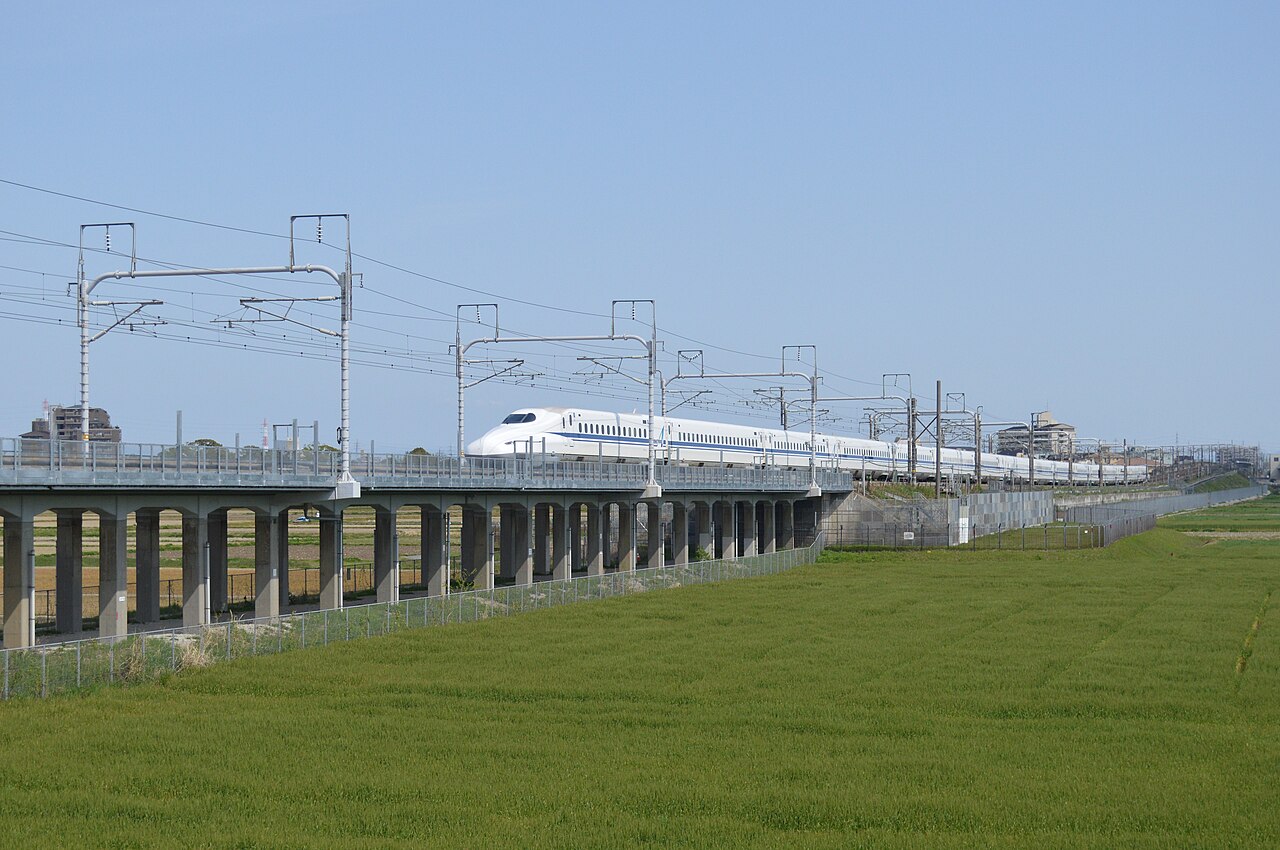
The line reshaped Japanese economic geography: cities once hours apart by conventional rail became practical for same-day return travel within a decade of opening. The Tōkaidō Shinkansen generates approximately 92 percent of JR Central's transport revenue; in fiscal year 2023 line revenue was approximately ¥1.2479 trillion. The opening of Shinagawa Station in October 2003 — the newest station on the line — allowed further timetable optimisation. With the Chūō Shinkansen (maglev) advancing in parallel under JR Central, the Tōkaidō Shinkansen is preparing for a future in which it may absorb higher-volume shorter-haul traffic once ultra-high-speed maglev takes the longest-distance demand — itself a testament to the extraordinary productivity the 515.4 km route has sustained for more than sixty years.
Timeline
- 1958December: the National Diet approves the Tōkaidō Shinkansen project, allocating ¥194.8 billion of the ¥300 billion estimated cost.
- 195920 April: construction begins. A World Bank loan of US$80 million (of $200M requested) is secured.
- 19641 October: the line opens, nine days before the Tokyo Olympics. Hikari 1 (Tokyo) and Hikari 2 (Shin-Osaka) depart simultaneously. Speed capped at 160 km/h; Hikari 4h / Kodama 5h. 0 series in service.
- 1965November: timetables revised to 210 km/h; Hikari Tokyo–Osaka 3h10m, Kodama 4h.
- 1976Cumulative ridership reaches 1 billion passengers.
- 1981The World Bank loan is fully repaid.
- 19851 October: 100 series introduced, with the first Shinkansen double-deck cars.
- 19871 April: JNR privatised; the Tōkaidō Shinkansen transfers to JR Central.
- 1992March: 300 series introduced; the Nozomi super-express launches at 270 km/h, cutting Tokyo–Osaka to 2h30m.
- 1997November: 500 series (JR West) introduced; 300 km/h on the San'yō, limited to 270 km/h on the Tōkaidō.
- 19990 series withdrawn from Tōkaidō service on 18 September after 35 years. 700 series introduced in July.
- 2000Designated a joint Historic Mechanical Engineering Landmark and IEEE Milestone.
- 2003100 series withdrawn (September). Shinagawa Station opens (October), enabling Nozomi timetable expansion.
- 20071 July: N700 series introduced, with the first active body-tilting on the Tōkaidō.
- 2010500 series withdrawn from Tōkaidō service (February); continues on the San'yō Shinkansen.
- 2012300 series fully retired (16 March).
- 20138 February: dedicated N700A new-build sets enter service.
- 201514 March: maximum operating speed raised to 285 km/h, the current ceiling.
- 2020700 series runs its final scheduled Tōkaidō service (1 March). N700S introduced (1 July).
- 2023FY2023 ridership ~158 million / ~432,000 daily; annual revenue ~¥1.2479 trillion; single-day record of 471 trains on 10 August.
Sources
Facts last verified 3 June 2026.
Gallery 2 photos
Every photo for this page — tap any image to view it full-size. All from Wikimedia Commons (credit under each).